More Controversy at Indian Wells

By Dr. Nancy E. Spencer

Venus and Serena Williams’ return to Indian Wells was supposed to close the book on a controversy that occurred in 2001. They faced a racist incident that was a painful memory for them and a blemish on the tournament. In 2016, Serena hoped to write a new chapter by advancing to the Women’s Singles final where she faced Victoria Azarenka. Their matches had always been close and promised to provide a storybook ending to this new chapter. While the final score did not end in Serena’s favor (Vika won 6-4, 6-4), a new controversy emerged as a result of sexist comments made by Ray Moore, the tournament’s director and CEO. Before the Men’s Singles final, Moore was asked how the men’s (ATP) and women’s tours (WTA) compared. He replied by calling  “the WTA a bunch of lucky coattail-ridin’ dummies who have the men to thank for their continued existence” (Redford, 2016, para. 1). But he didn’t stop there, adding, “If I was a lady player, I’d go down every night on my knees and thank God that Roger Federer and Rafa Nadal were born, because they have carried this sport. They really have” (Redford, para. 2).

In the press conference following her match, Serena was asked to comment on Moore’s statements. She began by saying, “I think Venus, myself, a number of players have been — if I could tell you every day how many people say they don’t watch tennis unless they’re watching myself or my sister, I couldn’t even bring up that number. So I don’t think that is a very accurate statement” (Dator, 2016, para. 4).

Asked further if she was surprised that sexist statements are still brought up, Serena replied: “Yeah, I’m still surprised, especially with me and Venus and all the other women on the tour that’s done well. Last year the women’s final at the US Open sold out well before the men. I’m sorry, did Roger play in that final or Rafa or any man play in that final that was sold out before the men’s final? I think not ” (Dator, 2016, para. 5).

Serena also referred to the history of progress that began with Billie Jean King whose “Battle of the Sexes” victory over Bobby Riggs has been credited with advancing the cause of all women in sport. In fact, Billie Jean also played an integral role in securing equal prize money for women at the U.S. Open in 1973 (D’Cunha, 2016). As Serena pointed out, “in order to make a comment you have to have history and you have to have facts and you have to know things. You have to know of everything. I mean, you look at someone like Billie Jean King who opened so many doors for not only women’s players but women athletes in general” (Dator, 2016, para. 6).

King herself played during the same era as Ray Moore when professional tennis was in its infancy. During that era, the ratio between men’s and women’s earnings was often as disparate as 11:1 (BJ King, personal communication, February 24, 1999). Billie Jean responded to Moore’s comments on Twitter saying she was: “Disappointed in comments. He is wrong on so many levels. Every player, especially the top players, contribute to our success.”

Chris Kermode, CEO of the Association of Tennis Professionals (ATP), the governing body of men’s professional tennis agreed with King in describing “Ray Moore’s comments towards women’s tennis” as “disappointing” (Rycroft, 2016, para. 5). Adding that the comments were “made in poor taste,” Kermode stated that, “The ATP fully supports equality across society, while at the same time acknowledging that we operate in the sports [and] entertainment business” (Rycroft, 2016, para. 5).

Unfortunately, Kermode’s comments are unlikely to carry as much weight as earlier statements made by the Men’s Singles winner and world No. 1 Novak Djokovic, who said after winning his match yesterday: “I think that our men’s tennis world, ATP world, should fight for more, because the stats are showing that we have much more spectators on the men’s tennis matches. I think that’s one of the reasons why maybe we should get awarded more” (D’Cunha, 2016, para. 15). There is an underlying problem with comments by both Moore and Djokovic, as D’Cunha (2016) pointed out, in that they “are indicative of the general disregard for women’s tennis by their male counterparts” (para. 18).

If there is any consolation it is the outpouring of support for women’s tennis that was expressed on Twitter and in other articles. Hopefully, women’s tennis (and all women’s sports) will continue the legacy begun by Billie Jean King, Gladys Heldman, the “Original Nine” and current WTA players. They’re not riding anybody’s coat tails!!

Note: According to reports on Twitter as of March 21, Raymond Moore has resigned as Tournament Director and CEO at Indian Wells. Perhaps, on this 10th anniversary of Twitter, it is fitting that the social media site played a key role in disseminating news of this controversy so quickly.

References

Dator, J. (2016, March 20). Serena Williams sends powerful message to Indian Wells CEO over sexist comments. SB Nation. Retrieved from http://www.sbnation.com/2016/3/20/11273222/serena-williams-press-conference-sexist-comments-indian-wells-ceo

D’Cunha, Z. (2016, March 21). Raymond Moore, Novak Djokovic, and the blatant disregard for women’s tennis by the men in sport. Firstpost.com. Retrieved from http://www.firstpost.com/sports/raymond-moore-novak-djokovics-comments-not-only-sexist-but-also-show-disregard-for-womens-tennis-2688386.html?utm_source=dlvr.it&utm_medium=twitter

Redford, P. (2016, March 20). Indian Wells CEO Raymond Moore has some bad and dumb thoughts on Women’s Tennis. Deadspin. Retrieved from http://deadspin.com/indian-wells-ceo-raymond-moore-has-some-bad-and-dumb-th-1766048378

Rycroft, R. (2016, March 21). ATP’s Chris Kermode responds to Raymond Moore’s controversial comments on WTA. Sportsgecko.com. Retrieved from http://sportsgecko.com/atps-chris-kermode-responds-to-raymond-moores-controversial-comments-on-wta/
 

Hopefully Luck is on Your Side This March

by Brendan Ripley-Barasch

It’s that time of year again. Millions of people nationwide are trying to piece together what they hope is the perfect bracket. No one has ever been able to predict every single game correctly, not the president, not any celebrity, and not even a professional college basketball analyst, it’s called March Madness for a reason.

Image via southfloridareporter.com

It is near impossible to guess what upsets there will be and when they will occur, in the past there have been many “Cinderella Stories” and “Bracket Busters” in the tournament. Arguably the most notable Cinderella story came in 1983 when the North Carolina State Wolfpack led by coaching legend Jimmy Valvano entered the tournament as a 6 seed. They tore through the tournament, upsetting multiple teams, staging historic comebacks, and eventually advancing to the national championship where they were pitted against college basketball juggernaut Houston, led by such elite players as Hakeem Olajuwon and Clyde Drexler. The end of that game is one of the most famous endings in sport history. Viewer’s saw NC State’s Dereck Whittenburg throw up a prayer that air balled only to be caught by Lorenzo Charles and slammed home just before the buzzer sounded which gave NC State the win and the title. There is no telling who that Cinderella team will be this year, we will just have to wait and see.

This year’s tournament is especially interesting for one reason in particular. Throughout most of the regular season there was no clear number one team, it felt like every week the #1 team was being upset and multiple top ten teams continued to get knocked off as well. The parity of college basketball this year is unreal, it is hard to think of another season where it seemed that every team was so evenly matched against one another. In an article on ESPN.com titled The Floor Is Yours: Is this parity or bad basketball? Author Myron Medcalf gives an interesting statistic, “Through Jan. 22, The Associated Press poll’s top five teams had suffered 19 losses, a record for that stretch.” This fact is mind-boggling, just a short year ago it was clear to everyone who the best two teams were, with Kentucky finishing the regular season 31-0 and Duke going 35-4 and eventually winning the National Championship. Later in the same article, Texas Head Coach Shaka Smart is quoted saying, “There’s less of a difference between the top 25 and next 25 in a given week.” A question everyone has probably asked themselves at some point this year is if this is good or bad for college basketball?

The fact that every team seems so evenly matched just makes it that much harder to try to make that perfect bracket. One way to try to gain the upper-hand when putting together your bracket would be to seek advice online. There are thousands of websites out there that offer a multitude of different strategies, so you have to choose wisely. One of these articles giving advice is by Jon Solomon of cbssports.com and is titled 2016 March Madness bracket: 8 fast facts to help you win your tournament. Solomon provides his  opinion which is put together with facts, statistics, and recent occurrences. Solomon’s number one fact is “National champs play offense and defense.” He backs this claim by saying, “Twelve of the past 13 National Champions finished in the top 20 of Ken Pomeroy’s offensive and defensive efficiency ratings.” Who knows if he is right or even if he will be of any help to you while you make your bracket, but you won’t know unless you try it.

It is highly unlikely anyone fills out a perfect bracket this year and even making a respectable one will be difficult. This year in college basketball has been a roller coaster and that in itself poses a problem. All we can do is hope luck is on our side this March, and even if your bracket doesn’t do that hot, you still get to sit back and watch some great basketball.


A Sad Chapter Ends… or Does It?

By Dr. Nancy E. Spencer

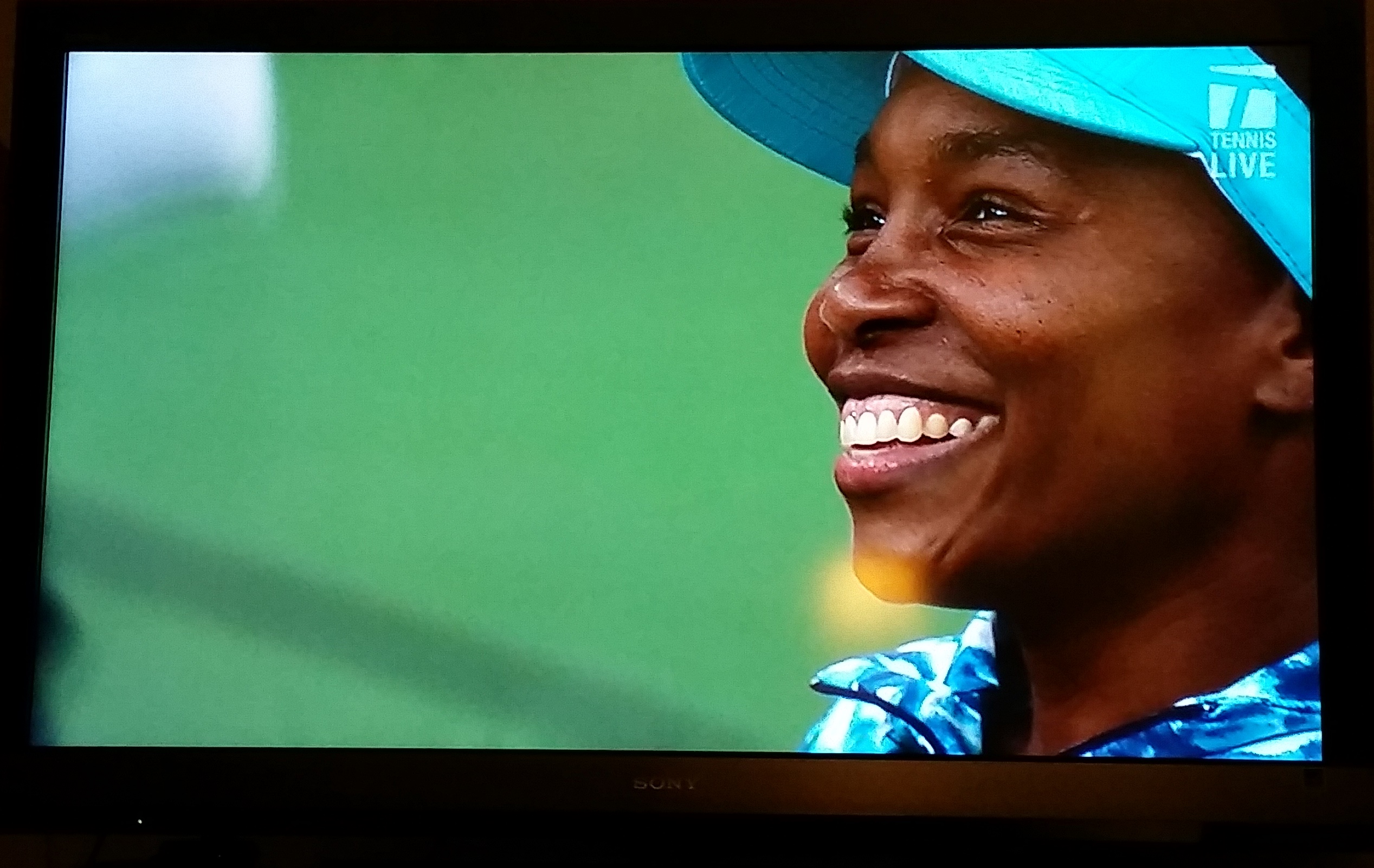
On Friday, March 11, 2016, Venus Williams made her return to Indian Wells, facing Japan’s Kurumi Mara in a first-round singles match. It had been 15 years since Venus last played in the tournament, and she received a warm welcome as reflected by her broad smile in the photo below.?

In March 2001, when Venus last appeared at Indian Wells, she was scheduled to meet her sister Serena in the semifinals. As it was reported by most media sources, Venus defaulted just moments before she was to have played Serena. Tennis writer Joel Drucker (2009), wrote that “four minutes before her match against Serena, Venus pull(ed) out with tendinitis. Players usually notify officials that they will be unable to compete at least 30 minutes before a match so organizers can make contingency plans” (para. 13).

Serena related a different version of this story in her autobiography, where she wrote that during Venus’ quarter-final match against Elena Dementieva, she was dehydrated and started to cramp; she also hurt her knee and questioned whether she would be able to play in the semifinals against Serena (Williams & Paisner, 2009). On the morning of their scheduled semifinal, “Venus checked in with the tour trainer and told him she didn’t think she could play” (Williams & Paisner, 2009, p. 64). According to the rules, the trainer needed to give his approval before Venus could officially withdraw. The trainer was then supposed to consult with the tournament director who would typically schedule another match in its place. [This part is confirmed by Drucker’s statement above].

Checking in with tour officials was an especially important step since Venus and Serena were scheduled to play on live TV (on ESPN) before a crowd that eagerly anticipated the “rare tennis treat” (2001, p. 3C) of seeing the sisters play each other for only the sixth time in their professional careers. There was clearly a lot riding on whether or not Venus and Serena played that match. Yet, according to Serena, the trainer “kept telling Venus to hold off on making any kind of final decision” (Williams & Paisner, 2009, p. 65).

Two hours before the match was slated to begin, Venus again told officials that she would not be able to play, but still no announcement was made that she was withdrawing. It was not until five minutes before the match was to start that a tournament official finally “announced to the packed stadium that Venus was withdrawing due to injury” (Williams & Paisner, 2009, p. 67). Needless to say, the timing of the announcement could not have been worse and fans unleashed their anger toward Venus since she was made to appear as the culprit who withdrew at the last minute.

Two days after Venus’ default in the semifinals, Serena played in the final against the Belgian Kim Clijsters. When Venus and her father entered the Stadium to watch the final, fans responded by booing vociferously. Richard Williams proclaimed that a dozen fans in the stands used racial slurs and one fan yelled that he would “skin him alive” (Smith, 2001, p. 3C). According to some sources, fans were upset not only because of the late default, but also because they had the impression that Richard, was responsible for orchestrating the outcomes of their matches. Dementieva, whom Venus defeated in the quarterfinals, had even suggested in her press conference that she thought their father Richard would decide who would win their semifinal match (Drucker, 2009). A headline in the National Enquirer also suggested that Richard ordered Serena to lose to Venus in the 2000 Wimbledon semifinals. This further fueled the impression of match-fixing.

Aside from such accusations about match-fixing, there has never been any concrete evidence to confirm that this is anything more than speculation. In fact, Bart McGuire who was then CEO of the WTA Tour, issued a statement on March 16, 2001, saying that “The tour is aware of the assertions being circulated regarding Venus and Serena Williams’ head-to-head matches. We have seen no evidence to support those assertions, and both players have denied them” (Drucker, 2009, para. 29).

On March 23, 2001, Venus addressed the role of the press in fueling the story about what happened at Indian Wells. When asked about the crowd’s response at Indian Wells, Venus said that she didn’t always understand the press, but she understood that they wanted a big story and they were “interested in selling papers” (Drucker, 2009, para. 49).Indian Wells’ Tournament Director Charlie Pasarell addressed the question posed to Venus about whether it was unfair of the crowd to respond as they did. Pasarell reported that he cringed “when all that stuff was going on,” adding that “it was unfair for the crowd to do that” (Drucker, 2009, para. 51).

At the beginning of Drucker’s (2009) article, the editor noted that “the controversy surrounding Venus and Serena Williams’ decision not to play at Indian Wells has been composed of rumors, conjecture and  confusing comments about racism and match fixing” (para. 1). While it may be difficult to make sense of all that has been reported and recorded by the press about Indian Wells over the last 15 years, what happened there in 2001 was enough to make the Williams’ sisters decide not to play in the tournament for the past 14-15 years. I vividly remember watching that match and was embarrassed by the vitriol spewed toward Venus, Serena and their father Richard. I have always understood their decision not to play at Indian Wells. While I applaud their willingness to forgive and move on, I question if that chapter is truly over if we have not fully addressed the underlying impulse for the crowd’s (mis)behavior at Indian Wells in 2001.

References

Drucker, J. (2009, March 11). What happened at Indian Wells? ESPN.com. Retrieved from http://espn.go.com/sports/tennis/columns/story?id=3952939&columnist=drucker_joel

Rare tennis treat: Williams vs. Williams. (2001, March 15). USA Today, p. 1C.

Smith, D. (2001, March 26). Williams decries fans as racist. USA Today, p. 3C.

Williams, S., & Paisner, D. (2009). On the line. New York, NY: Grand Central Publishing.

The Dunk Contest is Alive and Well

by Brendan Ripley-Barasch

The participants in the 2016 NBA Dunk Contest included, Denver Nuggets SG Will Barton, Pistons Center Andre Drummond, Orlando Magic PF Aaron Gordon, and defending champion Zach LaVine. The contest kicked off with Barton and Drummond scoring sub-par scores which left fans wondering if this would be another lackluster event. But then the event changed course when Gordon threw down a between-the-legs reverse dunk, this got the crowd going. LaVine answered with a behind-the-back reverse slam, scoring a whopping 50 from the scorer’s table. After this, it was obvious that the contest would be decided between these two heavyweights. Back and forth they went, one spectacular slam-dunk after another. LaVine’s success came from his multiple slams after leaping from the free-throw line and Gordon’s highlight of the night was when he executed a between-the-legs over the mascot dunk which many are claiming one of the greatest dunks ever performed in the history of the Dunk Contest. The two high-flyers ended the night in a dunk-off which eventually saw Zach LaVine walk away with the hardware for the second straight year. This contest provided the entertainment and fun that fans and media had been hungry to see, from the variety of crazy slams to the reactions of LaVine’s teammates and competitors.

The media held this dunk contest in high regards along with the fans. Stephen A. on first take went so far as to say, “To me the Slam-Dunk Contest was resurrected Saturday night.” He also went on to give his opinion on how he thought Aaron Gordon should have won and how Shaq dishing out low scores played a pivotal part in raising the bar to contestants so they would give a great performance. There were also multiple media personnel that compared the showdown of LaVine and Gordon to Dunk-Contest greats Michael Jordan and Dominique Wilkins. This is the quite comparison and just demonstrates how these players have brought the event back to the forefront of All-Star weekend entertainment.

In my opinion, this contest certainly was entertaining and may have changed many people’s outlook on the competition. I thought even the 2015 dunk contest took a huge step forward in drawing in viewers and causing a buzz around the league as well as the twitter-sphere. We can only hope as fans and as media that the Dunk Contests to follow will be as entertaining as this one.

Effects that tanking has on media and fans

by Brendan Ripley-Barasch

Recently, the issue of “tanking” was brought up at the latest Major League Baseball owner’s meetings. Tanking is described as teams intentionally being bad in hopes of landing a high draft pick and trading away veteran talent to acquire young prospects to build a better future. These teams that are reportedly tanking much prefer the term, “rebuilding.” Although no steps have been taken to prevent tanking in the future, it is good to know that it has crossed these owner’s minds that it is a problem that needs to be fixed.

The blueprint that teams currently tanking are trying to follow is that of the Chicago Cubs and Houston Astros. The Cubs had not made the playoffs since 2008 and until this past year they were known as one of the worst teams in the National League. As recently as 2012, the Cubs lost 101 games, and suddenly in 2015 they go 97-65; how is this possible? From those years of being terrible they managed to draft the 2015 Rookie of the year, Kris Bryant, with the second overall pick in the 2013 draft and Kyle Schwarber with the fourth overall pick in 2014. The rebuild was also helped by a couple key trades including the one that landed them Anthony Rizzo, but in just a couple years the Cubs had revamped their entire roster and are now recognized as a contender and have turned into a free agent hot spot. After signing such stars as Jason Heyward and Ben Zobrist, the Chicago Cubs are scary good.

The Astros may not be on the level of the Cubs yet but they have certainly had success with their tanking as well by making the playoffs in 2015. They certainly have a bright future though, by having the 2015 AL Rookie of the Year Carlos Correa, 2011 first round pick George Springer, and emerging superstar Dallas Kuechel. Prior to this season the Astros were seen as the very worst team in baseball and were seemingly content with staying that way with the lowest payroll in baseball in 2013 at a whopping $26 million. By contrast, Alex Rodriguez was making more than the entire Houston Astros team. They have been able to stockpile young talent and trade some of those pieces to acquire proven stars as well. They will be a playoff contender as well in 2016.

A team currently in the midst of tanking are the Cincinnati Reds. This offseason, fans saw their All-star third baseman, Todd Frazier, get traded to the White Sox for a handful of prospects and Aroldis Chapman be shipped off to the Yankees for a bunch of unproven young players. It seemed like after the All-star break, the Cincinnati front office decided to call it quits and tried to give the young players a chance to gain some experience before they geared up for a long rebuild process and this did not make fans or media happy. After sporting a starting rotation of almost all rookies for most of the season, the Reds finished the season 64-98 and earned the second overall pick in the 2016 MLB draft.

It is a dark time for Cincinnati fans and media. With the only proven players on their roster being Joey Votto and Homer Bailey, fans know they don’t have much to look forward to in 2016 or even 2017. The same goes for the media, it is difficult to cover a team that is intentionally running themselves into the ground. Maybe in the next couple years they will be able to draft well enough to put a contender on the field for 2018 though. In this day and age, tanking is a viable strategy because at least you will get a good draft pick that will contribute to the rebuild, instead of being somewhere in the middle and not getting good enough draft picks to get the team over the hump and into the playoffs. Media members in Cincinnati are not as ferocious as they are in let’s say New York, but certainly they will give their thoughts on the tanking strategy and it’s almost inevitable that some of them will voice their frustration and call for the GM’s head. The media has to be patient as well, the Reds will point at the Cubs and say they will be on that level in the next couple years; it is just a matter of time. It will be interesting to see what the Reds do with Joey Votto and his massive contract; will they look to him as an important part of their rebuild and hope he can help younger players develop or will they send him packing as well and hope to grab some good young players?

The one example of tanking that teams in other sports do not want to follow is the Philadelphia 76ers. The 76ers have not made the playoffs since the 2011-2012 and since then have drafted and traded Rookie of the year Michael Carter-Williams and in back to back years their number one draft pick missed the entire season. Finally it seems like they have drafted a top tier talent in Jahlil Okafor but they still have an absolutely embarrassing record of 8-43. Philadelphia media have been patient these past couple years but lately there have been grumblings that media and fans are done waiting and expect General Manager Sam Hinkie to start adding to the roster and surround young prospects Nerlens Noel and Okafor with some nice complementary players and end the embarrassment.

Hopefully in the next couple years the Cincinnati Reds and Philadelphia 76ers will be done with tanking and put out a product on the floor that will make the fans and media happy.

Media Dialogues about ‘Race’ in Super Bowl 50

Dr. Nancy E. Spencer
February 7, 2016
The time between January 24 and February 7, 2016 may seem like “the longest two weeks of the NFL season”  (Rosenthal, 2016, para. 1). However, during those two weeks, the media manages to construct story lines that generate plenty of hype. The lead-up to Super Bowl 50 was no exception. On Thursday, January 28, Cam Newton, Quarterback of the Carolina Panthers kick-started one conversation with his response to a question about why he had taken so much heat for his celebratory behavior on the field. Newton responded by saying, “I’m an African-American quarterback that scares people because they haven’t seen nothing that they can compare me to” (Samuel, 2016, para. 4). Cam’s statements fanned the controversy that had begun earlier in the season. Most of the criticism stemmed from his style of celebration that consisted of dabbing; some parents characterized his dances as “arrogant struts” and “pelvic thrusts” (Samuel, 2016, para. 9).
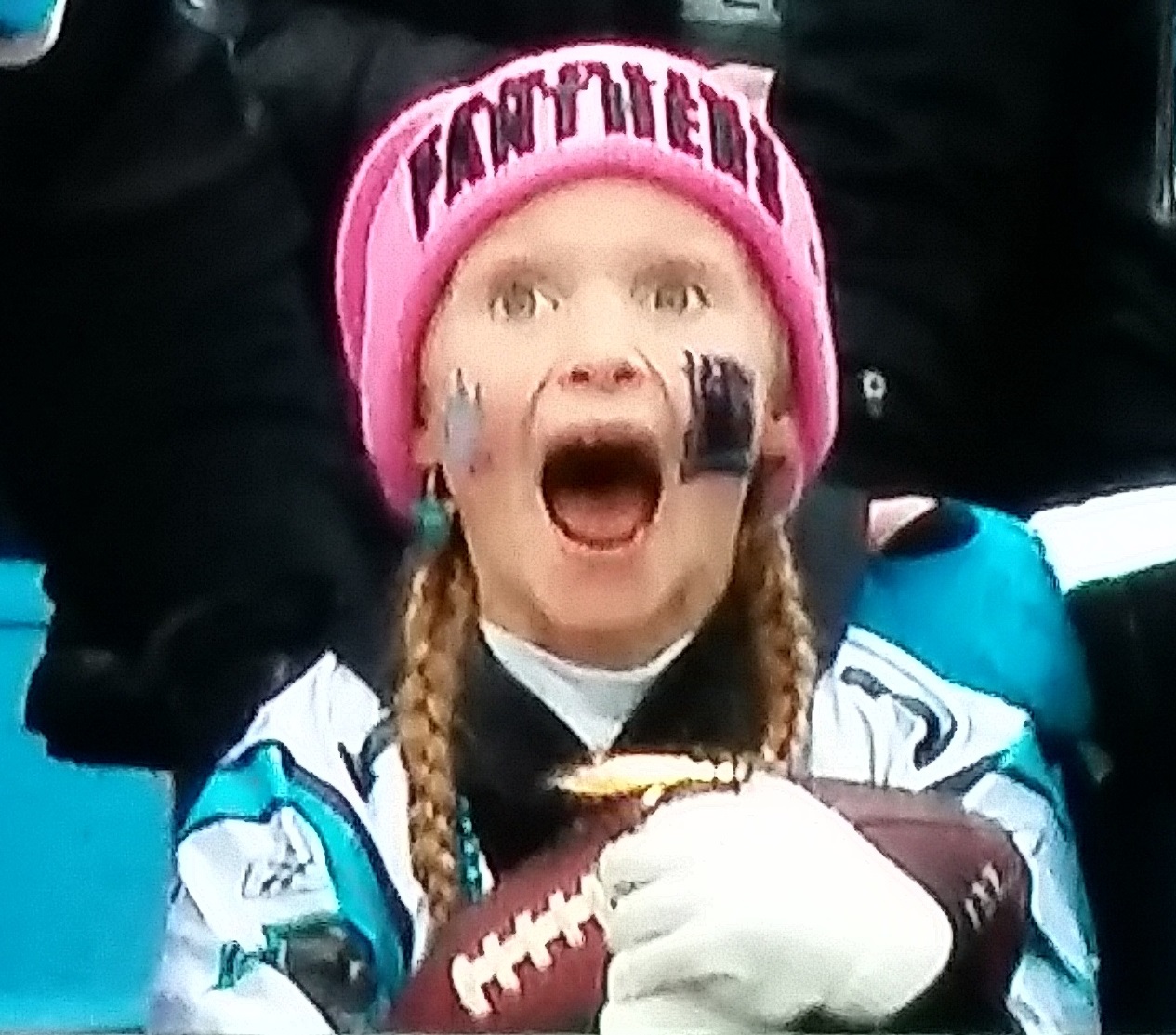
Despite teaching in a Sport Management program, I must confess that I did not watch a lot of football this season. Being a Browns’ fan does that to you. But I did catch some of the play-offs and saw what has become a tradition whenever Newton scores a touchdown. In this case, he awarded it to a young girl in the stands. I was so enamored by the spontaneous expression on her face that I took the photo below and posted it on my new Instagram account:
IMG_20160117_133933
Later that week, I heard Cam’s statement followed by ensuing conversations on various media outlets. On First Take, Stephen A. Smith and Skip Bayless navigated the thorny terrain of racial dialogue that can become contentious. In their conversation, Skip carefully outlined his ‘credentials’ as if to suggest that he should in no way be construed as ‘racist’ in what he was about to say. In fact, he took so much time emphasizing that he was not a racist that I cannot remember what he said about Cam’s statement.
Several days before Cam made the statement (above), Stephen A. Smith speculated that Newton would be the “villain” of Super Bowl 50 and that most of America would “be rooting for the fairy tale ending for Peyton Manning” (Miller, 2016, para. 5). Smith emphasized that his prediction had nothing to do with race. Rather, he suggested that it was just about people wanting a happy ending for Peyton; and besides, he added, “people are annoyed with Cam and the Superman pose and all this other stuff” (Miller, 2016, para. 10).
After watching countless conversations about Cam Newton that tried to convince it was not about race, how are we to have a fruitful dialogue? Ironically, (or maybe not), the Daily Show (now featuring Trevor Noah) did one of the best takes on how we could understand the conversation started by Cam Newton. Maybe Comedy Central is where we need to convene our much-needed dialogue about race!
References
Miller, R. (2016, January 25). Will Cam Newton become Super Bowl 50 villain? Stephen A. Smith will ‘bet check’ it happens. NJ.com. Retrieved from http://www.nj.com/super-bowl/index.ssf/2016/01/is_cam_newton_super_bowl_50_villain_stephen_a_smith_will_bet_check_it_happens.html
Rosenthal, G. (2016, January 25). Seven big storylines heading into Super Bowl 50. NFL.com. Retrieved from http://www.nfl.com/news/story/0ap3000000628271/article/seven-big-storylines-heading-into-super-bowl-50
Samuel, E. (2016, January 28). Cam Newton: ‘I’m an African-American QB that scares people.’ The Daily News. Retrieved from http://www.nydailynews.com/sports/football/cam-newton-african-american-qb-scares-people-article-1.2511614

Porzingis: Is the hype real?

by Brendan Ripley-Barasch

In the weeks leading up to the NBA draft lottery, Phil Jackson, the president of basketball operations for the New York Knicks, kept a close eye on the three best prospects. He attended Kentucky’s practice to see Karl-Anthony Towns, then stopped by at Madison Square Garden for a St. Johns-Duke game to scout Jahlil Okafor, and attended the Ohio State-Nebraska game to observe D’Angelo Russell. With a record of 17-65, the New York Knicks had a great chance at landing the number one overall pick in the 2015 NBA draft. Unfortunately the ping-pong balls did not fall their way, first pick went to the Minnesota Timberwolves, second went to the Los Angeles Lakers, and third went to the Philadelphia 76ers. How is that possible? How did the Knicks drop out of the top three? Finally at number four the New York Knicks name was called. Phil Jackson and Knicks fans alike were disappointed with landing the number four spot but still had hope that one of the top three prospects could fall to four.

Fast forward to the NBA draft, the solid depth of the draft opposed to recent years gave NY fans hope they could still find a superstar at the fourth pick. The draft begins with the Timberwolves predictably taking Karl-Anthony Towns. Next, the Lakers take D’Angelo Russell, and that was a bit crushing to fans and of course Phil Jackson because he was very public about how highly he thought of him, “He’s a great-looking kid,” said Jackson. Then the crushing blow to Knicks fans was when the 76ers selected Jahlil Okafor. The top three were gone, who is Phil going to pick? “With the fourth pick in 2015 NBA draft, The New York Knicks select Kristaps Porzingis,” announced commissioner Adam Silver. The arena filled with boos and the camera even caught a young Knicks’ fan crying. Everyone was baffled at the pick because no one even knew who this guy was.

Leading up to the season teammates and coaches were raving about Porzingis and his incredible athletic ability, but NY fans were not convinced, they had to see it with their own eyes. In the regular season opener against the Milwaukee Bucks, Porzingis dropped sixteen points including a three, grabbed five rebounds, and had a block. Now fans were paying attention, the 7-3 power forward had made a great first impression with the city of New York. This was the first of many great performances which led to Porzingis being named rookie of the month in November. The highlights of the first month  with a twenty-nine point and eleven rebound game against Charlotte and a game against Houston where he had twenty-four points, fourteen rebounds, and seven blocks.

After his insane first month, Kristaps Porzingis had become a sensation in New York. Much like the short-lived Linsanity that swept through Knicks fans, they were honoring Porzingis like a god, even with some giving him the nickname “Porzingod” or “Godzingis”. Night after night he made spectacular plays, most notably his put-back dunks over players and his use of the post move we know as the “Dream Shake.”  Everyone knows how New York media can hype something up, and that was exactly what was happening to Porzingis. First they booed him and ridiculed Phil Jackson for picking him and now all of a sudden they were praising him and foresee him as the savior for the New York Knicks. Number six jerseys were flying off the shelves, he was a fan favorite and his goofy personality made him a favorite of the press as well.

Now the media focuses on Porzingis more than they focus on the former superstar and savior, Carmelo Anthony. Remember that kid who cried when the Knicks drafted Porzingis? Yeah, they met and the kid ended up getting an autograph and apologizing. It is rare to find a story about the Knicks that doesn’t mention Porzingis now.

But is the hype about him real? I think so. After collecting his third consecutive Rookie of the Month award, helping the Knicks surpass their entire win total of last year before the All-star break, drawing raves about him from superstars such as Tim Duncan and Kevin Durant, and posting a line of 14 points/7.7 rebounds/1.9 blocks. It is fair to say that this is not the same case as with Jeremy Lin where the media got overly excited and talked about him being a future superstar and face of the franchise after one month and then he ended up falling off the NBA radar for a while. Porzingis has continued to display consistency, maturity, and improvement over the NBA season and may have the highest upside out of any rookie with his size, athletic ability, and basketball IQ. Although he’s not an All-star and might not even be the Rookie of the Year thanks to the stellar season that Towns is having, New York has found a player to build around for the future with Carmelo Anthony for sure.

Reactions to Tom Coughlin’s resignation

by Brendan Ripley-Barasch

As new head coach, Ben McAdoo sits in his office, evaluating the state of the New York Giants organization and Eli Manning and Odell Beckham Jr. prepare for the Pro Bowl later tonight. One man is confined to his couch getting ready to watch his former superstars perform, Tom Coughlin.

After 12 years as the head guy in New York, on Jan. 4, Tom Coughlin decided to step down from the position. Coughlin leaves with an overall record of 102-90 and two Super Bowl rings while also having had the opportunity to coach multiple elite players such as Michael Strahan, Eli Manning and Odell Beckham. During his tenure as Head Coach, something fans could always count on from the team was that the players were going to run out of that tunnel and play as hard as they could for Tom. It was hard to say that was true the past three years. Maybe that is what led to his resignation, or was it that the team had not made the playoffs since 2011? Or was his age becoming an issue? At 69 years old, Coughlin was the oldest coach in football. Any one of these reasons could have been the deciding factor for him to move on from the New York Football Giants.

At first it wasn’t clear whether Coughlin had stepped down under his own power, or the Giants had actually let him go, but out of respect told him he could tell the media he was resigning. Adam Schefter of ESPN cleared the air when he said Coughlin, “decided to step down before Giants asked if he wanted to stay.” Most New York media outlets running stories about Coughlin chose to describe the resignation as him stepping down or moving on from the organization; its easy to see the amount of respect that not only the fans have but also the media because instead of saying he resigned or was forced out they chose to use softer words to describe it.

During this past season, especially towards the end, there were pretty much two points of view on Tom Coughlin and his future with the Giants among fans and the media. One was that it was time to start fresh, after four years of missing the playoffs and having a losing record three of those years, most people were ready for a change. Many media sources wrote about Coughlin in negative but respectful ways, citing his multiple failed attempts at going for it on fourth down rather than kicking the field goal and more notably about how Coughlin didn’t remove Odell Beckham Jr. from the game when he and Carolina Panthers cornerback, Josh Norman, had multiple altercations during the game including trash talk, shoving and pushing, and even throwing punches at each other. The other view people had on the Tom Coughlin issue was that fans should stay loyal and the Giants organization should keep offering him one-year deals until he was ready to call it quits. Some people might have felt this way because of the two Super Bowls he brought to New York or because he brought the Giants back to elite status. The thing that may have swayed many loyal fans into having the first point of view was probably when the Giants were absolutely dismantled on Monday Night Football by the Minnesota Vikings, losing 49-17. When the team was pushing for the playoffs and playing in a huge Monday night game, they came out just flat and no one seemed like they wanted to be there or even cared about the outcome. With those circumstances, the team should have come out and played with a fire under them, but instead they rolled over and allowed the Vikings to do whatever they wanted.

All of the wins and losses, Super Bowls, and division titles are now just a thing of the past. All we can do now is look back at Tom Coughlin’s legacy with the Giants and it’s probably a safe bet to say that most people will remember him in a very positive way. He goes down as one of the best coaches in New York Giants’ history and we will all miss seeing him and his rosy cheeks on the sideline every Sunday.

Title IX: Now and Then

By Angeline Seames

Title IX: is a piece of legislation included in the Education Amendments of 1972 that requires schools that receive federal funds to provide girls and women with equal opportunity to compete in sports

Since the beginning, and as time has gone on, Title IX has affected sports in many different ways. When Title IX had just passed in 1972 there were still problems occurring for women across college campuses.

In 1971, the year before Title IX became law, fewer than 300,000 girls participated in high school sports, about one in 27. Today, the number approaches 3 million, or approximately one in 2½ (Garber).

The number of women participating in intercollegiate sports in that same span has gone from about 30,000 to more than 150,000. In the last 20 years alone, the number of women’s college teams has nearly doubled (Garber).

Before Title IX, only tennis and golf had established professional tours. Today, there are also women’s professional leagues for soccer, volleyball, bowling and two for basketball. Women have even made inroads in the traditionally male sports of boxing and mixed martial arts (Garber).

In 1976 the women’s crew from Yale protested to the Director of Physical Education by writing Title IX or IX on their backs or chest while naked in front of the director. The crew team had this protest to show what a cold shower caused to happen to these young women. The men rowing team on the other hand used the boathouse that had warm showers, while the woman’s used a trailer with four shower heads with only cold water. With this occurring some of the woman on the crew team got sick from sitting on a cold bus, soaking wet, in cold clothes. Nineteen women from the crew team showed up with Chris Ernst the captain to the appointment with the Director of Physical Education. The response from alumni and the nation caused more action to occur with Title IX. Alumni sent checks to help build a girls locker room the next year in the boathouse. With this happening, Title IX became a rally cry for other women on campuses. A documentary was created in 1999 called “A Hero For Daisy.”

Throughout time things have definitely changed for woman and Title IX.

Here are some stats:

1 in 27 – # of high school girls competing in sports prior to Title IX
1 in every 2.5 – # of high school girls competing in sports today
3714 – more women’s teams on college campuses than there were in 1972
989 – more men’s teams
32,000 – # of female college athletes in 1972
164,998 – # of female college athletes today
8.7 – The average number of women’s teams offered per NCAA school in 2005.
2 – # of women’s teams offered per NCAA school in 1972
33% of total NCAA athletic budgets spent on ALL women’s sports (title nine)

While women comprise approximately 54 percent of the enrollment in the 832 schools that responded to the NCAA’s 1999-2000 Gender Equity Study, they account for only 41 percent of the athletes. This violates Title IX’s premise that the ratio of female athletes and male athletes should be roughly equivalent to the overall proportion of female and male students (Garber).

According to 2000-2001 figures, men’s college programs still maintain significant advantages over women’s in average scholarships (60.5 percent), operating expenses (64.5 percent), recruiting expenses (68.2 percent) and head coaching salaries (59.5 percent) (Garber).

Only 44 percent of the head coaches of women’s teams are female, an all-time low that represents less than half the pre-Title IX figure (Garber).

Today, despite these advances, there is still gender discrimination that limits sporting opportunities for women at the intercollegiate level. Despite Title IX’s success in opening doors to women and girls, the playing field is far from level for them. For example, although women in division I colleges are 53 percent of the student body, they receive only 41 percent of the opportunities to play sports, 36 percent of overall athletic operating budgets and 32 percent of the dollars spent to recruit new athletes.

The United States General Accounting Office had recently done a report on the participation level of men and women athletics. According to their report, men’s intercollegiate athletic participation rose from approximately 220,000 in 1981–1982 to approximately 232,000 in 1998–1999. Between 1981 and 1982 and 1998 and 1999, football participation increased by 7,199—offsetting wrestling’s loss of 2,648 participants; outdoor track’s loss of 1,706 participants; tennis’s loss of 1,405 participants; and gymnastics’ loss of 1,022 participants. Other sports that gained participants include baseball (+5,452), lacrosse (+2,000) and soccer (+1,932). It is very clear that although more women’s teams than men’s have been added every year, there are still many men’s teams being added to compensate the programs that have been dropped (GAO 2001).


Garber, Greg. “Landmark Law Faces New Challenges Even Now.” ESPN. ESPN Internet Ventures. Web. 20 Nov. 2015. <http://espn.go.com/gen/womenandsports/020619title9.html&gt;.

General Accounting Office. “GENDER EQUITY Men’s and Women’s Participation in Higher Education.” United States General Accounting Office, 15 Dec. 2001. Web. 20 Nov. 2015. <http://www.gao.gov/assets/240/231026.pdf&gt;.

“What Is Title IX?” Title Nine. Web. 20 Nov. 2015. <http://www.titlenine.com/category/who are we/title ix- what is it-.do>.


DFS vs. NCAA

by Brandon Busuttil

For the past 2 years Daily Fantasy Sports has risen through the ranks and is now one of the most exciting ways for people to play fantasy sports. Out of all the people that do play these daily fantasy sports leagues, heavy restrictions have been put on NCAA athletes. In the United States, all but 5 states consider daily fantasy sports leagues to be legal and games of skill rather than games of luck.

Therefore the start of the debate was, if sites such as Fanduel and Draft Kings are considered games of skill rather than games of luck, it is not technically considered to be gambling. Overall, participation by athletes in DFS leagues was allowed.

It was reported that since the year 2004 NCAA athletes have been taking part in DFS leagues and the percentage of NCAA athletes putting money forth and receiving money awards for winning leagues has increased throughout each year.

It is at the point now that not just professional sports are involved, but so are college sports. College football and college basketball DFS leagues are played daily by individuals. Although the use of likenesses is another topic up for debate, athletes are getting in trouble for the use of DFS leagues.

Scott Stricklin, the Athletic Director at Mississippi State made it clear on September 22, 2015 that he was going to reiterate Oliver Luck’s words (NCAA Vice-President) that any college athlete gambling on sports (including DFS such as Fanduel and Draft Kings) will be subject to losing one year of eligibility. This was the beginning of the issue of DFS leagues.

This instance has had a large rippling affect on many aspects of the sporting world. To start, both the SEC Network and PAC-12 Network will no longer air any ads that have to do with Fanduel or Draft Kings, to show they do not support the use of DFS for college athletes. This was a huge decision because both networks lost some of its funding, as both Fanduel and Draft Kings were paying the networks a lot of money for advertising time.

ESPN is the largest network provider of college sports in America. Shortly after Scott Stricklin and Oliver Luck made sure NCAA athletes knew how serious it was to not gamble on any NCAA sanctioned sport, ESPN decided to disband their “cover alert” feature. The “cover alert” feature ESPN had on their apps and sites gave users an update on the broadcast that gives those who are betting a heads up on the score of a game in relation to its point spread. Disabling this feature for users shows that ESPN is trying to do their job by doing what they can to keep athletes safe by trying to keep them away from being tempted to bet. Although it is just a small move by ESPN, it is a move that in a way shows they care.

Overall, should NCAA athletes be allowed to play DFS such as Fanduel and Draft Kings? That is something that is up for a debate, and one that I am pretty sure would be a very long debate. Is it a game of skill or a game of luck? Again another debate that could take a long while to decide. For now the rule is stated that NCAA athletes cannot participate in DFS. However, with such a blurred line of what DFS is really considered, look for NCAA gambling rules to be clarified for athletes as time goes on and in the near future. More than likely the new rules will look to put even greater restrictions on NCAA athletes, as this seems to be a trend for the NCAA.