
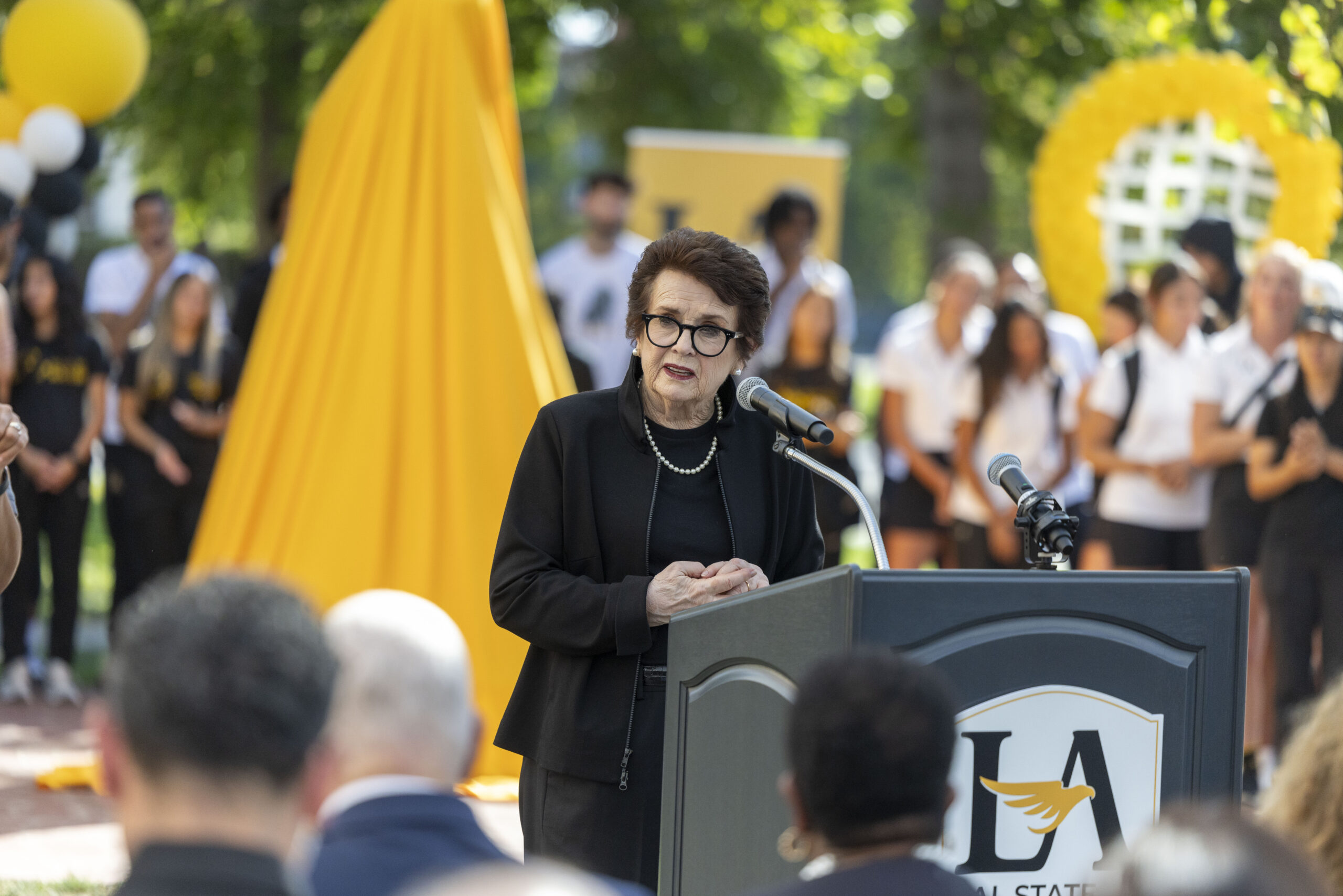
After attending Cal State-LA from 1961 to 1964, Billie Jean King completed History degree at age 82
By Dr. Nancy E. Spencer
Dr. Spencer is Professor Emerita at BGSU, having taught in the Sport Management program from Fall 1998 until Spring 2023. The main focus of her research is on sociological analyses of sports (primarily tennis), and includes articles on the Battle of the Sexes, the Evert v. Navratilova rivalry, and the Williams sisters at Indian Wells.
May 18, 2026
Imagine being a History Professor at California State-Los Angeles (CSULA) and learning that one of your incoming students made history herself as a member of the ‘Original Nine’ (in 1970) and earned plaudits for defeating Bobby Riggs in the 1973 Battle of the Sexes at the Houston Astrodome.
That would be pretty cool, wouldn’t it?
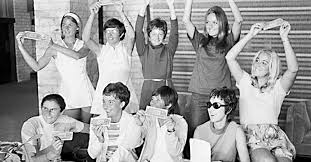
The ‘Original Nine’ featured: (counterclockwise, L-R) Judy Tegart, Kerry Melville, Rosie Casals, Gladys Heldman, Kristy Pigeon, Peaches Bartkowicz, Nancy Richey, Billie Jean King, and Val Ziegenfuss.
Now imagine that you are a freshly-minted Phd whose first job as an Assistant Professor begins in 1998 at Bowling Green State University. Among your first classes is the History & Philosophy of American Sports. ESPN has just featured a special about the “Battle of the Sexes” that occurred 25 years earlier. One of your colleagues (Dr. Ray Schneider) shares with you a videotaped program to present in your Sport History class. The week of September 20 (the 25th anniversary of the historic match), you show select segments of the program to your class of 60 Sport History students, none of whom even know about the event, and you tell them that you called lines for the match. You were a primary historical observer. That was how my first semester at BGSU began!
The ESPN Special revealed how the match was hyped – with King entering the court as the “feisty feminist,” and Riggs entering on a rickshaw as the “self-proclaimed male chauvinist pig.” Their rhetoric fitted perfectly with the zeitgeist. With “Women’s Lib” in ascendance, Gladys Heldman (who organized the ‘Original Nine’ and promoted the early tour) dubbed it “Women’s Lob.”
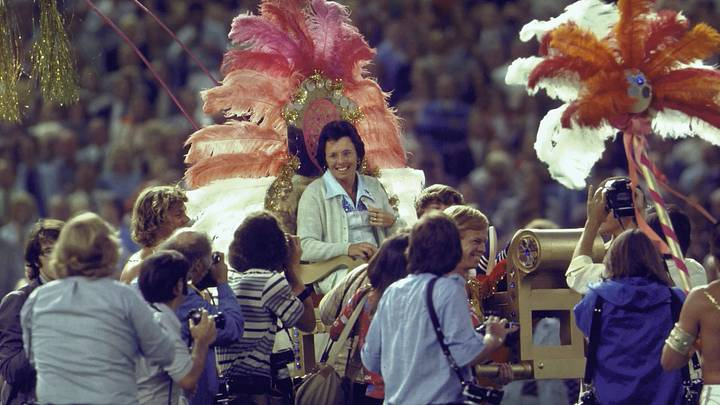
King entered court on a gold litter carried by four shirtless members of Rice University’s track team
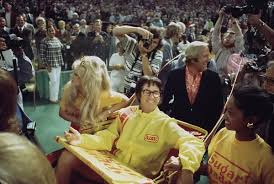
Riggs, a former No. 1 and winner of Singles, Doubles, and Mixed Doubles at the 1939 Wimbledon, added to the hype with his rhetoric. Among his memorable comments were that women belonged in the kitchen and the bedroom, but not on the same court as a man. He also suggested that he would beat Billie Jean because she was a woman and women were weak physically and mentally.
At the end of class, having set out the ‘spectacular’ buildup to the match, a student raised her hand to ask, “Who won?” I had forgotten that the students had not heard about this event. Almost as an afterthought, I replied, “Billie Jean King.” A student in the back of the classroom raised his hand (I still remember his name – Greg Berkmeier) and asked, “Was it rigged?” I was shocked that anyone would ask such a question. “No,” I replied defensively.
Why would anyone even think that?
Only later did I discover that one of Bobby’s best friends, Jack Kramer, had written in his autobiography (Kramer & Deford, 1979) that Billie Jean won that match fair-and-square. Riggs had wanted to use the hype to promote a tour for 35 & over (senior) men’s tennis comparable to that which the PGA had. Given that objective, Kramer pointed out that there was no way he would have purposely lost that match. In the end, Riggs acknowledged that he had underestimated King.
King entered the match knowing that this moment, while meaningless in terms of rankings, had the potential to change hearts and minds. Frequently, she said that it was about ‘social change.’ She and others said that it provided evidence that a woman could compete against a man even in sports. The impact of her victory was credited with contributing to advances in women’s sports that aligned with the women’s movement.
The same motivation that fueled King’s victory in the Battle of the Sexes and made her one of the most impactful leaders in the history of women’s tennis, also carried over to her pursuit of a college degree. Her parents had always emphasized the importance of education to Billie Jean and her brother Randy. Although they were no longer alive, King knew they would have been so proud of her accomplishment. She even rated it right up there with many of her tennis victories. Besides defeating Bobby Riggs in the Battle of the Sexes, King won 6 Wimbledons and a total of 39 grand slam victories in singles, doubles, and mixed doubles. In 2009, President Barack Obama presented King with the nation’s highest civilian honor in recognition of her lifelong advocacy for women’s equality and civil rights. King sought to see inclusivity based on gender, race, and sexuality. After being ‘outed’ in 1981, she initially denied that she was gay, but later came out as a lesbian and became a staunch advocate for LGBTQ+ rights.
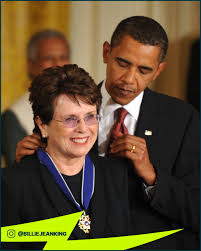
President Obama awards Billie Jean King with Presidential Medal of Freedom
In one of the the favorite parts of her coursework at CSULA, King participated in a program for the school’s Prison Graduate Initiative (PGI). In 2016, the PGI became “the first and only BA program to be designated a Second Chance Pell (PEP) site in California, and it was the first bachelor’s degree program in California to award a BA degree to incarcerated students.” According to USA Today’s Cydney Henderson (2026), King “gave a commencement speech for the first graduating class at the California Institution for Women in October.” She also spoke to inmates at a women’s prison and two men’s prisons, acknowledging that it was a life-changing experience.
Since Billie Jean King first came on the tennis scene as an ebullient tennis player in the 1960s, she has focused on effecting social change. She sees her most recent accomplishment as something that might inspire future generations, including ‘nontraditional’ students who might decide to go back to school at a later stage of their lives. Being a non-traditional student who received her Phd at 47, I can appreciate her influence on those who have doubts about whether they could succeed. As an educator, I would have loved to have a grad student older than me who returned to school on such a mission – whether or not she made history herself, as King did.

