Low Expectations for Browns yet again- Playoff Chances Diminished or Rising

By Cole Kegley

October 13, 2019

Cole Kegley is a junior undergraduate student at Bowling Green State University, majoring in Sport Management and minoring in General Business. The Bucyrus, Ohio alumnus focuses on basketball and football, with an emphasis on collegiate and professional levels. 

Browns’ fans were left in worry and bewilderment when their franchise relocated, becoming the Baltimore Ravens in 1996. To the surprise of no one, joy filled Cleveland when their beloved Brownies were back in the city beginning in the 1999-2000 season, following a 3-year deactivation period. The dawg pound was alive and thriving. Though, to what degree? 

Since their return to the NFL 20 years ago, the Browns have been nothing short of a disappointment. Similarly, an exponential number of quarterbacks have taken the reigns since their homecoming in 1999- thirty to be exact (Kenyon, 2018). To make matters worse, only one Quarterback has played a full 16-game season in the past 20 years for Cleveland, Tim Couch.

Browns’ fans have struggled through the past twenty years, witnessing numerous roster changes, head coaches fired mid-year, draft pick busts, players leaving in the off-season, and many other that took a toll on the organization. However, the culture and stigma surrounding the Cleveland Browns has begun to change in the past two years. The media, players, and fans alike are beginning to gain a sense of respect for this new-look team. 

Draft picks including Denzel Ward, Nick Chubb, Baker Mayfield, and Myles Garrett are just part of the reason why the Browns are turning heads. Another reason: trades and off-season acquisitions including the likes of Pro Bowlers Jarvis Landry, Olivier Vernon, and future Hall of Famer Odell Beckham Jr. make the Cleveland Browns an exciting team to watch. However, many media members refuse to accept Cleveland’s recent changes and their view as merely the “Mistake by the Lake” remains prominent. 

Colin Cowherd is one of the more popular faces of sport media, and more specifically as of late, Baker Mayfield; he has gone so far as to say, “I will be shocked if Baker does not finish top 2 in the MVP (voting)” He was also quoted saying, “of course Baker has a shot, because Baker has a better story. This is what MVP’s have become” (Cowherd, 2019). 

Clearly, Cowherd thinks highly of Baker and his story since taking an 0-16 team to 7-8-1 while only starting 13 games and throwing the most passing touchdowns by a quarterback in NFL history. However, he does not want to commit to the Browns becoming a winning and respectable team. 

Fast forward to week 4 of the NFL season, and the 1-2 Cleveland Browns (with their only win coming against a Jets team missing their starting QB) were looking at the 2-1 Baltimore Ravens with a sense of urgency. Consequently, A mere 14% of NFL teams starting 1-3 have made the playoffs since 1990 (Clayton, 2016). 

ESPN broadcasters such as Max Kellerman and Dan Orlovsky voiced how the Browns were desperately striving to replicate the Sean McVay-Rams phenomenon but failing. This comparison could not be more irritating as the Browns’ head coach is 11 years older than Sean McVay, and the reasoning for McVay’s fame is his relative success at such a young age- 33 years old (Kellerman & Orlovsky, 2019). 

False analogies sway viewers to believe un-factual information which is simply not comparable. Similarly, these broadcasters along with others have prematurely written off Freddie Kitchens and the Browns following only a handful of games. 

So, what should NFL consumers believe? The star-stacked Browns with a 2nd year quarterback and 1st year head coach started off slowly, dropping their first game by a margin of 30. Since then, they are 2-1 and are now sitting atop the AFC North, which they have not won since their return to the NFL (Lukas, 2019). 

All things considered, the Cleveland Browns deserve to be respected by the media. Sports broadcasters across American seem eager to see the Browns lose, leaving them to reaffirm their doubts of the Browns being the same old team to viewers. In spite of this fact, the Browns have struggled to begin the season. Though to their defense, 2 of their losses have come at the hands of the 4-0 San Francisco 49ers, and the Los Angeles Rams, 2018 NFC Champions. 

Lastly, multiple defenders including star-studded talent such as Denzel Ward, Greedy Williams, and Morgan Burnett have missed multiple games. All in all, playoffs are still intact for the Browns and hopes for success are still on the table, so do not be too quick to write off this team, as they are loaded with talent on offense and defense. 

References

Clayton, J. (2016, October 4). Ranking 1-3 NFL teams most likely to bounce back. ESPN.com. Retrieved from https://www.espn.com/nfl/insider/story/_/id/17708074/ranking-1-3-nfl-teams-most-likely-turn-2016-playoffs.

Cowherd, C. [The Herd with Colin Cowherd]. (2019, July 26). Baker Mayfield’s MVP odds are due to his story, Colin says to pay Dak before Zeke | NFL | THE HERD [Video File]. Retrieved from https://www.youtube.com/watch?v=ogHKc0zgmu4 

Kellerman, M. & Orlovsky, D. [ESPN]. (2019, September 24). Is Freddie Kitchens failing as the Browns head coach? | Get Up [Video File]. Retrieved from https://www.youtube.com/watch?v=bdkWLJhUXxU

Kenyon, D. (2018, May 10). Cleveland Browns Quarterbacks: Revisiting every starting QB since Tim Couch. Bleacher Report. Retrieved from https://bleacherreport.com/articles/2773955-cleveland-browns-quarterbacks-revisiting-every-starting-qb-since-tim-couch.

Lukas, M. (2019, October 1). Cleveland Browns, AFC North 1st place, say it aloud! Dawg Pound Daily. Retrieved from https://dawgpounddaily.com/2019/10/01/cleveland-browns-afc-north-1st-place-say-it-aloud/.


Risky move from Shurmur?

By Alex Sabo

October 11, 2019

Alex Sabo is a senior in Sport Management with a minor in marketing at Bowling Green State University. Alex is from St. Charles, IL and is interested in Pro sports, but follows football, basketball, baseball, and college football.

The second overall pick of the 2018 NFL draft, Saquon Barkley is now in his second season as a running back for the New York Giants. Coming off a hot start from his rookie season with 1,307 rushing yards (“2018 NFL Player,” 2018), Barkley and the Giants could find themselves in trouble for 8 weeks. If this is the case, the Giants will be without their star running back until week 12 with 75% of the regular season complete. The team is currently standing at 1-2 with a near win over the Tampa Bay Buccaneers in week 3. From the looks of things, it does not appear to be a positive start for the team and having their main playmaker injured will not help the team win games.

Struggling to find players to get the job done, they are trying to get their Super Bowl quarterback Eli Manning on track as his performances rapidly slipped, having seen their star wide receiver Odell Beckham Jr. switch teams, and the squad is left yearning  for a way to win games. While the defense had already given up 95 points by week 3, the total points scored on offense was only 63 points by week 4. Eager to try and fix that ratio and put some points on the board, the team needs a key element to their offense which seems like their only hope. Saquon Barkley, the second year running back, was an eye opener in his rookie season, given that not many rookies gain over 1,000 yards in their rookie season.  Unfortunately, Barkley came down with a high ankle injury week 3 against the Buccaneers and was fortunate that his team won by a hair to keep their fans’ hopes alive for week 4.

The issue with week four is the Giants will be missing Barkley as they battle the Redskins. We occasionally see elite athletes come right out of college and have a breakout rookie season, but that is not always the case. Given that the Giants need a playmaker desperately, they are in dire need of their running back. As a result, Giants coach Pat Shurmur  told ESPN writer Jordan Ranaan (2019),  “Rehab him and get him ready to go, see how that plays out” (para. 6). As desperate as the coach and the team is to have their only hope back, it is looking like a dangerous move, not for the team, but for Barkley. The 22 year old back is being rushed into the game by his coach and will not be put on injury reserve (IR). The reason the team won’t put him on IR is because this would bench him up to 8 weeks. Of course, the team can’t be without their running back!

No team wants to be without an integral part of their offense, and for a team which seems to be going downhill since week 3, the Giants are going to do all they can to win games. As explosive as Barkley is, “The second-year back won Offensive Rookie of the Year last season and was off to a strong start this year. He topped 100 yards rushing each of the first two weeks” (Ranaan, 2019, para. 10). Gaining just over 200 yards on 37 carries by week 3, he was entering what appeared to be an explosive season.

The question for Barkley is whether rushing him back into play if he is not fully healed could be a foolish move. Given that the team seems to be declining, could Coach Shurmur potentially be ruining things for his running back who is showing numbers and putting New York on the map for the running game? This highlights a risky move because Barkley’s numbers may never be the same if he gets injured again.

References

Raanan, J. (2019, September). Giants won’t place RB Barkley (ankle) on IR. ESPN. Retrieved from https://www.espn.com/nfl/story/_/id/27706974/giants-place-rb-barkley-ankle-ir

2018 NFL Player Rushing Stats. (2018). ESPN. Retrieved from https://www.espn.com/nfl/stats/player/_/stat/rushing/season/2018/seasontype/2/table/rushing/sort/rushingYards/dir/desc


Why was Melvin Gordon’s Holdout so Different from Le’Veon Bell’s?

By Drew Gallagher

October 7, 2019

Drew Gallagher is a second-year Sport Management student with a minor in General Business at Bowling Green State University. Drew is a proud native of Aurora, Illinois and is interested in many sports, but focuses primarily on baseball and football at the professional and collegiate levels.

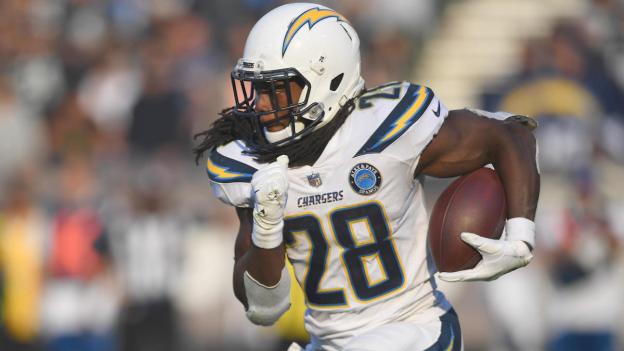
On Wednesday, September 25th, Melvin Gordon of the Los Angeles Chargers decided to end his hold out and returned to his team. His hold out for a better contract began in training camp and lasted until week 4 of the NFL season (Gordon, 2019). In the middle of the holdout in early August, “Melvin Gordon’s agent Damarius Bilbo [had] requested that the Los Angeles Chargers trade his client” (Abdeldaiem, 2019, para 1). The holdout included its share of ups and downs, but still seemed relatively quiet. This is especially apparent when put side-by-side with Le’Veon Bell’s 2018 holdout which lasted the entire season.

As a reminder, Le’Veon Bell was a member of the Steelers who was also in the last year of his contract. He decided in training camp that he wanted to hold out for a long-term deal with his current team. Both his camp and the Steelers had many separate contract negotiations throughout the preseason and early 2018 season, but no new deal came about. Because of this, he ended up foregoing the entire amount of the franchise tender that the Steelers had offered him, and he sat out the entire season. Gordon however, has had very similar circumstances, but still gave in to his holdout not even a fourth of the way through the year. One of these similarities is that both teams seemed to get by equally fine with their backup running backs (Ekeler and Conner) who thrived without their first string counterparts. This begs the question: how did the differences between the two affect the outcomes of their respective holdouts?

For starters, media coverage seemed to play a big role in how people perceived both incidents. Le’Veon Bell is known to be a very outspoken individual. He was constantly doing interviews and posting on social media to talk about his displeasure with how his holdout was going. Because of this, I believe that the media had a lot more interest in the story. Gordon, on the other hand, seemed to stay relatively quiet during his holdout and therefore had less coverage coming his way. This could very well be part of the reason why Gordon decided to come out of his holdout part way through the year unlike Bell. Without the constant media coverage, fans weren’t as eager to see the deal get done. This meant that Gordon had significantly less leverage than Bell when it came to contract negotiations.

Another reason that could be equally responsible for the difference in the holdouts is that If Gordon didn’t “play at all in 2019, his contract would… just transfer to 2020, when he would then be scheduled to earn $5.6 million once again” (Graziano, 2019, para. 5). However, Bell did not “have this problem because of the franchise-tag rules, which would have forced the Steelers to pay him nearly $21 million this year if they had wanted to franchise him for the third year in a row” (Graziano, 2019, para 6).

Whether the contracts themselves had the largest impact on the differences between how the respective holdouts ended up could definitely be debated. What is clear though is that the difference in media coverage definitely affected them in some way. I can definitely see similar circumstances affecting future holdouts as well.


References

Abdeldaiem, A. (2019, August 1). Melvin Gordon’s agent requests trade amid contract dispute with Chargers. Sports Illustrated. Retrieved from https://www.si.com/nfl/2019/08/01/melvin-gordon-trade-request-chargers-contract-dispute

Gordon, G. (2019, September 25). Melvin Gordon ending holdout, will report to Chargers. nfl.com. Retrieved from http://www.nfl.com/news/story/0ap3000001058986/article/melvin-gordon-ending-holdout-will-report-to-chargers

Graziano, D. (2019, August 8). Why you can’t compare the Ezekiel Elliott and Melvin Gordon holdouts to Le’Veon Bell’s. ESPN. Retrieved from https://www.espn.com/nfl/story/_/id/27342231/why-compare-ezekiel-elliott-melvin-gordon-holdouts-leveon-bells

The Return of Gordon Hayward?

By: Max Lewton

October 7, 2019

Max Lewton is a third-year undergraduate student from Cleveland, Ohio. He is currently studying Sport Management with a minor in Journalism at Bowling Green State University. His primary interests are basketball and football at both pro and collegiate levels, as well as baseball.

The 2017 NBA season opener between the Cleveland Cavaliers and Boston Celtics is one that we all remember vividly. Gordon Hayward went up to throw down an alley-oop dunk and came down hard on his left ankle, leaving a roar of gasps from the crowd. The gruesome injury occurred only minutes into the first quarter of Hayward’s Celtic debut and left the whole NBA in shock. Everyone saw how the injury affected Hayward last season. He seemed a step slower than everyone on the floor and just did not seem to have the same leaping ability as before. It was apparent that he was still suffering from the side-effects of the injury the year before. The former all-star is now coming into the 2019 season fully healthy and ready to show that he can still play at a high level.

Of course, Hayward will not be exactly the same kind of player that he used to be. An injury of that magnitude will surely effect his athleticism and speed. However, let’s not forget that prior to his injury he was averaging almost 22 points per game on 47% shooting from the field and almost 40% from behind the arc in 2017 (“Gordon Hayward Stats,” 2019). Gordon Hayward does not have to be a big bodied forward who takes it to the rack as long as he has good shooting percentages. In an article that appeared on Boston.com, Hayward comment on his improved shooting stroke  saying, “I feel like I’m shooting the ball really well, I’m still trying to figure out some of the timing and rhythm on pull-up and dribble jumpers. But I do feel a lot better shooting the ball—even better than I did before the injury” (DeCosta-Kilpa, 2018, para. 14). Hayward can transform himself into a threat from behind the arc, which if he can earn the defender’s respect from out there, he can start taking more people to the basket.

With the emergence of Jayson Tatum at small forward, Hayward will either be the sixth man off the bench or start as an undersized power forward. It really comes down to him finding his true role with the Celtics. Head coach Brad Stevens runs a great offensive system in Boston, and he will be able to find a good role for him. Honestly the level of Gordon Hayward’s play next year could be the deciding factor on whether Boston will actually compete. If he can play like he did with the Utah Jazz, then that is adding another all-star caliber player to Boston’s young and talented lineup. That could make them a legitimate threat to win the East and maybe even contend for an NBA title.

Hayward has the skill set and experience to bounce back and become a respectable player in the NBA once again. It has been two years now since the injury and even though he looked very slow on the floor last year, he will have at least some of the athleticism he once had back. With Boston having a few new faces in the starting lineup this year, Hayward will not only have to prove himself to the rest of the NBA, but to his teammates as well. Boston is a young team full of potential, if he can be that veteran leader to backup Kemba Walker then the team will flourish. Many NBA fans and others have already abandoned Hayward’s comeback, but I believe that he has still got a lot left in the tank.

References

DeCosta-Klipa, N. (2018, October 15). ‘I won’t be the same player’: How Gordon Hayward expects to be different post-injury. Boston.com. Retrieved from https://www.boston.com/sports/boston-celtics/2018/10/15/gordon-hayward-injury-return.

Gordon Hayward Stats. (2019.). Basketball Reference. Retrieved from https://www.basketball-reference.com/players/h/haywago01.html.

Whose Fault is it Anyway?

By Griffin Olah

October 3, 2019

Griffin is a second-year BGSU undergraduate student from North Ridgeville, Ohio. He is a Sport Management major and a Spanish minor. His primary sports interests are baseball and football, both collegiate and professional, but he is also interested in basketball, MMA, boxing and hockey.

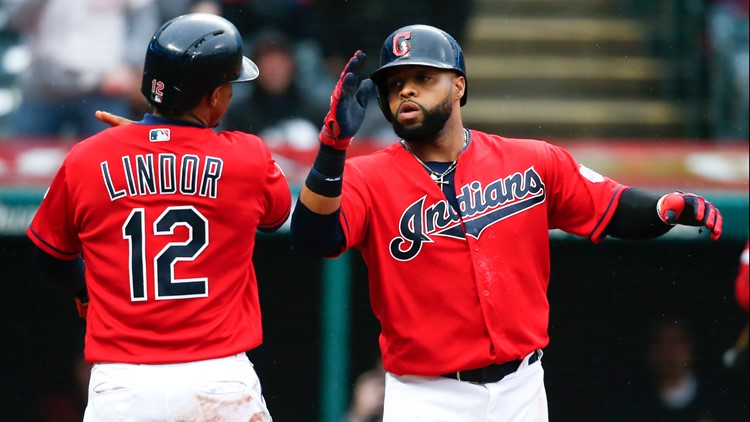
The Cleveland Indians’ 3-year reign over the AL Central has come to an end, and the Tribe has missed the postseason for the first time since 2015. The preseason division favorite finished in second place in the Central and third in the AL Wild Card with a 93-69 record. This season definitely did not go according to plan for anyone involved, but reasons for missing must be analyzed. 

Most media attention focuses on shoddy leadership, particularly from owner Paul Dolan, as the primary reason the Tribe sits on the outside looking in on the postseason. Before the season began, Dolan ordered the payroll to be cut. Following an embarrassing sweep in the ALDS at the hands of the Houston Astros (Torres, 2019), this was particularly puzzling. The 2018 iteration of the Indians was flawed for sure, with the top-heavy offense and top of the line rotation carrying the team to 94 wins, but there was no addition over the offseason (Perry, 2019). Following a three team trade of first basemen sluggers with the Rays and Mariners that netted the Indians Carlos Santana and Jake Bauers while losing Yandy Diaz and Edwin Encarnación, the Indians sat quiet for the offseason. 

The reasons behind the blame placed on the Dolans vary based on the article, but there are two main ideas. The first is that the Dolans either don’t care to spend or don’t care about the team’s success. Following the Astros’ sweep, the Indians had a window to improve and a few key contributors on the open market, including relievers Andrew Miller and Cody Allen, outfielder Michael Brantley and third baseman Josh Donaldson. All four left in free agency on contracts that the Indians could have afforded if the Dolans opened up their pockets. There is also the infamous comment from Paul Dolan telling fans to “enjoy” Francisco Lindor when asked about resigning him (Meisel, 2019). The other idea is that it is the fault of ownership. This group believes that the Dolans went farther than restricting the resigning of players, they instructed President of Baseball Operations Chris Antonetti and GM Mike Chernoff to cut payroll. The Indians “cut more than $15 million from the 2018 Opening Day salary obligations and reversed almost a decade-long trend of year-over-year increases” (Perry, 2019, para. 5), which led to the team not only losing key pieces of the 2018 team, but not being able to add any players at all. The Indians have a creative front office, but they were severely handicapped by the Dolans strategy and plans for the future.

Was this the reason that the team missed the playoffs? Yes, the offseason was flawed- letting Michael Brantley and Yandy Diaz leave was particularly painful for Indians’ fans both before and during their quality seasons- but there is a lot more to the picture than just the Dolans’ unwillingness to spend. The outfield was a serious issue, but one that was addressed by Antonetti and Chernoff. The Indians promoted outfield prospect Oscar Mercado in May, who went on to have a Rookie of the Year caliber season. They swung a major deadline deal with the Reds and Padres that brought in a year of Yasiel Puig and 5 of Franmil Reyes, shoring up the outfield and strengthening the overall lineup.

So, if the off-season concerns were addressed, what was the issue? Injuries. The Indians’ rotation, known across baseball as one of the most formidable in the sport, was decimated. Perennial Cy Young candidate Corey Kluber broke his arm on a comebacker to the mound, second ace Carlos Carrasco was diagnosed with leukemia and missed a significant portion of the season, and surging Mike Clevenger dealt with a back issue that caused him to miss over a month of the season. Jose Ramirez disappeared for the first half and then recaptured his MVP form in the second half, only to break his hamate bone in his right hand and miss the critical end of the season.

Even with all the injuries, the Tribe were still competitive, finishing 8 games behind the surprising Twins and 3 games behind the Rays for the second Wild Card spot. When looking at the season as a whole, where can the blame truly lie? The media puts it on the tight-walleted Dolans, but it should rest on the string of bad injuries. Would Corey Kluber and Carlos Carrasco give the team 3 more wins over the season? If Jose Ramirez performed to his MVP caliber the first half, could the team have won a few more games? These questions directly impact the win total of the 2019 Indians, possibly even more so than questions surrounding the Dolans’ choices over the offseason. So, in the ultimate question of “Whose fault is it anyway?” The answer rests solely on the unpredictability of baseball and the Indians’ lengthy IL.

References

Meisel, Z. (2019, March 25). Paul Dolan discusses the dollars and sense behind the Indians’ payroll and Francisco Lindor’s future. The Athletic. Retrieved from https://theathletic.com/884023/2019/03/25/paul-dolan-discusses-the-dollars-and-sense-behind-the-indians-payroll-strategy-and-francisco-lindors-future/

Perry, D. (2019, September 30).The Indians have been eliminated, and it’s mostly the fault of ownership. CBS Sports. Retreived from https://www.cbssports.com/mlb/news/the-indians-have-been-eliminated-and-its-mostly-the-fault-of-ownership/

Torres, L. (2019, September 30). The Dolans don’t care that the Indians missed the playoffs. Beyond the Box Score. Retreived from https://www.beyondtheboxscore.com/2019/9/30/20889710/cleveland-indians-ownership-dolan-missed-playoffs-cheap

Welcome to 2019-2020 Maxwell Media Watch

By Nancy E. Spencer, Faculty Adviser, Maxwell Media Watch

October 1, 2019

Welcome to the Richard A. Maxwell Sport Media Project as we enter the 2019-2020 academic year at BGSU. This year marks the eighth year that we have had undergraduate and graduate students write entries that critique print and/or broadcast media as well as social media. This past week, 15 students attended our initial meeting to discuss goals and potential topics for the coming semester. Within the next few days, students will begin to post entries on a variety of topics – ranging from how professional athletes utilize social media, to ESPN coverage (or lack of coverage) of European futball, to debates about who is No. 1 in hockey (Crosby vs. McDavid). Our goals for the coming year are to increase the quantity of entries and continue to improve the quality of writing in each entry that we post. We hope that you will enjoy reading the entries that our students submit and share them with others who might be interested in reading them.

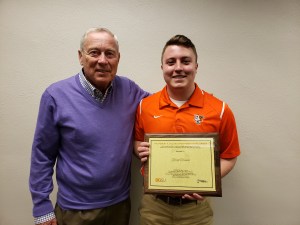
Two students will play significant roles in processing this year’s entries. David Dietrich is a senior Sport Management student who won the Collins Scholarship this past year and will assist with editing and posting entries this semester. A photo of him receiving the Collins Scholarship award from Dick Maxwell appears below.

“I am looking forward to another productive year with the Maxwell Media Watch,” said David. “When I joined last year, I never expected to receive a scholarship from distinguished alumnus Dick Maxwell. I am very excited to continue working on this wonderful project this year!”
In addition, we would like to welcome Tyanna Smith, a first-year graduate student in Sport Administration, who will be helping to organize our meetings and assist with editing entries.

We look forward to a productive year ahead and hope that you will read and reflect upon the topics that our students and guest writers post in the year ahead.

An Inside Look at the NFL Broadcast Boot Camp

By David Dietrich

May 6, 2019

David Dietrich is a second-year undergraduate student at Bowling Green State University. The Tiffin, Ohio native is a Sport Management major, with a minor in journalism. His primary sports interests are football, basketball, and baseball, at both collegiate and professional levels.

Broadcast Boot Camp

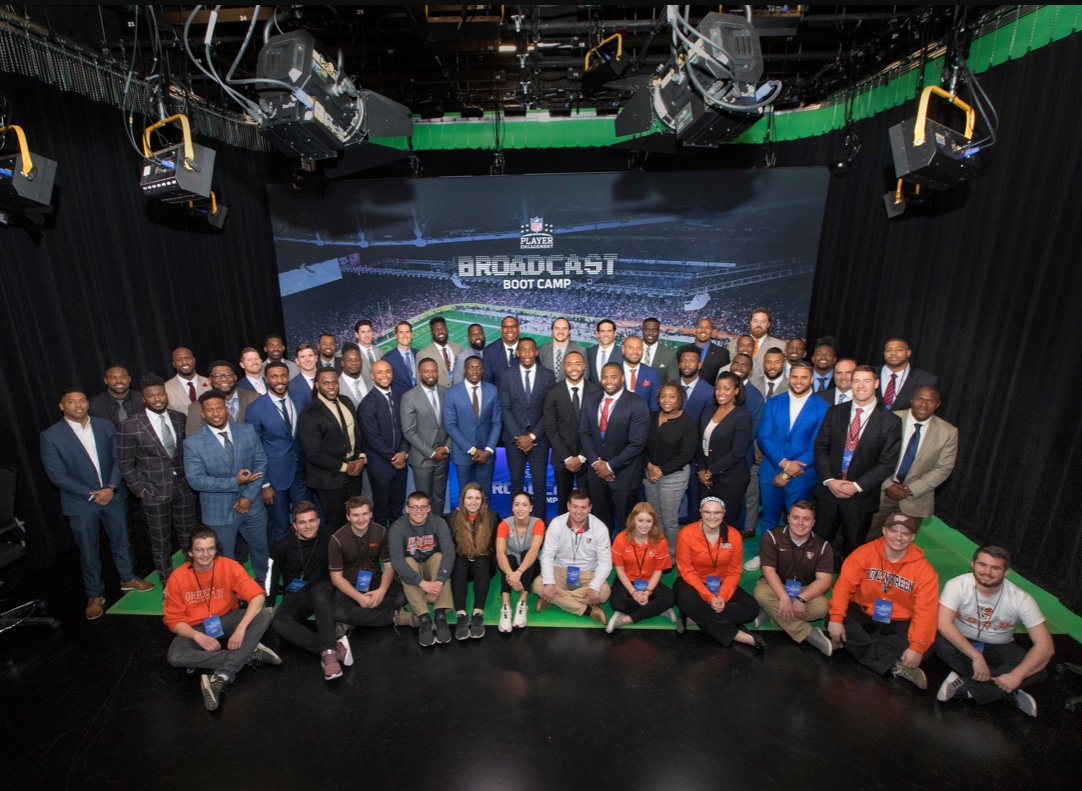
Earlier in April, I had the opportunity to be a student ambassador for the NFL Broadcast Boot Camp. For three days, I guided current and former NFL players around BGSU’s campus where they were trained in different aspects of sport media. During this time, I was able to observe some of the unique simulations that occurred in our facilities. The different types of training included TV studio and radio recordings, discussions about fair coverage, and analytical approaches that can be used with the newest technology.

For me, one of the biggest takeaways from this week was the demand for simplicity from the NFL’s representatives. All 39 players in attendance know that game inside and out, so they were instructed to explain everything in a way “a smart 5th grader” would understand. Early in the week, several players used the technical terms for coverages and routes, which would not be understood by the common viewer. As the week progressed, the players improved in this aspect and began speaking in a way that is normally heard on the NFL’s television or radio broadcasts.

Another thing that stood out to me was the kindness of everyone involved. There were 39 players, some who will continue playing next season, and some who may have an appearance in Canton in their future. There were countless NFL media members, including some of the biggest producers and hosts in the business. Regardless of their status, each person treated me and the rest of the BGSU students and faculty with respect, often smiling and thanking us for our help. Some went as far as introducing themselves, despite being so recognizable they needed no introduction. They asked questions about my background, experiences, and goals, and seemed genuinely interested in what I wanted to do in the future.

On the final day, I spoke with many players about our shared love for sports and our shared interest in the media. Despite wildly different backgrounds, we were all on the early stages of a similar career path. We all have a goal to work somewhere in sport media and the Broadcast Boot Camp provided some very valuable experiences as we progress towards our goals. Overall, this was one of the most informative and fulfilling experiences of my career, and I am very thankful BGSU and the Maxwell Media Watch was able to provide me with this opportunity.

Social Media and the NFL Draft

By Christopher Kyler

April 2, 2019

Christopher Kyler is a first-year undergraduate student at Bowling Green State University. He plans to major in Sport Management with a minor in Marketing. Christopher is from Parma Heights, Ohio and is a diehard Cleveland sports fan. He is interested in many sports, but mainly football at the professional level.

Draft

Less than a month away from the NFL Draft and Twitter is buzzing with all the rumors, pro day performances, and opinions from fans, reporters, and even players. The rise of social media has drastically changed how fans, teams, and prospects consume the annual NFL Draft process. Media at local and national levels are both very involved in the analysis of prospects down to every microscopic detail they can find.

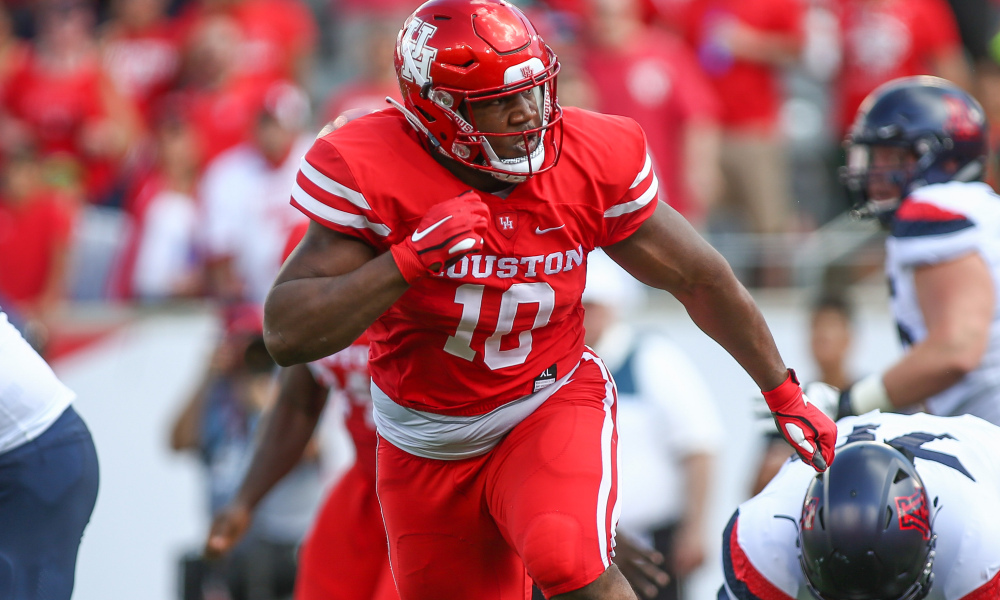
Last Thursday the University of Houston had their Pro day, where top prospect Ed Oliver had a stellar performance. At 6’2” 287 he ran a 4.73 40-yard dash (Maya, 2019); within hours, news of his impressive performance spread like wildfire all over Twitter. The rise of social media sites such as Twitter, Facebook, Instagram, and Reddit has spurred many avid fans to pursue the small name prospects their team just has to have.

EdOliver.jpg

Ed Oliver, the former Houston Cougar, stuffed the run, and padded his resume in his three seasons with the team. He tallied 192 tackles, 53 for loss, 13.5 sacks, 11 pass deflections, and 5 forced fumbles while mainly playing from the nose tackle spot (“Ed Oliver,” 2019). His name has been in headlines since he committed to Houston as the #4 prospect on the ESPN 300. This is one example of a top prospect going to a smaller name school, without having to drop a lot of exposure he received. Social media also helps smaller school prospects with easily being able to share their highlights, which helps get their name out there.

The NFL Draft isn’t new to small school talents going in the first round, and this year won’t be any different. But social media has made it possible for many prospects to have the possibility for it to happen to them. Access to more prospects than ever before has given NFL fans a greater awareness of prospects in every corner of college football.

References:

Ed Oliver College Stats. (n.d). College Football @ Sports-reference.com. Retrieved from  https://www.sports-reference.com/cfb/players/ed-oliver-2.html

Maya, A. (2019, March 28th). Houston Cougars’ Ed Oliver turns in prolific pro day. NFL.com. Retrieved from http://www.nfl.com/news/story/0ap3000001024644/article/houston-cougars-ed-oliver-turns-in-prolific-pro-day

ESPN Football Recruitment – Player Rankings. 2016 ESPN 300. (n.d). ESPN. Retrieved from http://www.espn.com/college-sports/football/recruiting/playerrankings/_/view/rn300/sort/rank/class/2016

What Does Harper Deal Mean for MLB and Other Leagues?

By Drew Gallagher

March 18, 2019

Drew Gallagher is a first-year undergraduate student at Bowling Green State University. He is planning to major in Sport Management with a minor in General Business. Drew is a proud native of Aurora, Illinois and is interested in many sports, but focuses primarily on baseball and football at the professional and collegiate levels.

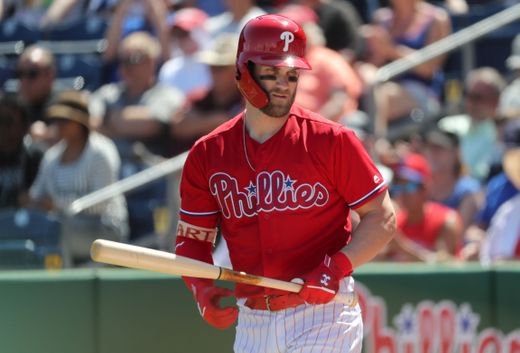
Back on February 28th, the most lucrative free agent contract in North American sports history was agreed upon by Bryce Harper and the Philadelphia Phillies. The deal ended up being worth $330 million over 13 years (Zolecki, 2019). The contract also included stipulations such as no-trade and no opt-out clauses for the 26 year-old outfielder (Zolecki, 2019, para. 5). Now, of course, this is an insane amount of money for any one individual to be making, especially since it is 100% guaranteed.

When you examine the deal individually, you can see that it benefits everyone involved. As Kram (2019) said, “Harper receives the largest contract by total value in U.S. sports history, while the Phillies can spread the payment over more years to reduce the per-year cost” (para. 1). When you examine the deal on the larger scale though, you see that it may be a sign of what’s to come for Major League Baseball. We can predict that deals, at least for star players, will start to become more and more about long-term security in the coming years. This is especially important when you think about the number of young talented players in the game right now who will all become free agents at some point within the next decade.

Many news outlets took this news another route though. Since the NFL is the most popular league in the country, why shouldn’t its players earn as much or more money than MLB players? There are many forms of this argument that we hear frequently since the NFL is infamous for limiting guaranteed money for its players. At the surface, this argument makes complete sense. The players that earn their league more money deserve to be compensated more for their play. But when you look at it from a business standpoint, it becomes apparent why that isn’t the case.

According to Cosentino (2017), “NFL players are far more likely to sustain injuries than those in MLB… the mean number of injuries suffered per game in the NFL is approximately 4.9 times higher than the sum of those other leagues [the MLB, NBA and NHL]” (para. 5). The truth is, such a high risk of injury leads teams to be more reluctant to dole out big money to players. The same can’t be said for baseball since it is rarer that a player suffers a major injury. Baseball is a more long-standing sport with a more influential players union. These two reasons set it apart from the other two major American sports.

It is my guess that the implication of Harper’s contract will extend primarily to MLB as a whole. It does make sense though that media outlets would try to apply it to other sports to make it a more universal topic for their viewers. The truth of the matter is that the sports world is very secular and not much of what happens in one sport will affect another.

References

Cosentino, D. (2017, August 1). Why only the NFL doesn’t guarantee contracts. Deadspin. Retrieved from https://deadspin.com/why-only-the-nfl-doesnt-guarantee-contracts-1797020799

Kram, Z. (2019, February 28). The ripple effect of Bryce Harper’s record-setting Phillies contract. The Ringer. Retrieved from https://www.theringer.com/mlb/2019/2/28/18245294/bryce-harper-philadelphia-phillies-giants-dodgers-yankees-cubs-trout-betts

Zolecki, T. (2019, February 28). Harper, Phils agree to 13-year deal. mlb.com. Retrieved from https://www.mlb.com/news/bryce-harper-deal-with-phillies

Social Media Discoveries Show a Different Story Between Westbrook and Jazz Fans

By David Dietrich

March 15, 2019

On Monday, the Oklahoma City Thunder defeated the Utah Jazz, 98-89. While the showdown between the potential playoff teams was a subject of discussion this week, it was not because of what happened on the court. A video surfaced that showed Thunder guard Russell Westbrook threatening two fans, with very strong language being used. The video can be found below, but there is inappropriate language used throughout.

When asked about his actions, Westbrook defended himself, telling reporters the fan made racially charged comments. “If I had to do it again, I would say the same exact thing, because I truly will stand up for myself, for my family, for my kids, for my wife, for my mom, for my dad every single time” (MacMahon, 2019, para. 5). Westbrook and the fan, Shane Kiesel, had conflicting stories about what was said. Westbrook claimed he was told to “get down on your knees,” (MacMahon, 2019, para. 3) but Kiesel told the media he was yelling “ice those knees,” (MacMahon, 2019, para. 6).

After the game, some of Westbrook’s teammates and opponents came to his defense, saying they heard the offensive comments and wanted to know how they were being protected as players. Westbrook and Jazz fans are no strangers to controversy, with Westbrook being criticized last year for slapping at a fan’s phone after a playoff game. It appeared this event would take the same path, with Westbrook receiving a $25,000 fine from the NBA. However, the discovery of Shane Kiesel’s social media posts completely changed the situation.

Because of the strong content, I will not be sharing links to the posts by Kiesel. I will leave it at this: racial slurs, offensive comments, and blatant disrespect are evident throughout. With this discovery, many came to the defense of Westbrook, such as USA Today’s Nate Scott (2019), who writes “The point guard screaming at the fan isn’t just an immature malcontent, especially when the fan allegedly said something horrible and has a history that appears to show extremely racist and violent thinking” (para. 13). Scott also mentions this is “one of those instances where I am glad we have the internet. Fifteen years ago, we would have labeled Russell Westbrook a problem or worse for what he yelled at a fan on Monday night. Today, we can (more quickly and easily) learn about the fan, and begin to understand and empathize with, if not exactly condone, what Westbrook did” (para. 6).

While Russell Westbrook’s comments were very inappropriate, they were nowhere near the level of offensiveness that Kiesel portrayed on social media. Like Nate Scott mentioned, this is a circumstance that was sorted out largely because of social media. Today, social media, especially Twitter, can be a blessing and a curse. With little to no context, we saw a video of an NBA star yelling profanities at a married couple. It is very easy to make assumptions based on this single video, but we are fortunate more information was brought to light. With news being spread as quickly as possible on social media, it is difficult to see the entire scope of every situation. Thankfully, media members in Utah and Oklahoma City were able to investigate the entirety of the situation. Because of their work, we are now aware that the video portrays NBA star Russell Westbrook standing up for himself against Shane Kiesel, a very racist spectator.

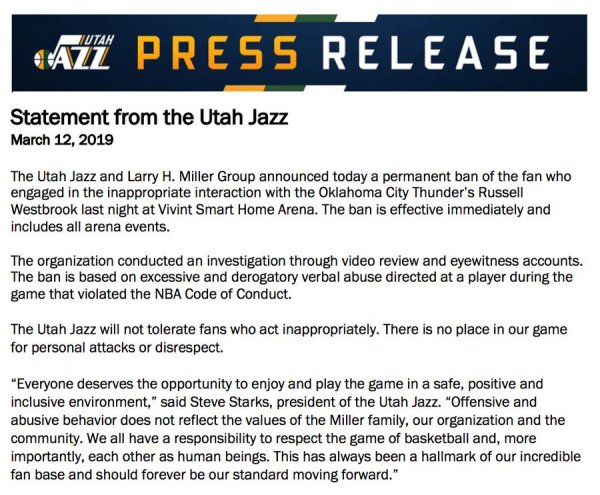
Note: The picture below is a screenshot of a statement from the Utah Jazz, which permanently banned Shane Kiesel from attending any events held in the Vivant Smart Home Arena.

Jazz statement

References

MacMahon, T. (2019, March 12). Russell Westbrook threatens courtside fan, fan’s wife. ESPN.com. Retrieved from http://www.espn.com/nba/story/_/id/26234619/westbrook-threatens-courtside-fan-fan-wife

Scott, N. (2019, March 12). Russell Westbrook threatened a Jazz fan, but then we learned about the fan. USAToday.com. Retrieved from https://ftw.usatoday.com/2019/03/russell-westbrook-jazz?utm_source=ftw&utm_medium=recirc&utm_campaign=rail-most-popular

utahjazz. (2019, March 12). A Statement from the Utah Jazz. Twitter.com. Retrieved from https://twitter.com/utahjazz/status/1105570407598321664

Woodyard, E. (2019, March 11). Things get heated between Russell Westbrook and Jazz fans again. Twitter.com. Retrieved from https://twitter.com/E_Woodyard/status/1105297381384368128