Category Archives: Women Athletes

A Deep Dive on Kim Mulkey

Mulkey points to the crowd, acknowledging their support. 

By: Lily Smith

Lily Smith is a first-year undergraduate at BGSU from Oregon, Ohio. She is majoring in Sport Management with a Marketing minor. 

March 30, 2024

Kimberly Duane Mulkey was born May 17, 1962 in the days of John F. Kennedy’s presidency. Kim was born in Santa Ana, California, but raised in Tickfaw, Louisiana. Growing up as one of the first girls to play organized boys’ basketball, she was predicted to be a star. This was proven by Hammond High School winning four state championships, led by Kim herself. This success foreshadowed her future playing and coaching careers. 

Many people have a lot of opinions about Mulkey, her coaching style, her political stances, and even her fashion choices. There is a lot to be said about all of these things, and I want to dive deeper into these choices and the reasons behind them, while also providing a history of this influential women’s basketball icon. 

History

Mulkey during her time at Louisiana Tech.

Kim’s persona didn’t start out being characterized by sparkles, ruffles, and hot pink. Her collegiate career was spent at Louisiana Tech University. Standing at just 5 ft 4 in, often with her hair in braids as pictured above, Mulkey made a name for herself as a point guard. During her college career, she earned the title of All-American. Mulkey and the Lady Techsters earned two national championships. In 1981, they claimed the Association for Intercollegiate Athletics for Women (AIAW) championship. They also impressively gained the title of national champions of the inaugural National Collegiate Athletic Association (NCAA) tournament in 1982. Her accomplishments as a player led her to win the first women’s Frances Pomeroy Naismith Award (top college senior under 5 ft 6 in) in 1984. 

Mulkey poses in her Team USA uniform.

In 1983, Kim was selected to play for Team USA at the Pan American Games in Venezuela. She also played for the Jones Cup in Taipei during 1984, as well at the Olympics in Los Angeles that year as well. During her Olympic run, she averaged 5.3 points per game, and claimed the gold medal.

After her international playing stint, Kim returned to her alma mater, Louisiana Tech as an assistant coach to the women’s team. Later, in 1996, she was promoted to associate head coach under Leon Barmore. During her coaching tenure, the Lady Techsters reached seven Final Fours, had a 430-68 record, and clinched the 1988 NCAA Championship. Mulkey stayed with Louisiana Tech until 2000 when she took over as head coach at Baylor. The previous year, the Lady Bears had gone 7-20 and finished last in the Big 12.

Mulkey coaching at Baylor.

Kim’s takeover at Baylor was truly noteworthy. In her first season, Baylor had their first ever NCAA tournament bid. In 2005, Baylor took down Michigan State for the NCAA title. This feat crowned Mulkey as the first woman to have won an NCAA Division I title as a player and head coach. Years later, in 2012, the Lady Bears achieved a perfect season, going 40-0, the highest number of wins in a single season in college basketball history, women or men. That same season, Baylor took home the NCAA championship yet again.

Controversy

Mulkey with Baylor and WNBA star, Brittney Griner.

During Kim’s glorious reign at Baylor, there were some things going on behind the scenes. Mulkey was very critical of her star player, Brittney Griner. Since then, Griner has seen her own controversies, but she still stands as a women’s basketball icon. She is an openly gay black woman. However, during her time at Baylor under Mulkey things were a bit different.

Griner was reportedly forced to hide her sexuality, and even other things like her tattoos. She was not allowed to speak freely, and had to wear sleeves underneath her jersey. Griner did not feel comfortable coming out to her coach or her peers because there was kind of a “Baylor standard,” and this kind of thing would not be allowed. Later on, Kim was asked if she had ever had a gay player on her team and Kim responded, “Don’t ask me that. I don’t ask that. I don’t think it’s anybody’s business. Whoever you are. I don’t care to know that.”

Understandably, everyone involved in this situation was getting criticism. In a sense, Mulkey was trying to suppress her athlete’s lives. Which in some cases is alright to do, because those athletes are there to play their sport, but they are people, too. Everyone deserves to be known and allowed to express themselves, inherently, as a human.

Being smack dab in the middle of the Bible Belt comes with some challenges for people of color and queer people. Women also hold a different position in society as well, taking place in a more traditional way. Forbes has an article diving into the standards of southern women. You could be an astronaut, but you had to keep dinner on the table for your family. The whole goal is “serve” God properly, and to not be too “out-there,” wear “too-little” or clothing that is “too distracting,” you can be “pretty” but you can’t be overly confident, and of course you “can’t” be a tom-boy.

Tom-boy or hyper-feminine?

Historically, taking the position of a basketball coach, or any coach in the sport industry is easier if you are a male. Therefore, it is inherently a male-centered career. Any female head coach is a pioneer of the industry, and it comes with some tough battles. “Feminine” women are viewed as not tough, ruthless, or victorious. I believe as in the following source that there is quite an interesting boundary between being a female and being an athlete.

Throughout history, women did not typically become athletes especially in sports that required speed, strength, and agility. Think back to the first modern Olympic games in 1896, there were only male competitors. Right now, close your eyes and think about the perfect example of an athlete. Probably not a woman, right? It is probably a well-toned, muscly, oiled-up, big, strong man. Not a woman wearing pink, having long styled hair, wearing makeup, having her nails painted, AND having muscles and other athletic features. This is just not the way society has constructed the ideal athlete.

Now, think about a successful basketball coach. You are probably thinking about an older man, with grey hair, khakis and a sweater vest. This is where Kim Mulkey comes in. A lot of her colleagues, mentors, and former coaches, probably all fit this standard. Still to this day, this is the standard of coaches across all sports, leagues, and ages.

Maybe to combat this kind of male-focused standard, Mulkey feels like she has to hyper-feminize herself to make it known she is a woman. Maybe it is not about female empowerment, but stems from an inner-feeling cultivated in the Bible Belt. She is the perfect example of a Southern woman on paper; she just happens to also be a championship winning basketball coach.

Mulkey is a conventionally attractive woman. Her hair is always perfectly hair-sprayed into place, her makeup is always perfectly done, and her outfits never seem to be too revealing. She is showing off her femininity, and making it known she is a woman. You will never see her wearing sweatpants, a t-shirt, or any sort of comfortable looking clothing or anything that combats her femininity, which would make her more manly looking.

One of Mulkey’s most popular looks.

I personally, like her over-the-top pink, sparkle, feather, ruffle style. I think it’s a statement and if I was in her position I would probably dress a little dramatic. I would get a pink pantsuit and walk into a room full of men. However, I don’t have the idea of a “Southern woman” hanging over my head. I don’t feel as if I have to live up to a certain standard of femininity like she might. I don’t know if my take is right, and it could be that she just likes this style.

There is a lot to be discussed about Kim Mulkey, but I think however you view her, she is an all-round successful woman in the sport industry. She has so many accomplishments and that is nothing to belittle because of the way she dresses. Kim has had her issues, and still continues to have some questionable takes on coaching tactics and politics, and maybe even more that is not in the media. However, all of the female athletes, coaches, and advocates are making way for so many young girls who look up to them, especially during March Madness.
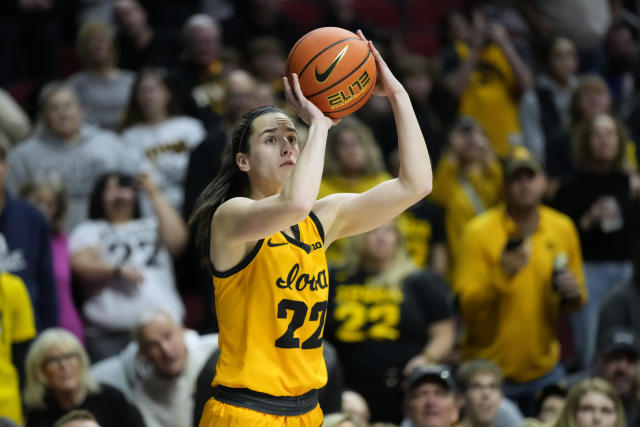
Caitlin Clark shoots to break several scoring records

Caitlin Clark puts up a shot, hoping to break the Division I all-time scoring record.

By Lily Smith

Lily Smith is a first-year undergraduate at BGSU from Oregon, Ohio. She is majoring in Sport Management with a Marketing minor. 

February 14, 2023

Caitlin Clark was just in sixth grade when Iowa head coach, Jan Jensen first recognized her. Clark grew up in West Des Moines, playing on boys’ basketball teams. She was said to have a “sassy 3 pointer” in middle school, and that skill positioned her where she is today. 

Growing up playing girls basketball is a different animal. I personally played, and I can say that there is a different kind of emotion attached to it. The highs are up in the clouds, and the lows, well I’m not even sure where I’d place those. Clark has mentioned that during her early years of play, she would cry after every loss. Undoubtedly, Clark has been criticized for showing these big emotions, even in her college years. 

This emotional tie can be negative in some respects, but it further proves her attachment to her sport and her willingness to work hard. With these attributes, it’s no surprise she is in position to break records. Currently, she sits with 3,520 points, and averages 32.1 points per game. Kelsey Plum of the Las Vegas Aces, holds the record with 3,527 points from her days at Washington. To break the NCAA Division I scoring record, she needs just eight points. On February 15th, the Hawkeyes are set to play Michigan at home, and this is the game predicted to break that record. 

Most recently, Clark snagged the spot of the all-time leading scorer in the Big Ten on January 31st. Clark is also on track to overcome the NCAA’s all-time scorer. This achievement belongs to “Pistol” Pete Maravich who played for Louisiana State University from 1967-1970. Maravich sits with 3,667 points in his Division I career. This 55 year old record is about to be impressively beaten by a female athlete in the near future.

“Pistol” Pete Maravich in a game during his time at LSU. 

Most records between women’s and men’s sports are at different levels. There is just a different level of physicality and ability between the sexes, which proves in athletic records like this. However, Clark is proving that women and women’s sports are just as impressive and high-achieving as men’s sports. There are several sources who are critical of Clark passing Maravich’s record, due to the immense amount of change in the actual sport of basketball, as well as eligibility concerns, claiming that her breaking the men’s record is not quite the same as breaking the women’s.

Either way you view it, that number of points and dedication are not something to look past or discredit. Clark brings a new sense of skill, ability, and motivation to all women, and all sports. Not only has NCAA Women’s Basketball seen an uptick of interest in the past few years, but young girls and women everywhere are opening their eyes to new opportunities. These female athletes are bringing about a new interest and leveling the playing field of women’s and men’s sports as well as their coverage in the media. 

This Is Us: Softball’s walkout that the media missed

By Pershelle Rohrer

October 6, 2020

Pershelle Rohrer is a second-year BGSU student from Logan, Utah. She is a Sport Management major with a minor in Journalism. Her primary sports interests are football, basketball, and baseball, both at the professional and collegiate levels.

On June 22, 2020, the Scrap Yard Dawgs, an independent professional softball team, played the first of what was supposed to be a seven-game series against Florida-based USSSA Pride. The game marked the return of softball, as the sport was one of the first to restart from the coronavirus-related shutdown that effectively halted sports in March. The New York Times writer Natalie Weiner (2020) noted, “For a few hours this week, softball had a shot at something it has pursued for decades: the spotlight” (para. 1). The sport did receive attention following the game, but it wasn’t because of the teams’ play on the field. Rather, a mid-game tweet from Scrap Yard’s general manager caused an uproar that led all 18 players and the team’s coaches to walk away from the team (Poe, 2020).

When the players arrived back in the locker room following the game, they were met with screenshots and texts about the tweet. Scrap Yard general manager Connie May posted a photo on Scrap Yard’s Twitter page of the team standing on the field during the national anthem, tagging President Donald Trump’s Twitter handle with the caption, “Hey @realDonaldTrump Pro Fastpitch being played live … Everyone standing for the FLAG!” (Poe, 2020, para. 3). The President has been critical of athletes who kneel for the national anthem in protest of police brutality and racial injustice. The tweet was posted at the height of the Black Lives Matter movement, just shy of a month after the police killing of George Floyd in Minneapolis, Minnesota. The tweet was deleted before the conclusion of the game.

The players quickly identified May as the poster of the tweet and met with her to discuss the issue. May used the phrase “all lives matter” during the meeting, a statement that is often used in opposition to “Black lives matter” in order to disregard the struggles of the Black community to find justice and equality (Weiner, 2020). Kiki Stokes, one of Scrap Yard’s two Black players, walked out of the meeting, and the rest of the team followed (Hays, 2020b).

Players expressed their frustration about the politicization of the post. Pitcher and Olympic gold medalist Cat Osterman said, “We were used as pawns in a political post, and that’s not OK” (Weiner, 2020, para. 9). USSSA Pride player A.J. Andrews emphasized the freedom to express personal political beliefs but opposed speaking for an entire group without consent. “Any statement anyone wants to make regarding the national anthem — it’s their right to take their own personal stand. It’s no one else’s right to take that for them. So to have someone shift that and have it come out in a statement that does not represent you as a person — you feel violated,” she said (Brunt, 2020, para. 9).

The story spread through the players’ social media accounts, which they used to call out Connie May. Aubree Munro and Aubrey Leach both emphasized that “this isn’t us” and stated that they wouldn’t play for Scrap Yard again.

May’s tweet from the Scrap Yard page was a deviation from the norm. Jade Hewitt, a longtime employee of Scrap Yard, managed the team’s social media almost exclusively. It was unusual for anyone else to post to the Scrap Yard accounts, so when May’s tweet was posted, many people assumed that it was written by Hewitt (Hays, 2020a). May’s decision to tweet from the official account not only took away the voices of the players, but also caused Hewitt to receive backlash for something that she did not post (Hays, 2020a).  It was a demonstration of how quickly a social media post can spread and the impact it can have on the image of the individuals involved with its creation.

Hewitt said, “I did not write or post that tweet. It is not what I personally stand for. I stand by our athletes, I stand by our players. And Scrap Yard is no longer an organization that I will be affiliated with” (Hays, 2020a, para. 13).

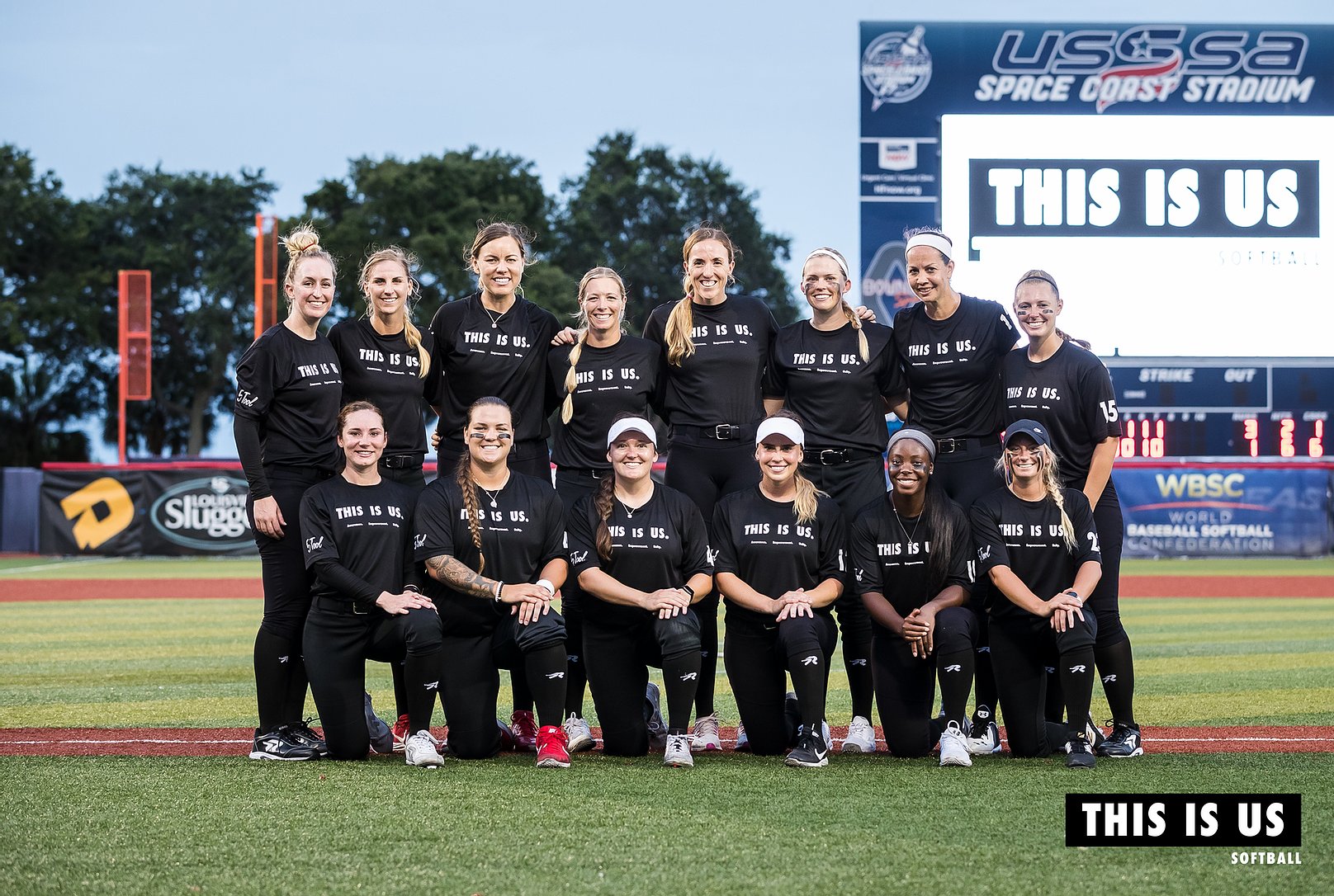
Scrap Yard’s players pledged to never represent the organization again, and many fans and media members assumed that their season was over. However, the players felt that they could continue to make an impact on the field. Yahoo Sports’ Chris Cwik (2020) wrote, “The players may have left the Scrap Yard Dawgs behind, but had no intention of walking away from softball, especially after what happened. So they did the next best thing: They started their own team” (para. 3). The 18 players, 11 of whom are listed on the United States roster for the Tokyo Olympics, rebranded as “This Is Us” with the intention of continuing their series against the USSSA Pride (Poe, 2020). The team developed a mission statement, saying that This Is Us is “here to spark a necessary change in the softball community, gaining and sharing knowledge about racial injustice in our world” (Hays, 2020b, para. 4). 

The team put their words into action following their first game under the new brand. This Is Us defeated the Pride, 3-1, on June 27. Kiki Stokes and Samantha Show took a stand against social injustice by kneeling for the national anthem prior to the contest, and Sam Fischer led a moderated panel discussion on the field following the game. Stokes, Show, Aubree Munro, and Taylor Edwards participated in the discussion about the events of the past week (Rosenberg, 2020).

Media members praised the players of Scrap Yard for making the difficult decision to leave the team behind despite the potential financial insecurity it could cause. The Orlando Sentinel’s Julia Poe (2020) talked about the risk behind the decision, explaining that, “Professional softball is a high-risk, low income sport in the U.S., with players coaching or picking up extra jobs on the side to support their careers” (para. 11). ESPN’s Graham Hays (2020b) wrote that Scrap Yard was one of the most lucrative options for softball players to compete professionally without going overseas to Japan. Natasha Watley, the first Black softball player for team USA, emphasized that, “We’re already getting paid pennies and now we’re going to get paid nothing to stand up for this. That’s how much it matters” (Poe, 2020, para. 14).

Despite the potential financial issues the walkout could cause, Cat Osterman explained that the decision to rebrand was easy. “We’re not going to tolerate that in our sport. It wasn’t as hard of a decision as everyone thinks it was, because we knew it was the right thing to do,” she said (Weiner, 2020, para. 20).

This Is Us played through donations and fundraising before Smash It Sports helped sponsor the team. USSSA helped provide uniforms for the team and planned on hosting the team for at least 20 games against the Pride with the season ending on July 24 (Rosenberg, 2020). However, the season was cancelled on July 8 after just five games due to This Is Us being exposed to COVID-19 (Hays, 2020c). 

While This Is Us didn’t have the opportunity to finish their season, their story was covered by national news outlets such as the New York Times and Associated Press (Rosenberg, 2020). However, sports media, particularly ESPN, had little to no coverage of the series of events. Graham Hays was the only ESPN writer to cover This Is Us, writing three articles about their journey from quitting Scrap Yard to the rebrand to the season’s cancellation. ESPN’s social media accounts do not have any coverage of this story. Social media plays a major influence in fans’ perceptions of sports, and ESPN’s lack of coverage could be a cause of This Is Us’ story remaining virtually unknown in the sports world three months later. Yahoo Sports’ Chris Cwik, Softball America’s Benjamin Rosenberg, and Sports Illustrated’s Jenna West also released stories about This Is Us, but it remains unknown how much more coverage an entire team’s disaffiliation would have received if it occurred in a more popular sport. 

The rebranding of the Scrap Yard players into This Is Us helped inspire change in a predominantly white sport. “Playing would be really powerful, taking that control back that was taken away from us,” This Is Us player Sam Fischer noted (Hays, 2020b, para. 8). That goal should be considered a success, as the softball world united behind the 18 players who walked out and supported them on their goal for achieving racial equality. Although their season was short, This Is Us looks to continue to fight for social justice in 2021 and beyond.

References

Aubree_Munro1. (2020, June 22). Tonight we were misrepresented by Connie May who acted on behalf of @ScrapYardFP I’m appalled by the insentivity & will not represent Scrap Yard ever again. I’m so sorry to all my friends & teammates and the future softball players that are hurt by this. [Tweet]. Retrieved from https://twitter.com/Aubree_Munro1/status/1275247782648053760?s=20

aubrey_lynne10. (2020, June 22). THIS ISN’T US! What has happened was incredibly inconsiderate, we do not condone, and will no longer be supporting @ScrapYardFP due to the actions taken behind our backs. This season was ment to be something special, to be a light in the darkness. [Tweet]. Retrieved from https://twitter.com/aubrey_lynne10/status/1275239965862002692?s=20

aubrey_lynne10. (2020, June 22). [Statement following Connie May tweet] [Tweet]. Retrieved from https://twitter.com/aubrey_lynne10/status/1275245355995664384?s=20

Brunt, C. (2020, June 25). Pro softball team suffers fallout after GM’s anthem tweet. Associated Press. https://apnews.com/article/b624cbde1bff8817ee8a112646f5322e

Cwik, C. (2020, June 26). How a Donald Trump tweet controversy inspired pro softball players to speak out and form a new team. Yahoo! Entertainment. https://www.yahoo.com/entertainment/how-a-donald-trump-tweet-controversy-inspired-pro-softball-players-to-stand-up-and-form-a-new-team-191245388.html

Hays, G. (2020a, June 23). Scrap Yard Dawgs softball players walk out after GM’s tweet about national anthem. ESPN. https://www.espn.com/olympics/softball/story/_/id/29353915/scrap-yard-dawgs-softball-players-walk-gm-tweet-national-anthem

Hays, G. (2020b, June 27). Ex-Scrap Yard softball players return to form This Is Us team. ESPN. https://www.espn.com/olympics/softball/story/_/id/29372544/ex-scrap-yard-softball-players-return-form-us-team

Hays, G. (2020c, July 8). ‘This Is Us’ all-star softball team cancels season 2 weeks after launch. ESPN. https://www.espn.com/olympics/softball/story/_/id/29431087/this-us-all-star-softball-team-cancels-season-2-weeks-launch

Poe, J. (2020, June 29). This Is Us softball team formed in response to Donald Trump anthem tweet. Orlando Sentinel. https://www.orlandosentinel.com/sports/os-sp-softball-this-is-us-anthem-donald-trump-20200630-qaoyfr4oxfd57b5wowelpjzjr4-story.html

Rosenberg, B. (2020, July 6). This Is Us Softball hopes to continue fight for racial justice. Softball America. https://www.softballamerica.com/stories/this-is-us-softball-hopes-to-continue-fight-for-racial-justice/

Weiner, N. (2020, June 24). A softball team’s tweet to Trump leads players to quit mid-series. New York Times. https://www.nytimes.com/2020/06/24/sports/scrap-yard-softball-anthem-tweet.html

Media Spreads the Word about Jazz Matthews

By Dr. Nancy E. Spencer

February 19, 2019

The entries that we post on Maxwell Media Watch typically focus on critiques of the media with suggestions for how they could do better. This post will be different since it recognizes the outstanding work of several area media outlets that have shared the story of a former BGSU student and basketball stand-out. Thanks to a story that appeared in the Toledo Blade (Briggs, 2019) and another that was broadcast on WTOL (Paley, 2019), tens of thousands of dollars have been raised in support of a woman who needs a miracle.

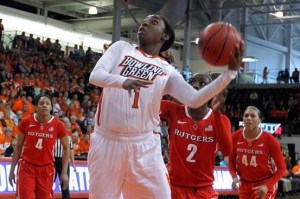
If you follow BGSU Women’s Basketball, you may be familiar with Jasmine Matthews (Jazz), who played on the team from 2011-2015. The Toledo Blade writer David Briggs (2019) described her as “the picture of athletic grace, a sweet-shooting guard for the Bowling Green women’s basketball team” (para. 1).

Jazz was a Sport Management major as an undergraduate and decided to continue her education by pursuing a Master’s degree in Sport Administration. I was fortunate to have Jasmine in my classes as both an undergraduate student and as her graduate adviser.

I vividly remember the day that Jazz told me what she decided to do for her Master’s Project. She had been talking to her godfather (Gerald) who was the head coach at Trinity Valley Community College in Texas. Gerald knew that Jazz had been contemplating a career in coaching after she finished her master’s program.

But he had a better idea.

“Officiating.”

At first, Jazz was skeptical about the suggestion. But as Gerald talked to her more, he began to convince her that her training and knowledge of the game, plus her fitness made her a prime candidate to succeed as a basketball official. She could get experience at an entry level, and if she did well, she could eventually advance to Division I women’s basketball.

Once she was convinced, Jasmine pursued the idea with all the vigor of a motivated athlete who suddenly sees the big picture and trains hard to prepare for the biggest game of her life. Better yet, her godfather’s suggestion gave her an idea for what she could do for her Master’s Project.

As Jazz filled me in on what she wanted to do with the rest of her life, she explained how it related to her idea for a final project. She wanted to write about her experiences in becoming an official. We discussed the idea of doing an autoethnography, which would enable her to integrate her personal experiences with literature about her potential career path. She even found an autoethnography by another woman who had played basketball in college – Claire Schaeperkoetter (2016), whose article on “Basketball officiating as a gendered arena” became the template for her to examine and reflect upon her own experiences.

In December 2016, Jasmine completed her project and received her Master’s degree.

A year later, she was diagnosed with MS, “multiple sclerosis… the insidious disease with no cure that attacks the nerve cells in the brain and spinal cord” (Briggs, 2019, para. 6). Within three weeks, she had lost everything, and was completely disabled (Paley, 2019).

Jazz has made progress in fighting the disease, but she needs support to take the next step in her journey. Thanks to a doctor who lives near her home, Dr. Richard Burt, she is a candidate for “the use of stem cell transplants to treat” her (Briggs, 2019, para. 15). But the treatment is expensive and her insurance does not cover it. Therefore, Jazz set up a GoFundMe page on Facebook to raise the $125,000 needed for the treatment. Nearly $60,000 in donations have already been contributed by 790 people, as of this writing.

Jasmine’s dream to become a basketball official is still alive. She concluded her interview on WTOL by saying, “Once I get my life back I plan on being a Division I official, referee” (Paley, 2019, para. 14).

Jazz has only begun to write her story, and I cannot wait to read the next chapter!

Briggs, D. (2019, February 12). As a former BG player hopes for a ‘miracle,’ a basketball community rallies. The Toledo Blade. Retrieved from https://www.toledoblade.com/sports/bgsu/2019/02/12/former-bowling-green-falcons-player-jasmine-matthews-battles-multiple-sclerosis/stories/20190212137

Paley, T. (2019, February 12). Community donated thousands to former BGSU basketball player with MS. WTOL.com. Retrieved from http://www.wtol.com/2019/02/12/community-donates-thousands-former-bgsu-basketball-player-with-ms/

Schaeperkoetter, C. (2016). Basketball officiating as a gendered arena: An autoethnography. Sport Management Review, 128-141.

The WNBA’s Low Pay in the Age of Social Media

By Bre Moorer

For the past couple of months, WNBA stars have been more outspoken than usual about the pay gap.  Or maybe they have always shared their thoughts, but did not get as much attention as they are getting now.  It could be because they can just type their thoughts out in 140 characters or less and simply hit a button that shows their message to millions of people.  That has been an option for years, but why are the fed up women of the professional basketball league seemingly being heard now more than ever?  With the help of social media, specifically Twitter, the low salaries in the WNBA are back in the spotlight this summer, but this time it feels different.

To get the discussion started this time around, Skylar Diggins-Smith of the Dallas Wings appeared on ESPN’s Get Up on May 28th to address the issue with Jalen Rose and Michelle Beadle.  Jalen directed his frustration toward the NBA by saying they need to do a better job of “dedicating resources to help promote” the women’s league since the WNBA is a “subsidiary of the NBA.”  While Diggins-Smith did not flat out agree with Jalen’s point about the NBA being responsible for WNBA players not getting paid as much, she did bring up the fact that “it’s all about exposure.”  In the same breath, the fearless leader of the Dallas Wings also mentioned social platforms should be better utilized.  She recommended showing more games on Twitter.  The South Bend legend’s comments inspired her peers to express themselves without regret.

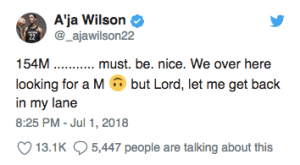
In the wake of LeBron James signing a 4-year deal with the Los Angeles Lakers for a whopping $153.3 million, rookie sensation A’ja Wilson of the Las Vegas Aces took to Twitter to “congratulate” King James.

While some Twitter users backed Wilson, most users bombarded the 1st overall pick in the 2018 draft with reasons as to why they think she should get back in her lane.  One person said ratings are too low for the women hoopers to get more money, to which Wilson responded it is more than just viewings.  A couple of users tweeted that if she was as good as LeBron, then she would earn more.  The power forward laughed at those tweets for the most part, but she did say to one troll that bench players in the NBA get paid more than starters in the WNBA – eliminating the arguments that the pay gap is about skill set.  Perhaps the most popular argument against the WNBA getting paid more is the NBA bringing in more revenue than the WNBA.  The 2017 NCAA champion had a response for that too.  She said that the NBA gets more of a percentage of the revenue they bring in than the women so it is still unfair regardless of how much revenue is brought in.  Wilson spent a whole weekend defeating Internet trolls in the beginning of July. She ended her run by hoping that the men in her mentions had daughters who want to play basketball so that they can grasp where she is coming from.  She was “glad to stir the pot.”

This past weekend, NBA superstar Damian Lillard watched A’ja Wilson’s Las Vegas Aces and the Connecticut Sun work.  He was obviously impressed by what he saw and backed Wilson’s call for equal pay.  By the end of the game, a video of Lillard revealing his thoughts on the lack of respect WNBA players get was trending on Twitter.

In Lillard’s opinion, the women as individuals should be treated as the pros they are as far as salaries go and their league deserves to be exalted.  Having someone like Damian Lillard, who is a 3-time NBA All-Star, could start a trend of NBA players speaking up in support of WNBA players getting paid more.

After all is said and done, the WNBA is in need of support and exposure in order for its players to get what they deserve in the first place – more money.  As long as the women continue to use their platforms and their male counterparts actively show their love for the WNBA, the future looks bright for equal pay between the NBA and WNBA.

Dear Maya

Dear Maya,

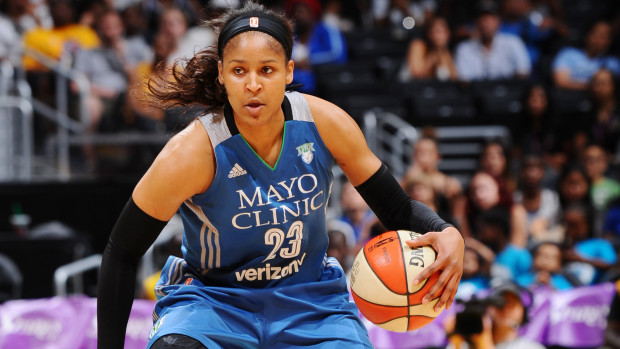
Thank you. Thank you for being an inspiration. It goes deeper than basketball. I could talk all day about your career accolades. The rings, the stats, the awards. I could go on for days about it. But you already know that. As one of my favorite athletes, you have always captivated me with your abilities on the court. You represent something much more than basketball to me.

You’re hope. I think one of the most impactful things I’ve ever experienced was a sport and gender class last year. I learned so much more about the plight of the woman athlete. It was truly eye-opening, but it also made me more conscious than ever about what people say. I see the nasty things people say on message boards and comments. The Internet provides people the space to do so anonymously and without consequence. Yet you press on. It’s bigger than that.

I see the impact of representation. Your Jordan commercial was something to behold. The wave of kids you inspired from using your platform in such a way is uniquely special. Count myself in as well. I see visions of a world being shaped by our current-day athletes that will allow me to tell my children they can do anything. That nothing can hold them back. As athletes, whether you think it’s fair, you all have an enormous reach. I want to thank you for being a great role model.

I wrote an article a while back [See: “Why can’t I buy a WNBA jersey?” on this site]. I was griping about not being able to purchase your jersey that day. I should have been a bit more patient as the next day it was available on the team store. However, I am a man of my word. Today, I’ll be rocking one of my favorite player’s threads seeing her play for the first time in person. Please try not to give out too many buckets today against the Sky. They are still my hometown team.

You’re a walking legend. On and off the court. And for that, I thank you.

Sincerely,

Don Collins