Category Archives: Tennis

Lines of Life

Caption: Bobby Riggs hits a backhand while linesperson Betsy Blaney looks on.

By Betsy Blaney

Betsy Blaney is retired and lives in Lubbock, Texas. She spent about 20 years as a tennis professional before becoming a journalist. She worked for The Associated Press and the Lubbock affiliate of NPR during her 29 years in journalism. Now she teaches tennis to kids, plays a lot of Pickleball and volunteers with a local hospice.

September 16, 2023

I was a ball girl for her in the 60s.

I (remarkably) called lines for her in the 70s.

I played her and her partner in doubles in the 1980s.

And, as a newspaper and wire service journalist, I wrote two first-person anniversary pieces (in the 1990s and the 2000s) from my unique, on-court vantage point for her triumph over Bobby Riggs.*

It’s an understatement to say that Billie Jean King has been a steady part of my life’s timeline as a tennis player and a journalist. My serve and volley game is a direct result of watching her play in Milwaukee in the early years of my tennis playing.

No one I knew foresaw the long-lasting implications of the Battle of the Sexes match in Houston’s Astrodome on Sept. 20, 1973.

I sure didn’t. I was a somewhat meek 19-year-old – living in Dallas and learning how to teach tennis – who lucked into calling lines on the historic match.  And I will always remember her circling back near my chair to tell me I’d blown a call on Riggs’ serve. It wasn’t a pretty admonishment.

The influence she’s had in my life, in the lives of millions of women – athletes of all sports and just generally – can’t be quantified. 

As the match anniversary approaches, it’s important to remember she is also responsible for women receiving equal prize money at the four Grand Slam tournaments. The first Grand Slam was the 1973 US Open, which recently honored her and 50 years of her efforts to elevate women in all arenas. 

I had the great good fortune of taking in the entire fortnight of Wimbledon this year. I was nearby the media building one day and spotted Billie Jean. I approached her, shook her hand as I re-introduced myself to her. She remembered the supposed blown call and our two interviews for the anniversary pieces. I just wanted to wish her a happy 80th birthday in November. She wished me the same for my 70th next spring.

It was a nice bookend to how our paths have crossed since I ran after tennis balls as she played the Virginia Slims tournament in Milwaukee 60 years ago.

*Note: Another article entitled Line Judge Turned Reporter, by Brooke Sjoberg, appeared in the Texas Standard: The National Daily News Show of Texas on September 20, 2018.

Media Hits and Misses At Indian Wells

By Dr. Jacquelyn Cuneen

This is part of an ongoing series of guest posts by those in academia and in the professional world of sport. This week’s post is written by Dr. Jacquelyn Cuneen, Ph.D, a former Sport Management Professor at Bowling Green State University.

Usually, tennis news is just like other sports news — who won the games, how they won the games, who rivals who, who dominates, and when do they play again. Except, quite often, an age-old dispute emerges from tennis that causes us to revisit a new version of an old controversy. Sexism!

The BNP Paribas Open — Indian Wells — is a premier stop on both the women’s and men’s tennis tours. The tournament is greatly respected by players, fans, and media, and it is so prestigious that Indian Wells may one day be granted Grand Slam status. Thus, all the top players compete, global media cover the matches from start to finish, and fans set attendance records each year. In other words, the tournament itself is news. However, from the very start to the very finish of 2016’s event, the global media had much more to cover than matches when sexism, tennis’ recurring nemesis, once again intruded. And while the media devoted more than ample coverage to the major stories, they missed some critical undercurrents.

Opening day brought the Maria Sharapova doping scandal. The world number 11 had for ten years been using mildronate, a drug prescribed primarily for angina and other cardiac-related ills. Since January, the drug has been banned by the World Anti-Doping Agency because among its effects is an increase in blood flow which can enhance athletic performance. Sharapova apparently missed the agency directive sent to all players in December 2015 that announced this newly banned drug; she tested positive for mildronate and was disqualified from playing at Indian Wells. The media, particularly Tennis Channel and ESPN, doggedly analyzed Sharapova’s performances and discussed advantages she may have gained from using mildronate. Commentators also, but with less ceremony, listed those Sharapova sponsors that deserted her very quickly upon the breaking news.

With such comprehensive coverage of Sharapova’s predicament, what possible undercurrent could the media have missed and how did it relate to Sharapova’s drug use and sponsorships? In a word: Nike!

Nike was one of the first of many sponsors (e.g., Tag Heuer, Evian, Avon, Porsche) to run for cover when news of Sharapova’s failed drug test was made public. So, what undercurrent did the media miss related to Nike and why do Nike’s repudiations relate to sexism? In a word, Tiger.

Think back to the 2009 holiday season when news broke about Woods’ numerous extramarital affairs. His sponsors did not abandon him immediately, but within a matter of weeks, Woods, like Sharapova, lost many sponsors (e.g., Tag Heuer, Gatorade, Gillette, Buick) but not Nike. Nike continued their association with Woods, lasting to this day.

Where were the media to ask questions related to Nike’s sponsorship decisions? Why did they not note the undercurrent and ask Nike about the rationale that fueled their loyalty to Woods, but did not extend it to Sharapova? Is it even thinkable that taking a performance-enhancing drug “inadvertently” (as claimed by Sharapova) is worse than serial infidelity, when many golf and tennis fans would find both to be repugnant? Only Nike knows their reasons for deserting Sharapova; no one else knows because the media did not inquire about it. Fans in a discerning world might like to know how a company with a 2017 target of realizing $7 billion in women’s spending — which will constitute 20% of their total annual revenues — can make such a questionable and possibly gender-biased decision.

Closing day brought the Ray Moore scandal. Moore was a professional player of little note and no consequence between 1968 and 1983, but gained notability as one of the founders and eventual chief executive officer of the Indian Wells tournament. At a breakfast meeting prior to the women’s final match, Moore expressed his beliefs that, among other things, women’s players ride the coattails of the men, and if he was a woman player, he would go down on his knees nightly and be thankful that Roger Federer and Rafa Nadal were born because they have carried the game. Media, even non-sports media, covered Moore’s comments in depth. Stories in traditional and posts within modern social media universes expressed outrage and disgust over Moore’s archaic ideals. So, what undercurrents did the media miss in the Moore disgrace? In a word, men!

Not only were Moore’s insults obviously degrading and dismissive to those women players who rank among the best athletes in history, his opinion about Federer and Nadal carrying the game is an insult to the other men on the tour. Federer, and particularly Nadal of late, are not carrying the game and they never actually did. While they may have been among the most visible of recent players, plenty of others have dominated tournaments as well. Why did the media not seek opinions from champions such as Andy Murray, Novak Djokovic, and Stan Wawrinka who have dominated Federer and Nadal for the past few years. Moore’s comments were not just offensive to the women players. His version of sexism offended every player regardless of gender, except Federer and Nadal.

Moore learned the consequences of antiquated ignorance expressed in a modern world within three days of the tournaments’ conclusion. He resigned as Indian Wells’ CEO, and as the controversy is ongoing, it is the media’s obligation to discover the reasons for his retreat. Could Moore not face the personal significance of his comments or was his resignation forced by inside and outside sources? It would be nice to know that story.

A final thought for consideration: Ray Moore played on the men’s professional tennis tour for 15 years.  In that time, he managed to win eight doubles titles, none of them a major, playing with 16 different partners. This was during the tennis boom of King, Evert, Laver, and Connors. It was the era when dedicated tennis beat reporters emerged and media coverage of the game flourished. Yet, few besides the most faithful of tennis aficionados heard of Ray Moore then or now … speaking of riding coattails.

More Controversy at Indian Wells

By Dr. Nancy E. Spencer

Venus and Serena Williams’ return to Indian Wells was supposed to close the book on a controversy that occurred in 2001. They faced a racist incident that was a painful memory for them and a blemish on the tournament. In 2016, Serena hoped to write a new chapter by advancing to the Women’s Singles final where she faced Victoria Azarenka. Their matches had always been close and promised to provide a storybook ending to this new chapter. While the final score did not end in Serena’s favor (Vika won 6-4, 6-4), a new controversy emerged as a result of sexist comments made by Ray Moore, the tournament’s director and CEO. Before the Men’s Singles final, Moore was asked how the men’s (ATP) and women’s tours (WTA) compared. He replied by calling  “the WTA a bunch of lucky coattail-ridin’ dummies who have the men to thank for their continued existence” (Redford, 2016, para. 1). But he didn’t stop there, adding, “If I was a lady player, I’d go down every night on my knees and thank God that Roger Federer and Rafa Nadal were born, because they have carried this sport. They really have” (Redford, para. 2).

In the press conference following her match, Serena was asked to comment on Moore’s statements. She began by saying, “I think Venus, myself, a number of players have been — if I could tell you every day how many people say they don’t watch tennis unless they’re watching myself or my sister, I couldn’t even bring up that number. So I don’t think that is a very accurate statement” (Dator, 2016, para. 4).

Asked further if she was surprised that sexist statements are still brought up, Serena replied: “Yeah, I’m still surprised, especially with me and Venus and all the other women on the tour that’s done well. Last year the women’s final at the US Open sold out well before the men. I’m sorry, did Roger play in that final or Rafa or any man play in that final that was sold out before the men’s final? I think not ” (Dator, 2016, para. 5).

Serena also referred to the history of progress that began with Billie Jean King whose “Battle of the Sexes” victory over Bobby Riggs has been credited with advancing the cause of all women in sport. In fact, Billie Jean also played an integral role in securing equal prize money for women at the U.S. Open in 1973 (D’Cunha, 2016). As Serena pointed out, “in order to make a comment you have to have history and you have to have facts and you have to know things. You have to know of everything. I mean, you look at someone like Billie Jean King who opened so many doors for not only women’s players but women athletes in general” (Dator, 2016, para. 6).

King herself played during the same era as Ray Moore when professional tennis was in its infancy. During that era, the ratio between men’s and women’s earnings was often as disparate as 11:1 (BJ King, personal communication, February 24, 1999). Billie Jean responded to Moore’s comments on Twitter saying she was: “Disappointed in comments. He is wrong on so many levels. Every player, especially the top players, contribute to our success.”

Chris Kermode, CEO of the Association of Tennis Professionals (ATP), the governing body of men’s professional tennis agreed with King in describing “Ray Moore’s comments towards women’s tennis” as “disappointing” (Rycroft, 2016, para. 5). Adding that the comments were “made in poor taste,” Kermode stated that, “The ATP fully supports equality across society, while at the same time acknowledging that we operate in the sports [and] entertainment business” (Rycroft, 2016, para. 5).

Unfortunately, Kermode’s comments are unlikely to carry as much weight as earlier statements made by the Men’s Singles winner and world No. 1 Novak Djokovic, who said after winning his match yesterday: “I think that our men’s tennis world, ATP world, should fight for more, because the stats are showing that we have much more spectators on the men’s tennis matches. I think that’s one of the reasons why maybe we should get awarded more” (D’Cunha, 2016, para. 15). There is an underlying problem with comments by both Moore and Djokovic, as D’Cunha (2016) pointed out, in that they “are indicative of the general disregard for women’s tennis by their male counterparts” (para. 18).

If there is any consolation it is the outpouring of support for women’s tennis that was expressed on Twitter and in other articles. Hopefully, women’s tennis (and all women’s sports) will continue the legacy begun by Billie Jean King, Gladys Heldman, the “Original Nine” and current WTA players. They’re not riding anybody’s coat tails!!

Note: According to reports on Twitter as of March 21, Raymond Moore has resigned as Tournament Director and CEO at Indian Wells. Perhaps, on this 10th anniversary of Twitter, it is fitting that the social media site played a key role in disseminating news of this controversy so quickly.

References

Dator, J. (2016, March 20). Serena Williams sends powerful message to Indian Wells CEO over sexist comments. SB Nation. Retrieved from http://www.sbnation.com/2016/3/20/11273222/serena-williams-press-conference-sexist-comments-indian-wells-ceo

D’Cunha, Z. (2016, March 21). Raymond Moore, Novak Djokovic, and the blatant disregard for women’s tennis by the men in sport. Firstpost.com. Retrieved from http://www.firstpost.com/sports/raymond-moore-novak-djokovics-comments-not-only-sexist-but-also-show-disregard-for-womens-tennis-2688386.html?utm_source=dlvr.it&utm_medium=twitter

Redford, P. (2016, March 20). Indian Wells CEO Raymond Moore has some bad and dumb thoughts on Women’s Tennis. Deadspin. Retrieved from http://deadspin.com/indian-wells-ceo-raymond-moore-has-some-bad-and-dumb-th-1766048378

Rycroft, R. (2016, March 21). ATP’s Chris Kermode responds to Raymond Moore’s controversial comments on WTA. Sportsgecko.com. Retrieved from http://sportsgecko.com/atps-chris-kermode-responds-to-raymond-moores-controversial-comments-on-wta/

 

A Sad Chapter Ends… or Does It?

By Dr. Nancy E. Spencer

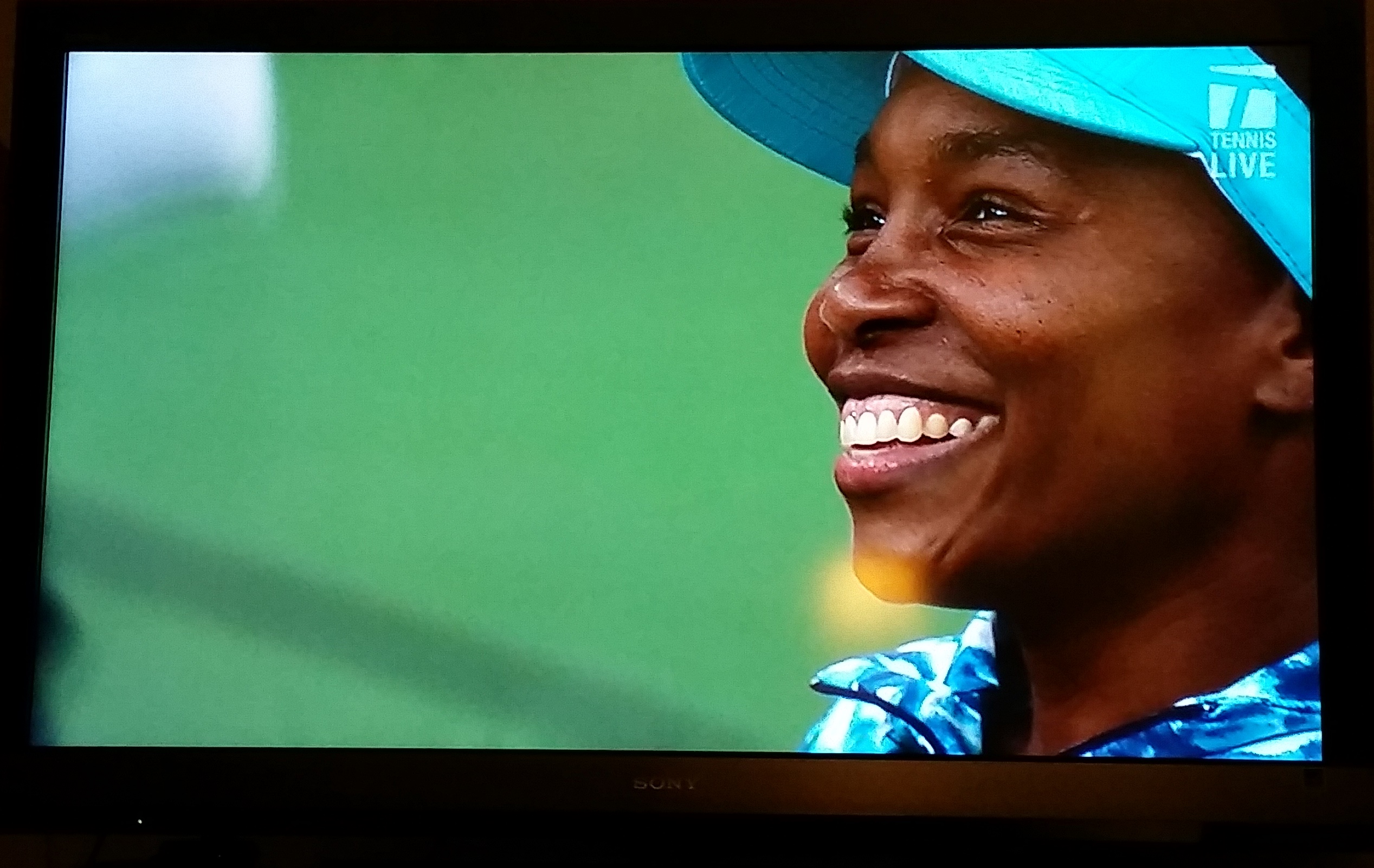
On Friday, March 11, 2016, Venus Williams made her return to Indian Wells, facing Japan’s Kurumi Mara in a first-round singles match. It had been 15 years since Venus last played in the tournament, and she received a warm welcome as reflected by her broad smile in the photo below.?

In March 2001, when Venus last appeared at Indian Wells, she was scheduled to meet her sister Serena in the semifinals. As it was reported by most media sources, Venus defaulted just moments before she was to have played Serena. Tennis writer Joel Drucker (2009), wrote that “four minutes before her match against Serena, Venus pull(ed) out with tendinitis. Players usually notify officials that they will be unable to compete at least 30 minutes before a match so organizers can make contingency plans” (para. 13).

Serena related a different version of this story in her autobiography, where she wrote that during Venus’ quarter-final match against Elena Dementieva, she was dehydrated and started to cramp; she also hurt her knee and questioned whether she would be able to play in the semifinals against Serena (Williams & Paisner, 2009). On the morning of their scheduled semifinal, “Venus checked in with the tour trainer and told him she didn’t think she could play” (Williams & Paisner, 2009, p. 64). According to the rules, the trainer needed to give his approval before Venus could officially withdraw. The trainer was then supposed to consult with the tournament director who would typically schedule another match in its place. [This part is confirmed by Drucker’s statement above].

Checking in with tour officials was an especially important step since Venus and Serena were scheduled to play on live TV (on ESPN) before a crowd that eagerly anticipated the “rare tennis treat” (2001, p. 3C) of seeing the sisters play each other for only the sixth time in their professional careers. There was clearly a lot riding on whether or not Venus and Serena played that match. Yet, according to Serena, the trainer “kept telling Venus to hold off on making any kind of final decision” (Williams & Paisner, 2009, p. 65).

Two hours before the match was slated to begin, Venus again told officials that she would not be able to play, but still no announcement was made that she was withdrawing. It was not until five minutes before the match was to start that a tournament official finally “announced to the packed stadium that Venus was withdrawing due to injury” (Williams & Paisner, 2009, p. 67). Needless to say, the timing of the announcement could not have been worse and fans unleashed their anger toward Venus since she was made to appear as the culprit who withdrew at the last minute.

Two days after Venus’ default in the semifinals, Serena played in the final against the Belgian Kim Clijsters. When Venus and her father entered the Stadium to watch the final, fans responded by booing vociferously. Richard Williams proclaimed that a dozen fans in the stands used racial slurs and one fan yelled that he would “skin him alive” (Smith, 2001, p. 3C). According to some sources, fans were upset not only because of the late default, but also because they had the impression that Richard, was responsible for orchestrating the outcomes of their matches. Dementieva, whom Venus defeated in the quarterfinals, had even suggested in her press conference that she thought their father Richard would decide who would win their semifinal match (Drucker, 2009). A headline in the National Enquirer also suggested that Richard ordered Serena to lose to Venus in the 2000 Wimbledon semifinals. This further fueled the impression of match-fixing.

Aside from such accusations about match-fixing, there has never been any concrete evidence to confirm that this is anything more than speculation. In fact, Bart McGuire who was then CEO of the WTA Tour, issued a statement on March 16, 2001, saying that “The tour is aware of the assertions being circulated regarding Venus and Serena Williams’ head-to-head matches. We have seen no evidence to support those assertions, and both players have denied them” (Drucker, 2009, para. 29).

On March 23, 2001, Venus addressed the role of the press in fueling the story about what happened at Indian Wells. When asked about the crowd’s response at Indian Wells, Venus said that she didn’t always understand the press, but she understood that they wanted a big story and they were “interested in selling papers” (Drucker, 2009, para. 49).Indian Wells’ Tournament Director Charlie Pasarell addressed the question posed to Venus about whether it was unfair of the crowd to respond as they did. Pasarell reported that he cringed “when all that stuff was going on,” adding that “it was unfair for the crowd to do that” (Drucker, 2009, para. 51).

At the beginning of Drucker’s (2009) article, the editor noted that “the controversy surrounding Venus and Serena Williams’ decision not to play at Indian Wells has been composed of rumors, conjecture and  confusing comments about racism and match fixing” (para. 1). While it may be difficult to make sense of all that has been reported and recorded by the press about Indian Wells over the last 15 years, what happened there in 2001 was enough to make the Williams’ sisters decide not to play in the tournament for the past 14-15 years. I vividly remember watching that match and was embarrassed by the vitriol spewed toward Venus, Serena and their father Richard. I have always understood their decision not to play at Indian Wells. While I applaud their willingness to forgive and move on, I question if that chapter is truly over if we have not fully addressed the underlying impulse for the crowd’s (mis)behavior at Indian Wells in 2001.

References

Drucker, J. (2009, March 11). What happened at Indian Wells? ESPN.com. Retrieved from http://espn.go.com/sports/tennis/columns/story?id=3952939&columnist=drucker_joel

Rare tennis treat: Williams vs. Williams. (2001, March 15). USA Today, p. 1C.

Smith, D. (2001, March 26). Williams decries fans as racist. USA Today, p. 3C.

Williams, S., & Paisner, D. (2009). On the line. New York, NY: Grand Central Publishing.

Serena Williams: The Return to Indian Wells (Part I)

This post comes from, Bowling Green State University Sport Management Professor and Maxwell Media Watch faculty advisor, Dr. Nancy Spencer.

By Dr. Nancy Spencer

March 2, 2015

On March 13, 2001, I sat in front of my TV, eagerly awaiting the sixth match that Venus and Serena Williams were to play against one another in a professional tennis tournament. The tournament was at Indian Wells, a small affluent desert community in California that was home to many retirees from the entertainment world.

About five minutes before the match was to begin, an ESPN announcer reported that there would be no live match since Venus Williams had ‘just’ defaulted. The announcement was made in front of a packed stadium of angry fans that proceeded to boo loudly. They felt like they had been robbed.

Unlike in team sports, when a superstar fails to play on a given date, the game goes on. LeBron and Kyrie may not have played against the Indiana Pacers on Friday night, but the Cleveland Cavaliers still played. There may have been different match-ups, and fans may have been disappointed that they did not get to see Kyrie and LeBron, but they still got to see a meaningful game. When someone defaults in tennis – especially in the semifinals or finals, a substitute can step in to play an exhibition match, but it is not a meaningful match.

Unfortunately, for the Williams sisters, Venus’ default coincided with published reports (albeit in the National Enquirer) that their father, Richard, may have fixed their most recent match-up in the semifinals of the 2000 Wimbledon. Venus won that match and advanced to win her first Wimbledon title. The report (in the National Enquirer) was enough to fuel speculation that perhaps Richard Williams had fixed this match. There has never been proof to substantiate that or any other allegation, even though Venus and Serena Williams have made it clear repeatedly that it was difficult for them to play one another (since they are sisters as well as best friends).

Two days later, Serena met Kim Clijsters in the finals at Indian Wells. She could not have anticipated the boisterous environment she would encounter. Even as she was introduced and again, when her father and Venus entered the stadium, fans booed vociferously.

In response, Richard raised his fist, evoking the symbolism displayed by Tommie Smith and John Carlos at the 1968 Olympics. Fans continued to boo Serena throughout the match, even when she hit winners and even at the end when she remarkably managed to come from behind to win in three sets. Later, Richard reported that he heard racist comments, including one fan who claimed that he was lucky it wasn’t 1975, or he would ‘skin him alive’ (Smith, 2001, p. 3C). The response from tournament director Charlie Pasarell was that those weren’t Indian Wells fans (Smith, 2001). That seemed a curious statement to make and certainly did not justify the unruly behavior in my book.

My immediate response to watching ‘tennis fans behaving badly’ was that racism in tennis was now visible for the whole world to see – except that this was Indian Wells, not the U.S. Open or Wimbledon, where the whole world would have been watching.

And this was before Twitter and social media would have quickly spread the news. In 2009, Serena’s autobiography was published, containing a chapter on ‘The fiery darts at Indian Wells.’ That was the first I learned Serena’s version of what happened in 2001 (in her own words) (Williams & Paisner, 2009). That was when I discovered that Venus had injured her knee during her quarterfinal match against Elena Dementieva.

On the morning of the semifinal, Venus checked in with the trainer, informing him that she didn’t think she would be able to play. What should have happened at that point was that an announcement of Venus’ withdrawal should have been made and another match should have been scheduled for the Stadium. But it wasn’t – for whatever reason. As a result, when Venus defaulted, it appeared that she made the call at the last minute and fans made the Williams’ sisters the scapegoats.

In her autobiography, Serena details the devastating impact of the fans’ behavior that she and Venus faced at Indian Wells in 2001. Because of that behavior, Venus and Serena determined not to return to Indian Wells since 2001… until this year… Serena is returning to Indian Wells.

Next week: Part II – Serena’s Return: How it Happened/What it Means

Go back

Your message has been sent

Warning
Warning
Warning
Warning

Warning.

Mad Man At Courtside

This is part of an ongoing series of guest posts by those in academia and in the professional world of sport. This week’s post is written Dr. Jacquelyn Cuneen, a retired Professor of Sport Management at Bowling Green State University. 

Viewers of the Emmy winning AMC series Mad Men are taken back to the 1960’s in America — an era of stringent social order when all individuals were branded by gender conformity. Even the most unattractive of males were able to swagger as if they were Frank Sinatra and even the brightest of females were expected to sashay as if they were Marilyn Monroe. Sport, of course, was the domain of males. Females were tolerated in certain “gender appropriate” activities (see Eleanor Metheny’s essay on Connotations of Movement in Sport), and women in some of those sports (e.g., golf, tennis, bowling) were starting to establish their place in athletics.

The Olympic Games provided the biggest stages for 1960’s athletes who happened to be female and some of the most visible athletes at both the summer and winter games were women from the former Soviet Bloc countries. The Soviet women were particularly dominant in track and field. They were highly trained, highly fit, very serious, and very muscular. Their appearances prompted the American media, particularly the print media, to focus more on the athletes’ bodies rather than their performances. Amid questions related to doping, chromosome testing, and sexuality, the Soviet athletes were chided for being too masculine. In other words, they were too good to be women. And, the collective Ministers of Sport from the Soviet countries were outraged over these insulting questions and accusations.

Fast-forward to half a century later when some of the best and most popular athletes in the world are skilled, strong, forceful, muscular women and the era of Mad Men is far behind — except perhaps in Russia, the principal country of the old Soviet Bloc. In October 2014, Russian tennis official Shamil Tarpischev appeared on his country’s late-night talk show Evening Urgant and, due either to unbelievable ignorance or a dim-witted attempt at comedy, referred to Venus and Serena Williams as The Williams brothers.

The Williams Brothers! Venus, who can walk a fashion runway to rival any Vogue model. Serena, so dazzling that she can walk on to the CBS Late Show set and render host David Letterman speechless. Brothers? What could prompt a coach to refer to such women as brothers? Could it be that, in his Mad Men mind, they are too good and too powerfully built to be women?

It is appalling that the Williams’ or any females who work to reach the top of their sport must hear such comments from their sports’ insiders. It is particularly disconcerting to hear such denigrating remarks from someone who has worked so closely with skilled women and ought to know their capabilities. A person such as Tarpischev, of all people, should know the success that comes to women who are accountable and committed to their sport and prepare themselves for excellence. He behaves like a mad man.

A final word to Shamil: Watch Mad Men and be happy you live in an era when you have accomplished women to coach. Then, get yourself off the talk show circuit, go back on court, leave social commentary to Gloria Steinem, leave comedy to Chelsea Handler, and start coaching better so some of your Russian players can come up to the Williams standard.

Go back

Your message has been sent

Warning
Warning
Warning
Warning

Warning.


What’s So Funny About the “Williams Brothers?”

This is part of an ongoing series of guest posts by those in academia and in the professional world of sport. This week’s post is written by Dr. Nancy Spencer Ph.D, a Sport Management Professor at Bowling Green State University.

On October 13, Shamil Tarpischev, head of the Russian Tennis Federation appeared on a Russian television show (Evening Urgant) with former player Elena Dementieva. During the interview, the host of the show asked Dementieva what it was like to play the Williams’ sisters. Before she could respond, Tarpischev interjected by calling them the ‘Williams’ brothers,’ and describing them as ‘scary.’ Merlisa Lawrence Corbett urged the United States Tennis Association (USTA) and the Women’s Tennis Association (WTA) to respond to the derogatory comments. Several former players Martina Navratilova and Katrina Adams – both now members of the media – also tweeted their disapproval of Tarpischev’s remarks. Martina even called for the ouster of Tarpischev. By the end of the week, heads of both the USTA and WTA had responded to the derogatory comments.

This is clearly not the first time that sexist comments have been made about world-class female athletes such as Venus and Serena Williams or others. When former Wimbledon winner Amelie Mauresmo emerged on the tennis scene in 1999, WTA players Lindsay Davenport and Martina Hingis said it was like playing against a man. In 2013, after Marion Bartoli won the Wimbledon Women’s Singles title, BBC announcer John Inverdale made sexist remarks, suggesting she needed to become a great tennis player since she would never be a ‘looker’ (like Maria Sharapova). And when Baylor University star Britney Griner led her team to the 2012 NCAA Women’s Basketball Championship over Notre Dame, ND Coach Muffet McGraw said it was like playing against a guy, a statement she meant as a compliment.

In 1988, sport sociologist Mike Messner wrote about the dilemma facing women athletes who become so good that they are said to ‘play like men.’ Messner called it a “double-edged” sword. He explained that on one hand, it appears to be a compliment about an individual woman’s skills (indeed, Tarpischev later claimed that was what he meant). On the other hand, the implication is that because she is so good, perhaps she is not a ‘real woman’ after all.

By the end of last week, Stacey Allaster, Chairman and CEO of the WTA announced that Tarpischev would be fined $25,000 (the maximum allowable) and suspended for a year. Allaster also sought to remove Tarpischev from his position as Chairman of the Board for the Kremlin Cup, a position he has held for 18 years. In announcing these sanctions, Allaster said that Tarpischev’s comments were “insulting, demeaning and have absolutely no place in our sport.” She described Venus and Serena Williams as “outstanding human beings, incredible sportswomen, and amazing role models who have done so much to inspire women and girls around the world.”

Meanwhile, Dave Haggerty, the President and CEO of the USTA called on Tarpischev to formally apologize to Venus and Serena. Less than a week after making the initial comments on Russian television, Shamil Tarpischev issued a letter of apology that is now posted on the WTA website. In it, he apologizes for the “insensitive remarks” which he understands “could be construed as discriminatory by the public.”

The USTA and WTA have not always been swift to speak out on behalf of the Williams sisters. When Richard Williams reported that he and his daughters faced racist epithets at Indian Wells in 2001, the tournament director Charlie Pasarell replied that ‘those weren’t Indian Wells people.’ To be fair, that incident occurred before Stacey Allaster or Dave Haggerty were in leadership positions with the WTA and USTA, respectively. In reporting on Serena Williams’ response to Allaster’s fine, the New York Times’ Ben Rothenberg wrote that she “praised the swift and decisive action taken by the WTA.” If Serena can praise the actions of the WTA, that is good enough for me. Hopefully this incident and the swift responses of the WTA and USTA will serve to curb the thoughtless sexist (and racist) comments about female athletes at all levels.

Go back

Your message has been sent

Warning
Warning
Warning
Warning

Warning.