Tag Archives: Billie Jean King

Calling Lines: The 1973 Battle of the Sexes

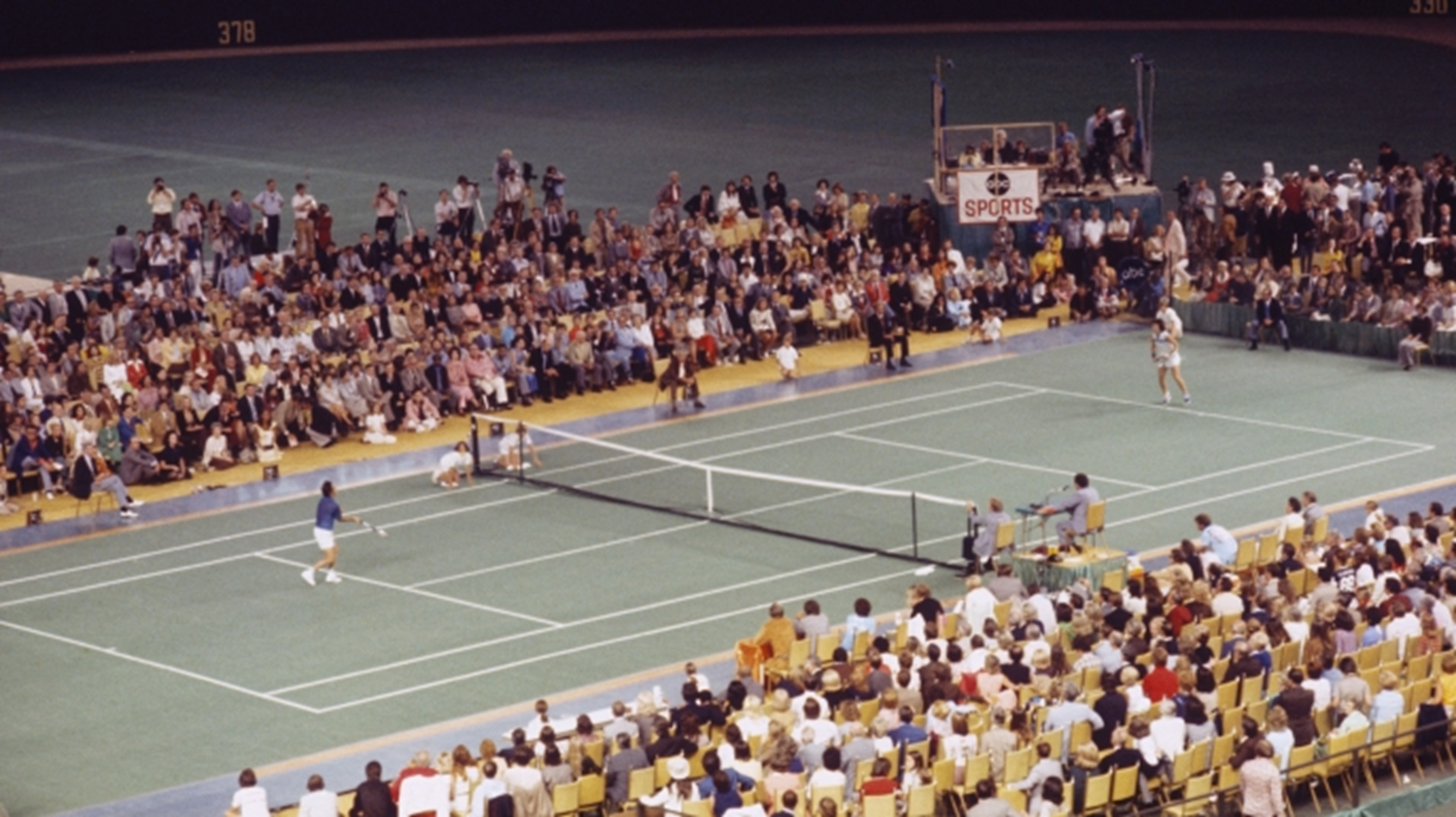
Caption: The ‘Battle of the Sexes’ at the Houston Astrodome featured Bobby Riggs (L) and Billie Jean King (R). The author called the center service line and is seated to the right of King.

By Nancy E. Spencer

Nancy E. Spencer is Professor Emerita in Sport Management and taught in the SM program for 25 years. Before joining the faculty of BGSU’s SM program, Dr. Spencer taught and played tennis professionally. She is currently writing a book on Professional Women’s Tennis, with portions of this article appearing in the Introduction.

September 19, 2023

On September 20, 1973, Billie Jean King and Bobby Riggs played the most famous “Battle of the Sexes” in tennis history. While some thought it a farce to pit an aging former champion (a man) against a woman in the prime of her career, that woman comprehended the gravity of the moment. Ted Tinling, who designed Billie Jean’s dress, believed it was the most important match in women’s tennis history. Ken McAllister, a Texan who called lines for the match, thought it played a big role in kicking off a tennis boom that has not been matched since. An estimated crowd of 30,492 set a record for the largest audience ever to view a live tennis match, as they packed the Houston Astrodome with some paying $100 to sit courtside and drink champagne. The attendance record stood until 2010 when Belgium’s Kim Clijsters played Serena Williams in an exhibition match before 35,681 in Brussels.

In 1973, I was an Assistant Teaching Professional at the H.E.B. (Howard E. Butt) Tennis Center in Corpus Christi, Texas. Several weeks before the match, I received a phone call from Tim Heckler, a teaching pro in Houston and President-elect of the Texas Professional Tennis Association (TPTA). As consultant/director for the King vs. Riggs match, Tim was putting together a crew to umpire and call lines for the ‘Battle of the Sexes’ at the Astrodome. He wanted to secure an equal number of male and female line judges and asked if I would call lines for the match. Initially, I was noncommittal, since I was still reeling from the outcome of an earlier male vs. female match played on Mother’s Day, 1973. That match had featured Bobby Riggs vs. the Australian Margaret Court, although she was not Riggs’ original choice to play such a match.

After Billie Jean King earned more than $100,000 in 1971, Riggs had begun to pester her about playing a winner-take-all match (Lichtenstein, 1974). He was convinced that the best senior man could easily defeat the best woman and it irked him that a woman could make so much money. King was the perfect foil – the outspoken women’s libber pitted against the self-proclaimed male chauvinist pig. When King rejected Riggs’ repeated challenges, he turned to Margaret Court (then the No. 1 ranked woman), who believed she could make an easy $35,000 by playing him. Unfortunately, Court did not realize until it was too late that Riggs was hustling her. After Riggs won easily (6-2, 6-1), the match became known as the “Mother’s Day Massacre.”

Court’s lopsided loss was infuriating to Billie Jean King and other women on the nascent Virginia Slims’ tour. But Margaret’s loss to Bobby was also demoralizing to me and countless other women teaching pros since the outcome undermined our legitimacy. Roberto Chavez, a college player at the University of Corpus Christi, boasted that he could beat me playing left-handed. Of course, he was right-handed… and he was right. After losing to Roberto and witnessing Margaret’s loss, I was none too eager to invest my hopes and/or time in another male vs. female spectacle that could further erode my self-confidence as a teaching professional.

I shared my hesitation with Tim, who countered by telling me the benefits of calling lines. Each linesperson would receive two free tickets to the match plus a pass to go anywhere in the Astrodome. Houston was a 4-hour drive, not that far in light of the geographical expanse of Texas. I reasoned that I could visit friends if I made the trip and agreed to the gig. Later, I wrote to my family, reporting that I had purchased an “outfit with brown-checked pants and brown blouse that was comfortable and just right for being a lineswoman.”

On September 20, I left for Houston before noon, a day that was especially hot – even by Texas standards! Halfway to Houston, I stopped at a dusty gas station where the attendant filled the tank of my 1964 red Plymouth Fury. It cost less than $5 to fill the tank, thanks to the ‘gas wars’ of the early seventies that lowered the price at one point to less than 20 cents a gallon. The attendant asked who I thought would win the ‘big match’ that night. Did he know I would be calling lines? Once again, I was noncommittal, but said I hoped Billie Jean would win.

The linespersons needed to be at the Astrodome by 4:30 p.m. When I arrived, Billie Jean was warming up before a smattering of spectators. In my letter home, I wrote, “We had a meeting of linesmen and women to go over details. They told us that Riggs had agreed not to have any linesmen removed, but Billie Jean hadn’t agreed… so they would comply if she requested” to have someone removed.

Around 6:00 p.m., there was a ‘Pro-celebrity’ Mixed Doubles exhibition featuring singer Andy Williams and his former wife Claudine Longet vs. the game show host Merv Griffin and Sandra Giles. An actor in the mold of Marilyn Monroe, Giles was “Bobby’s starlet girlfriend” (Lichtenstein, 1974, p. 232). I noted that the celebrities “were really nervous and not such experienced players but they… lobbed a lot and moved well in covering the court.” The set lasted just 20 minutes, with Williams and Longet winning 6-1. I called the center service line, but there were no calls for me to make in the exhibition, so “I wasn’t exactly ‘warmed up.’”

We had about 40 minutes after the mixed doubles before we needed to return to our assigned seats, so I spoke with the three other lineswomen. I already knew Betsy Blaney, an assistant pro at Brookhaven Tennis Club in Dallas (Betsy’s article is posted at this link on Maxwell Media Watch). I had played her that spring in the Maureen Connolly Brinker tournament on the USLTA Pro Tour in Dallas, where she beat me 6-4 in the third set. Another lineswoman named Dee Dee Dally had long dark hair and glasses; she traveled on the spring circuit as “a volunteer linesperson” whose expenses were sometimes paid. The fourth woman, Jean, was a friend of Riggs from San Diego, and she said he was not as bad as he sounded. We admitted to each other that we were nervous, knowing that some 40 million people were expected to tune in to the live broadcast on TV.      

Before King and Riggs entered the court, the University of Houston band played, accompanied by dancing clowns. I described the ambiance as “quite a carnival atmosphere.” The ‘carnival-like atmosphere’ was “accompanied by horns, dancers and outrageous costumes in a spectacle worthy of an end-of-times bonanza.” There were plenty of celebrities and movie stars surrounding the court, including George Foreman, Jim Brown, Glen Campbell, JoAnne Pflug, Stefanie Powers, Robert Stack, and Ron Ely (a.k.a., Tarzan). A woman from Corpus Christi who attended the match later gave me copies of her photos that revealed even more celebrities who attended – the recently-wed Lee Majors, the ‘six-million-dollar-man,’ and Farrah Fawcett, who had played tennis at Corpus Christi Ray High School.
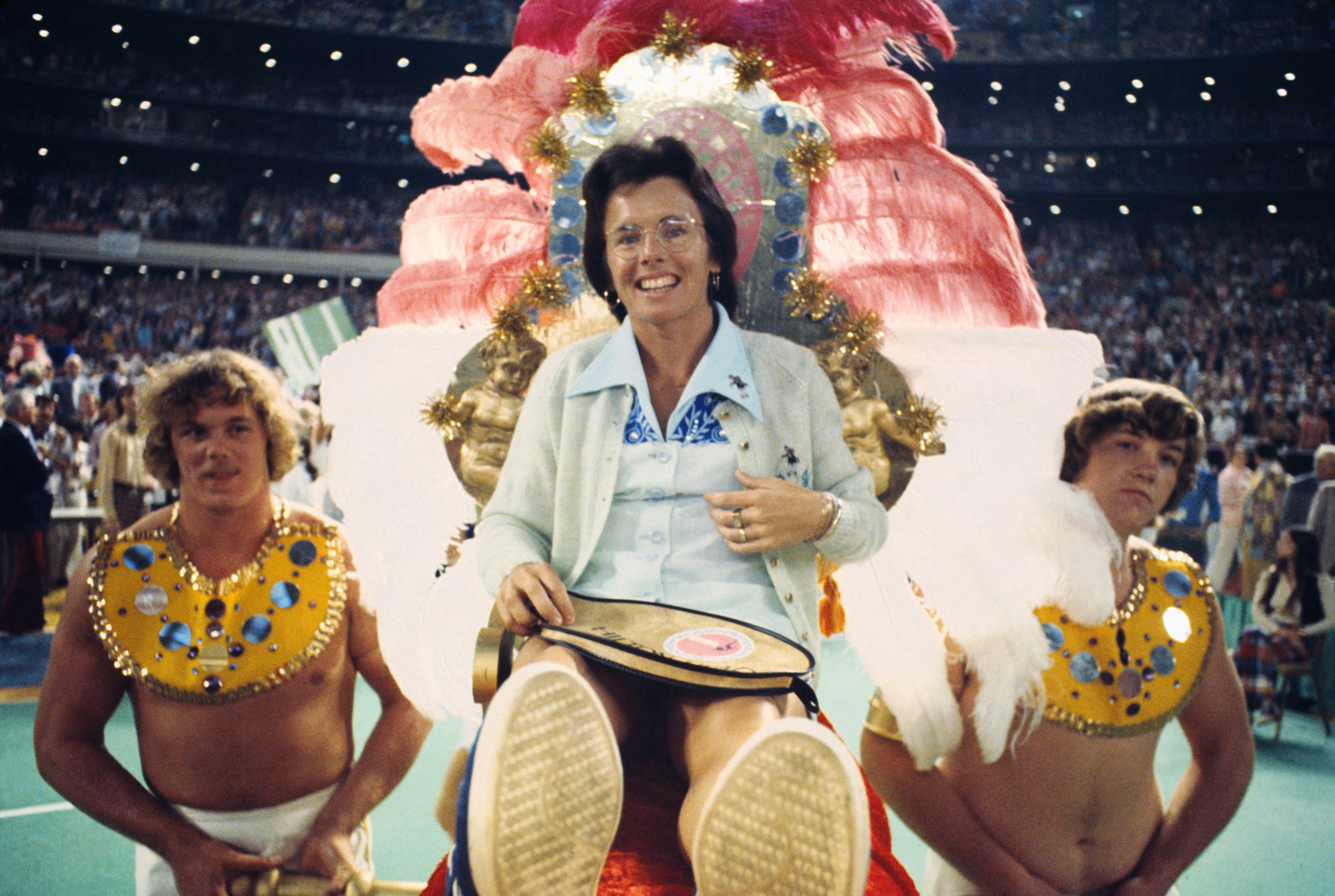
Caption: Billie Jean King escorted onto the court by two of the Rice University athletes.

Coverage of the match described the atmosphere as something “right out of a Cecil B. DeMille movie,” more like a circus than a sporting event. Before the match began, the two protagonists entered the court with a flourish – “Mrs. King came first on a Cleopatra-style gold litter that was held aloft by four muscular track-and-field athletes from nearby Rice University.” Among the toga-clad carriers was “Dave Roberts, one of the world’s finest pole vaulters.”
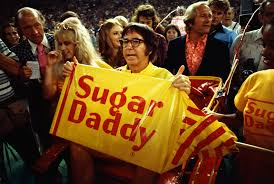
Caption: Bobby Riggs holding Sugar Daddy before gifting it to Billie Jean King. 

Meanwhile, six professional models (dubbed “Bobby’s Bosom Buddies”) wearing tight red and gold outfits transported Bobby Riggs onto the court in a rickshaw with gold wheels (Amdur, 1973). During courtside introductions, Riggs presented King “with a two-foot Sugar Daddy and made a tongue-in-cheek reference to suckers,” while King gifted Riggs with “a squealing baby pig,” a tribute to Riggs’ touting himself as a “Male Chauvinist Pig” (Roberts, 2005, p. 119).

The match between King and Riggs was far different from the one-sided ‘Mother’s Day Affair.’ Billie Jean refused to let Bobby intimidate her. Although I thought Riggs looked helpless from the start, I still was not sure that King would win decisively, especially since Jean had said Riggs might let her win the first set just to make it more interesting. When he double-faulted on set point in the first set, I thought that might be happening.

During the match, I made 5 or 6 line-calls, including 2 serves that hit lines. I can still envision one of Billie Jean’s serves that Bobby questioned after I made my call. King must have served with slice, because for a split-second, I thought it was going to be wide to the left of the deuce court, but the spin made it curve enough to catch the center service line. When the chair umpire looked to me for confirmation, I put my hands out to show that the serve was good. Riggs immediately spun around and looked at me incredulously, questioning my call. Again, I put my hands out parallel to the court to signal that it was good. He shook his head, clearly disagreeing with my call. I was sure that my heart palpitations were loud enough for people seated behind me to hear. 

Fast-forward to 1998, when ESPN aired footage of the Battle of the Sexes. It was the 25th anniversary of the famous match and ESPN’s coverage. It was the first time I had seen the match and it coincided with my first year of teaching the History & Philosophy of Sport class at BGSU. Not only did I get to show the students primary evidence of an event most had never heard of, but also I could give them my first-hand account of being there. I still remember a question that a student, Greg Berkmeier, posed: “Was the match rigged?” I was stunned that someone would even ask! I said then, and again in 2013, when Don Van Natta, Jr. asked me the same question in an interview, that I firmly believed it was not rigged. Based upon his research for ESPN, Van Natta argued that Riggs threw the match.

Later, I came across a quote that provided further evidence to support my initial impression. It was made by one of Bobby’s good friends, Jack Kramer, who wrote in his autobiography, “Billie Jean beat him fair and square” (Kramer & Deford, 1979, p. 87). I can see no reason why someone who hyped the match and put his reputation on the line would proceed to throw the match. If anything, I wondered why no one asked if Margaret Court had thrown the Mother’s Day match against Riggs!

If you never saw the match, or you want to see it again, after all these years, you can see the match in its entirety by clicking here. Tomorrow, Wednesday, September 20, 2023, is the 50th anniversary of the celebrated match.

Caption: Billie Jean King lifts trophy for winning the storied Battle of the Sexes over Bobby Riggs, 6-4, 6-3, 6-3.

References

Amdur, N. (1973, September 21). Mrs. King defeats Riggs, 6-4, 6-3, 6-3, amid a circus atmosphere. The New York Times, pp. 1, 31.

Lichtenstein, G. (1974). A long way, baby: Behind the scenes in women’s pro tennis. New York, NY: William Morrow & Company.

Outlaw, A. (2010, July 9). Kim Clijsters, Serena Williams draw record crowd in Belgium. TennisNow.com. http://www.tennisnow.com/News/Kim-Clijsters,-Serena-Williams-Draw-Record-Crowd-I.aspx

Roberts, S. (2005). A necessary spectacle: Billie Jean King, Bobby Riggs, and the tennis match that leveled the game. New York, NY: Crown.

Tinling, T. (1983). Sixty years in tennis.  London: Sidgwick & Jackson.

Van Natta, Jr., D. (2013, August 25). The match maker. ESPN.com. http://www.espn.com/espn/feature/story/_/id/9589625/the-match-maker
The “Summer of Coco” Culminates with 2023 U.S. Open Title

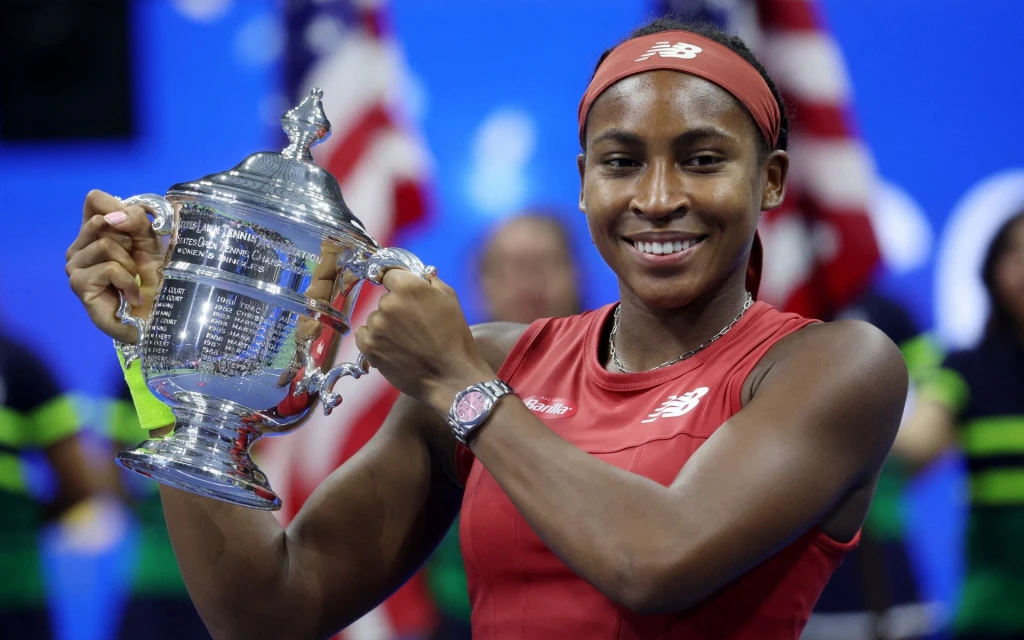
Caption: 19-year-old Coco Gauff captures first Grand Slam title at 2023 U.S. Open

By Nancy E. Spencer

Nancy E. Spencer is Professor Emerita in Sport Management, having taught in the SM program for 25 years. After competing and teaching tennis professionally for over 25 years, she went to graduate school at the University of Illinois to become a sport sociologist. Her research focuses on professional women’s tennis.

September 11, 2023 [updated: September 12, 2023]

Five years after playing in her first professional tournament, 19-year-old Coco Gauff had the tournament of a lifetime at the 2023 U.S. Open, where she won her first Grand Slam title. She became the youngest player to win a Grand Slam tournament since Serena Williams did so in 1999. She credited Venus and Serena for inspiring her – showing her that a Black player could reach the top. After winning the match, she reminisced about attending the U.S. Open when she was 8-years old.

How did she go from being that excited dancing little 8-year old girl to a 19-year old Grand Slam winner? Read on.

It was Coco’s father who took her to the U.S. Open when she was 8, and she credited him for being there, coaching her until recently when she added Pere Riba as her coach and Brad Gilbert as a consultant.

In 2017, at age 13, Gauff signed a contract with Team 8 to play professionally. Team 8 was a sport agency founded by Tony Godsick (husband of former U.S. player Mary Joe Fernandez) and his former client Roger Federer. The 20-year-old newcomer Ben Shelton is another player who signed as a client with the agency. Coco had to wait until she was 14 to play in her first event, the $25,000 Osprey tournament near her home in Florida. There she won three qualifying matches to advance to the main draw, where she got her first win as a pro by beating Moldavian Alexandra Perper, 6-2, 6-3.

Caption: Coco Gauff turns pro after winning 2018 Orange Bowl title.

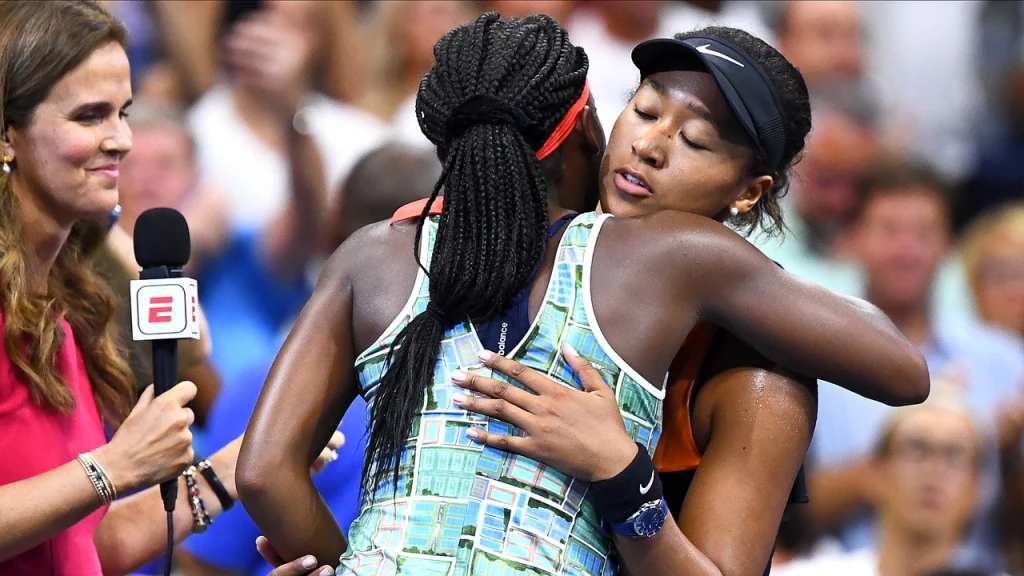
In 2019, I caught my first glimpse of Coco at the U.S. Open, thanks to my Illinois friend and fellow grad student, Jessie Daw who had an extra ticket. The player I most wanted to see was Coco, who had won her first match at Wimbledon against none other than Venus Williams earlier that summer. My favorite photo from the 2019 Open shows Naomi Osaka hugging Coco after beating her 6-3, 6-0 in the third round. While Coco’s lopsided loss left her in tears, Naomi hugged her, told her it was okay to cry, and invited her to join in the post-match interview with Mary Joe Fernandez. That moment has since gone viral.

August 31, 2019 – Coco Gauff and Naomi Osaka speak after their match at the 2019 US Open. (Photo by Garrett Ellwood/USTA)

In Coco’s first year as a pro, her talent and determination suggested that she could become the new face of American women’s tennis.

Fast forward to 2023, when Coco dominated play during the summer. In the intervening years, Gauff had continued to show signs of promise, although some wondered if she would ever realize her full potential. By the 2023 season, she had won three WTA singles titles, had reached the 2022 French Open final to climb to a top 10 ranking, and also reached the world No. 1 ranking in doubles. Some called 2023 the “summer of Coco.” Expectations could not have been higher for her entering the US Open.

Besides her string of victories, Coco brought something else to the 2023 US Open – a new perspective on life that enabled her to deal with the pressure of expectations. On a sign at the entry way to Arthur Ashe Stadium there is a quote that says: ‘Pressure is a privilege;’ it is the title of a book by Billie Jean King.

When Coco was asked about how she dealt with pressure to win the Open, she said she knew life brought a number of different kinds of pressure, adding “There are people struggling to feed their families… People who don’t know where their next meal is going to come from, people who have to pay their bills. That’s real pressure, that’s real hardship, that’s real life.” As a professional tennis player, Coco recognized that she was privileged, that she was paid to do what she loves and has been supported for it. And that is something she no longer takes for granted.

Coco would need her new outlook to persevere through her draw at the U.S. Open. In the first round, she outlasted her German opponent, Laura Siegemund, in a match that Coco later described as “slow!’ Siegemund regularly used the full 25 seconds on the serve clock before serving. Gauff eventually addressed the official in the chair, saying that it wasn’t fair that Siegemund often went beyond 25 seconds without a warning from the umpire. It was the first time that I can remember Coco voicing a complaint to an official during a match. Given the partisan nature of the US Open crowd, fans began cheering Laura’s errors. After the match, Siegemund criticized the crowd for their partisanship.

In her next 6 matches, Gauff would be pushed to 3 sets by Elise Mertens (3rd round), Caroline Wozniacki (4th round) and Aryna Sabalenka (final). She also had to endure a 50-minute delay in her semifinal against Karolina Muchova when 4 protesters wearing shirts that read “End fossil fuels” were escorted out of the stadium. Three protesters left without further incident. It took longer for the fourth person who had glued their bare feet to the concrete, meaning that “NYPD and medical personnel were needed in order to safely remove this individual from the stadium.”

Entering the final, second-seeded Aryna Sabalenka was the clear favorite and was about to become the World No. 1 since Iga Swiatek lost earlier in the tournament. But Coco seemed to have momentum going into the match. In the first set, Sabalenka came out firing on all cylinders, outhitting her young opponent and making few unforced errors. Aryna is arguably the hardest hitter on the women’s tour and brings an intimidating presence to her play. However, Coco later disclosed that she had practiced against an American player, Chris Eubanks, who had advanced to the Wimbledon quarterfinals earlier in the summer. She acknowledged that he helped her to deal with Sabalenka’s pace. But Sabalenka’s power, placements, and consistency were too much for Gauff in the first set, which Sabalenka won 6-2.

After going down 2-0 in the second set, Gauff slowly climbed back into the match. As she began retrieving more of her opponent’s hard-hit placements, Sabalenka started pressing and making more errors. Coco won 6 of the next 7 games to take the second set, 6-3. The match would go to a third and Coco was beginning to feel the momentum with the crowd enthusiastically supporting her.

In the third set, Gauff showed her determination and concentration by pulling out to a 4-0 lead before Sabalenka could get a game. Even then, Coco kept the pressure on to take the set 6-2 and win the match on her first match point. Afterwards Coco laid on the court, in obvious relief and joy, before rising to embrace her opponent at the net, and celebrating her hard-fought victory with her parents, coaches and fans.

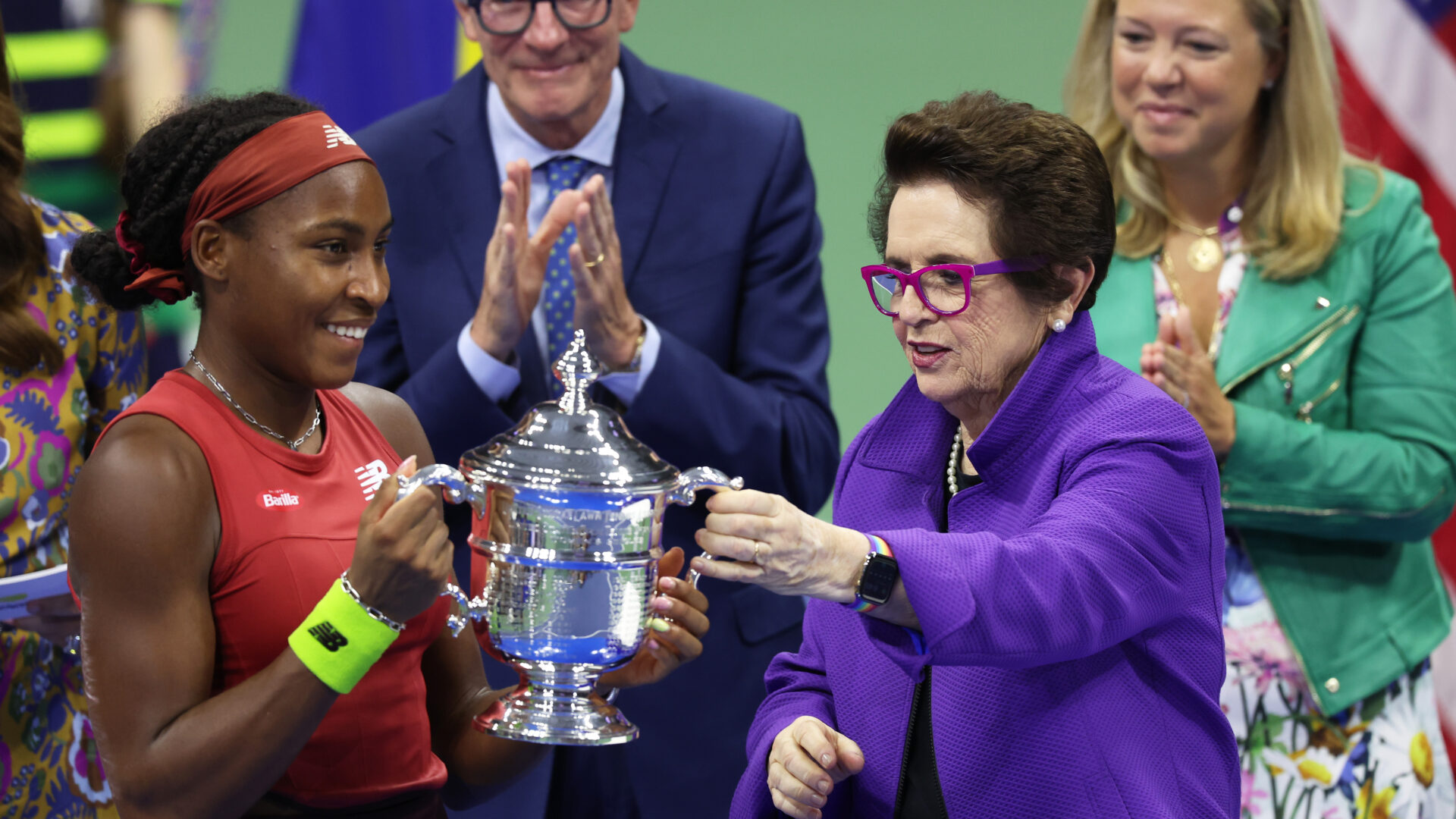
When Billie Jean King presented her with the trophy for winning the 2023 US Open Women’s Singles championship and the $3 million first prize, Coco was quick to credit King for her efforts to bring equal pay to women at the 1973 US Open.

As the adage from the seventies goes, it seems we “have come a long way, baby!”

NEW YORK, NEW YORK – SEPTEMBER 09: Former American tennis player Billie Jean King presents the winners trophy to Coco Gauff of the United States during the ceremony after Gauff defeated Aryna Sabalenka of Belarus in their Women’s Singles Final match on Day Thirteen of the 2023 US Open at the USTA Billie Jean King National Tennis Center on September 09, 2023 in the Flushing neighborhood of the Queens borough of New York City. (Photo by Clive Brunskill/Getty Images)

*Notes: Thanks to commenters Jessie Daw who pointed out that the shot clock allows 25 seconds instead of 30 seconds, and to Jessie, Sharyl Ginther, and Montana Miller for noting that one protester had glued their feet instead of their shoes to the concrete.

More Controversy at Indian Wells

By Dr. Nancy E. Spencer

Venus and Serena Williams’ return to Indian Wells was supposed to close the book on a controversy that occurred in 2001. They faced a racist incident that was a painful memory for them and a blemish on the tournament. In 2016, Serena hoped to write a new chapter by advancing to the Women’s Singles final where she faced Victoria Azarenka. Their matches had always been close and promised to provide a storybook ending to this new chapter. While the final score did not end in Serena’s favor (Vika won 6-4, 6-4), a new controversy emerged as a result of sexist comments made by Ray Moore, the tournament’s director and CEO. Before the Men’s Singles final, Moore was asked how the men’s (ATP) and women’s tours (WTA) compared. He replied by calling  “the WTA a bunch of lucky coattail-ridin’ dummies who have the men to thank for their continued existence” (Redford, 2016, para. 1). But he didn’t stop there, adding, “If I was a lady player, I’d go down every night on my knees and thank God that Roger Federer and Rafa Nadal were born, because they have carried this sport. They really have” (Redford, para. 2).

In the press conference following her match, Serena was asked to comment on Moore’s statements. She began by saying, “I think Venus, myself, a number of players have been — if I could tell you every day how many people say they don’t watch tennis unless they’re watching myself or my sister, I couldn’t even bring up that number. So I don’t think that is a very accurate statement” (Dator, 2016, para. 4).

Asked further if she was surprised that sexist statements are still brought up, Serena replied: “Yeah, I’m still surprised, especially with me and Venus and all the other women on the tour that’s done well. Last year the women’s final at the US Open sold out well before the men. I’m sorry, did Roger play in that final or Rafa or any man play in that final that was sold out before the men’s final? I think not ” (Dator, 2016, para. 5).

Serena also referred to the history of progress that began with Billie Jean King whose “Battle of the Sexes” victory over Bobby Riggs has been credited with advancing the cause of all women in sport. In fact, Billie Jean also played an integral role in securing equal prize money for women at the U.S. Open in 1973 (D’Cunha, 2016). As Serena pointed out, “in order to make a comment you have to have history and you have to have facts and you have to know things. You have to know of everything. I mean, you look at someone like Billie Jean King who opened so many doors for not only women’s players but women athletes in general” (Dator, 2016, para. 6).

King herself played during the same era as Ray Moore when professional tennis was in its infancy. During that era, the ratio between men’s and women’s earnings was often as disparate as 11:1 (BJ King, personal communication, February 24, 1999). Billie Jean responded to Moore’s comments on Twitter saying she was: “Disappointed in comments. He is wrong on so many levels. Every player, especially the top players, contribute to our success.”

Chris Kermode, CEO of the Association of Tennis Professionals (ATP), the governing body of men’s professional tennis agreed with King in describing “Ray Moore’s comments towards women’s tennis” as “disappointing” (Rycroft, 2016, para. 5). Adding that the comments were “made in poor taste,” Kermode stated that, “The ATP fully supports equality across society, while at the same time acknowledging that we operate in the sports [and] entertainment business” (Rycroft, 2016, para. 5).

Unfortunately, Kermode’s comments are unlikely to carry as much weight as earlier statements made by the Men’s Singles winner and world No. 1 Novak Djokovic, who said after winning his match yesterday: “I think that our men’s tennis world, ATP world, should fight for more, because the stats are showing that we have much more spectators on the men’s tennis matches. I think that’s one of the reasons why maybe we should get awarded more” (D’Cunha, 2016, para. 15). There is an underlying problem with comments by both Moore and Djokovic, as D’Cunha (2016) pointed out, in that they “are indicative of the general disregard for women’s tennis by their male counterparts” (para. 18).

If there is any consolation it is the outpouring of support for women’s tennis that was expressed on Twitter and in other articles. Hopefully, women’s tennis (and all women’s sports) will continue the legacy begun by Billie Jean King, Gladys Heldman, the “Original Nine” and current WTA players. They’re not riding anybody’s coat tails!!

Note: According to reports on Twitter as of March 21, Raymond Moore has resigned as Tournament Director and CEO at Indian Wells. Perhaps, on this 10th anniversary of Twitter, it is fitting that the social media site played a key role in disseminating news of this controversy so quickly.

References

Dator, J. (2016, March 20). Serena Williams sends powerful message to Indian Wells CEO over sexist comments. SB Nation. Retrieved from http://www.sbnation.com/2016/3/20/11273222/serena-williams-press-conference-sexist-comments-indian-wells-ceo

D’Cunha, Z. (2016, March 21). Raymond Moore, Novak Djokovic, and the blatant disregard for women’s tennis by the men in sport. Firstpost.com. Retrieved from http://www.firstpost.com/sports/raymond-moore-novak-djokovics-comments-not-only-sexist-but-also-show-disregard-for-womens-tennis-2688386.html?utm_source=dlvr.it&utm_medium=twitter

Redford, P. (2016, March 20). Indian Wells CEO Raymond Moore has some bad and dumb thoughts on Women’s Tennis. Deadspin. Retrieved from http://deadspin.com/indian-wells-ceo-raymond-moore-has-some-bad-and-dumb-th-1766048378

Rycroft, R. (2016, March 21). ATP’s Chris Kermode responds to Raymond Moore’s controversial comments on WTA. Sportsgecko.com. Retrieved from http://sportsgecko.com/atps-chris-kermode-responds-to-raymond-moores-controversial-comments-on-wta/