Pershelle Rohrer is a first-year BGSU student from Logan, Utah. She is a Sport Management major with a minor in Journalism. Her primary sports interests are football, basketball,and baseball, both at the professional and collegiate levels.
The XFL had a major officiating controversy at the end of a game between the Houston Roughnecks and Seattle Dragons on March 7. The way the league handled it could set an example for the NFL, a league that has struggled to improve its officiating for years.
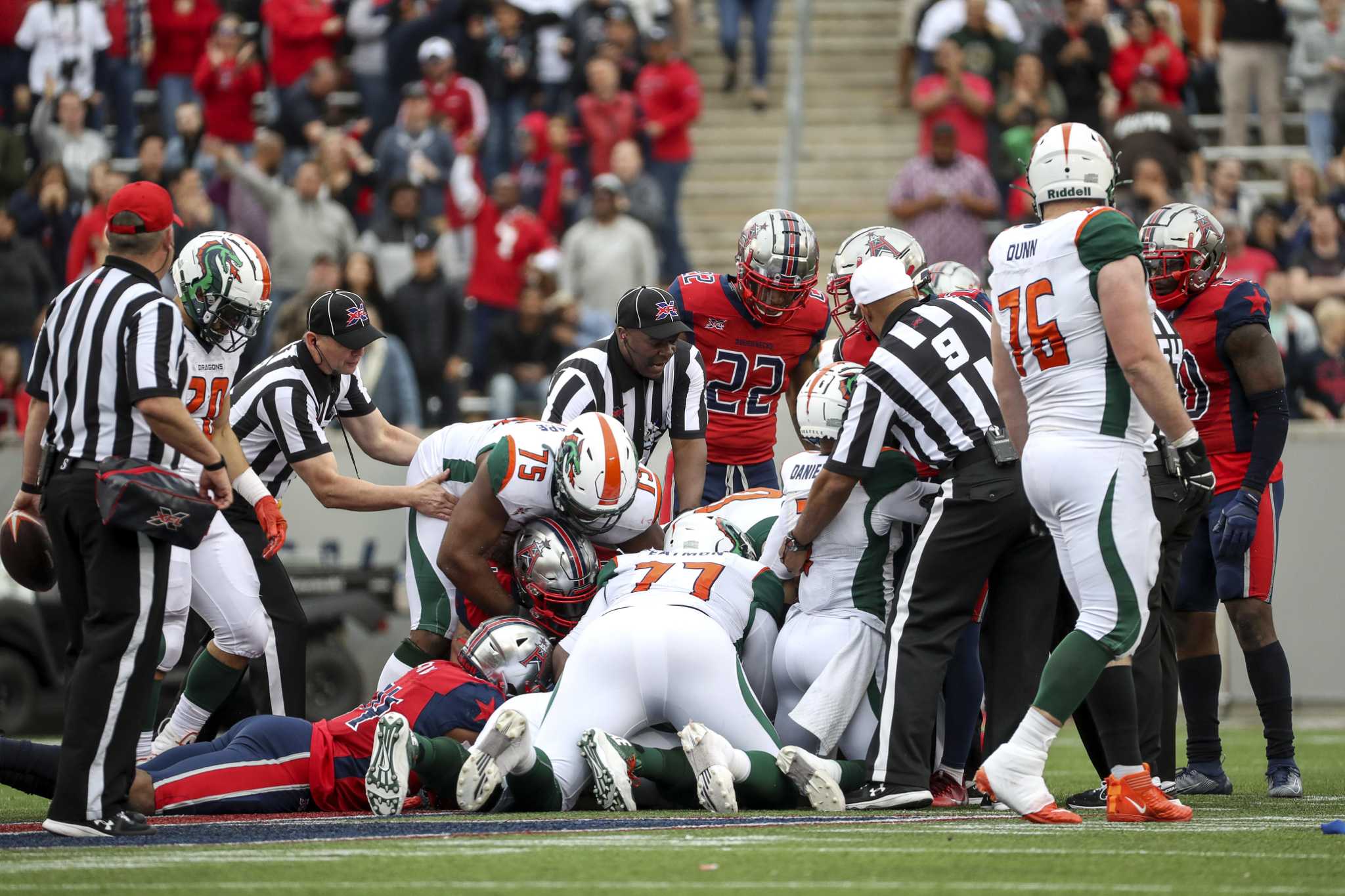
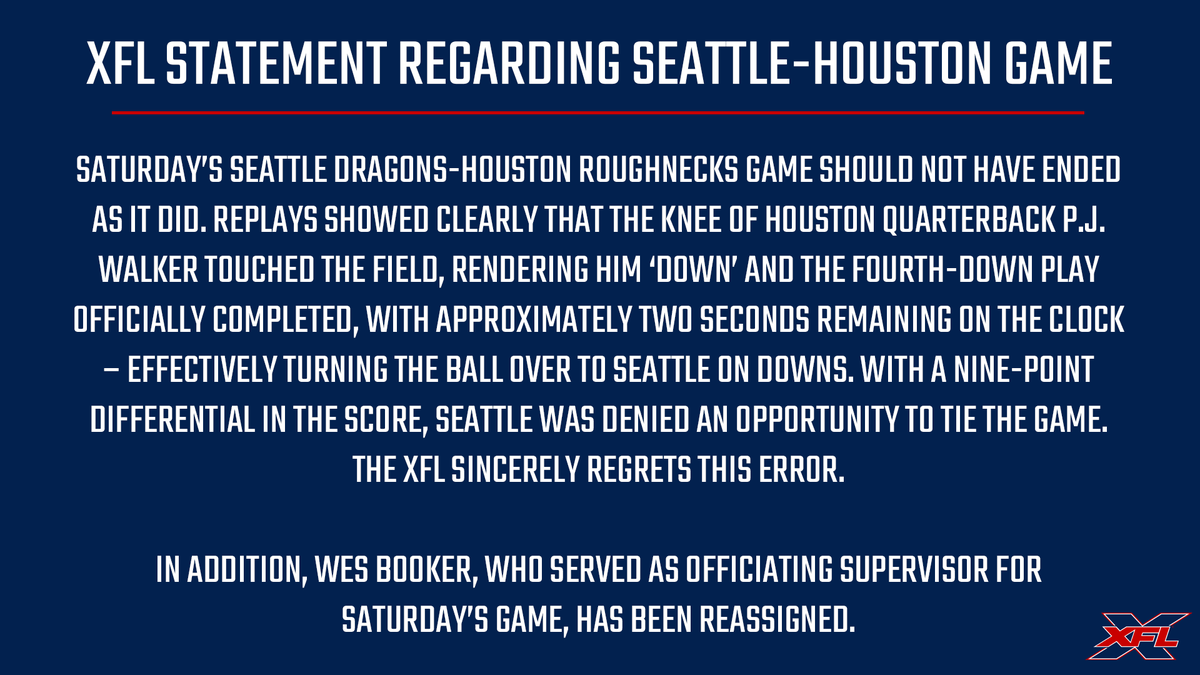
The Roughnecks led the Dragons, 32-23, with the clock running down at the end of the fourth quarter. Instead of throwing the ball out-of-bounds on fourth down to kill the remainder of the clock, Houston quarterback PJ Walker took a knee with two seconds remaining. The play should have resulted in a turnover on downs, granting Seattle one last shot at the end zone from Houston’s 21-yard line (West, 2020).
Seattle would have had a chance to tie the game with a touchdown and three-point conversion. Instead, the clock ran out, the referees left the field, and the game was declared over. ABC announcers Steve Levy and Greg McElroy immediately called out the officiating crew. McElroy said, “It can’t happen. It absolutely can’t happen. It is inexcusable,” (Werner, 2020, para. 5). When they asked officiating supervisor Wes Booker why the game was called with time on the clock, he admitted his mistake but claimed that he could not bring the teams and officials back for the final play. In USA Today writer Barry Werner’s words (2020, para. 4), “The replay official told ABC the game was over and there was nothing they could do about it, somehow.”
Later that evening, the XFL reassigned Booker and released a statement apologizing for the mistake. Dan Lyons wrote, “Good on the XFL for getting a statement and apology out very quickly,” (2020, para. 7).
The XFL’s quick response to the situation was impressive for the league, especially in a time where fans, players, and coaches are frustrated with the officiating in the larger NFL. Tampa Bay Buccaneers head coach Bruce Arians called out the NFL in 2019, stating that, “My biggest thing is, referees aren’t held accountable,” (Seifert, 2019, para. 25). The NFL and XFL officiating crews have different levels of exposure, and the transparency of the XFL is what allowed Booker to be held accountable for his mistake. In the XFL, all officials are mic’d up throughout the game, and the access to the officiating supervisor in the booth made it possible to immediately ask for his reasoning behind calling the game early.
All plays are booth reviewable in the XFL, with a replay official in the stadium. In the NFL, plays are only booth reviewable for the last two minutes of each half, and the replay official is at a central command center in New York (Schwartz, 2020). Since officials are mic’d up in the XFL, fans can listen to the booth official’s conversation with the on-field referees and understand the reasoning for either overturning or upholding a call.
Geoff Schwartz claims, “The NFL is already in need of an officiating overhaul and letting people in on the review process would go a long way to making nice with everyone involved” (2020, para. 14). Taking a page out of the XFL’s playbook could be the solution the NFL needs to help restore integrity to its officiating and improve the in-game experience for players and fans alike.
Brody Hickle grew up in Bluffton, Ohio and now studies Sport Management at Bowling Green State University. The third-year undergraduate student minors in General Business. His primary sport interests are hockey and football.
Today, I heard about the coronavirus hitting in Ohio (which is my home state), so I wanted to write about how the disease has been affecting the world of sports. I have many friends who attend Ohio State University, and when I saw the news that they were suspending classes for 20 days, I was more than shocked. First, before I talk about how the disease is affecting the world of sports, I did some research on the symptoms athletes and other individuals can get from the coronavirus, and the symptoms include difficulty in breathing, fever, and coughs (CDC, 2020).
So far, we have seen several cases of the coronavirus affecting sporting events and other activities across the world. When I began writing this, Italy suspended all sporting events until April 3rd, due to the coronavirus. In the sports world, they aren’t just focusing on athletes. They are also focusing on and taking precautions with the media. Jeff Passan (writer/reporter for ESPN) was mentioned in an article updated by another reporter, Randy Miller, stating that the NHL, NBA, NFL, and MLS has restricted media access due to the spread of the coronavirus. In the article, Miller states that in Clearwater, Florida (a popular location for spring training baseball), the New York Yankees decided that for an hour early in the morning, they would allow interviews from the media, because they wanted to keep out of the clubhouses at restricted times due to the concerns of the outbreak.
In Jeff Passan’s part of the article, he said, “Major League Baseball will join the NBA and NHL in closing clubhouses to media due to fear over potential spread of coronavirus, sources tell ESPN. After a conference call with owners Monday evening, MLB remains committed to playing the remainder of the slate of spring-training games as well as opening the regular season on time, the plan, like so many, is contingent on how the coronavirus spreads,” (Miller, para. 4-5, 2020).
I think this is a smart move for the MLB because they don’t want to suspend games like there already have been. Obviously, it is important to keep the athletes, coaches, and everybody else safe. I’m sure that some people working in the media may not be as happy with this move, because they only have one hour to ask questions to the athletes or coaches, and they may not get a big selection of who they can talk to. I wonder how long this disease will continue to affect the world, because we obviously are not just seeing it in sports, but we are seeing it affect companies, schools, and many other businesses around the world.
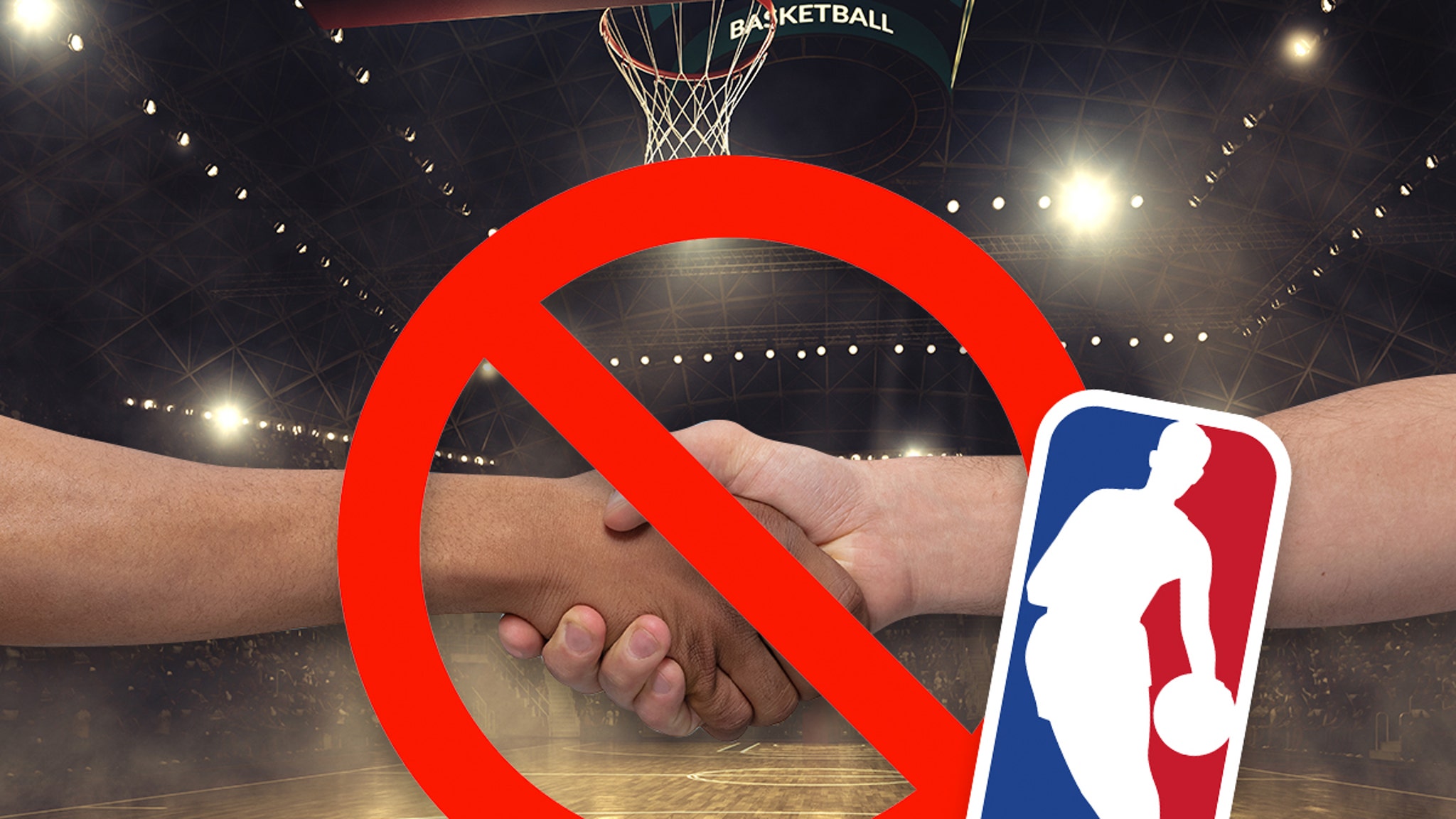
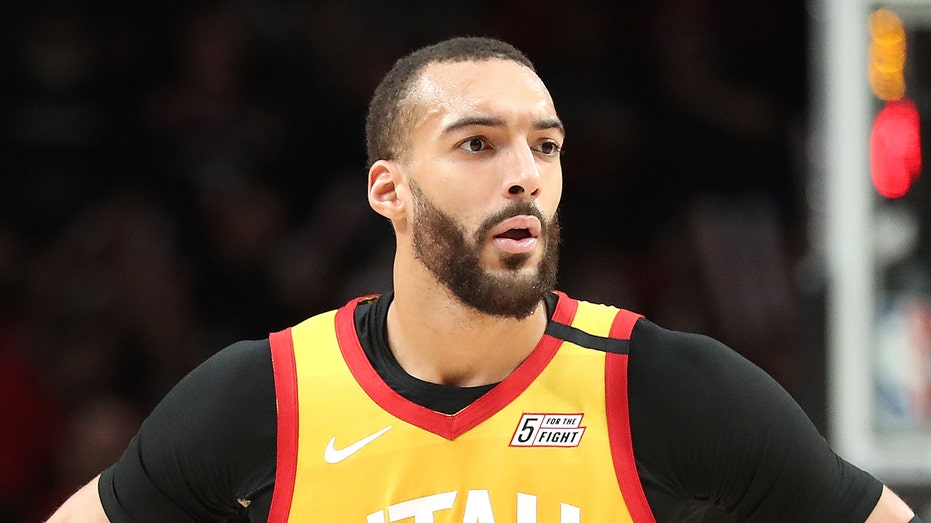
On March 11, the NBA suspended their regular season, and the NHL did the same the next day. While the NBA was making the decision, the media announced that two Utah Jazz stars (Rudy Gobert and Donovan Mitchell) were tested positive for the coronavirus. From what I have noticed, a lot of fans are not happy with this decision. Being a huge NHL fan, I agree with both of these moves, as I did for the MLB. Again, it is not just happening in sports. On the same day the NBA decided to suspend the regular season, many schools (including mine) moved classes to online to help students avoid the coronavirus as much as possible. Going back to the leagues suspending their seasons, I think they did it more than for keeping the athletes safe. They also want to keep the fans safe. I believe that it is a safe and smart move by the leagues. If any league has a fan tested positive from attending an event, how is that going to look good for the organization? Personally, it is a move I would have made.
Griffin is a second-year undergraduate BGSU student from North Ridgeville, Ohio. He is a Sport Management major and a Journalism minor. His primary sports interests are baseball and football, both collegiate and professional, but he is also interested in basketball, MMA, boxing and hockey
On February 20, 2020, two of the top heavyweight boxers in today’s game met in Las Vegas for a championship bout. WBC Heavyweight Champion Deontay Wilder stood across the legendary Irish giant Tyson Fury for a rematch years in the making. With the WBC Heavyweight Championship on the line, boxing was ready to shine again.
Wilder and Fury met once before in December 2018, where their bout drew 325 thousand pay-per-view (PPV) viewers, which was the tenth largest PPV audience for a fight since the Paquiao-Mayweather superfight in 2015 (World Boxing News, 2019). Their first fight was a wildly entertaining disputed draw ending that captivated viewers. It didn’t do much, however, to push boxing back to the forefront of the casual sports viewer. It did create a perfect backdrop to a fight that may be able to bring boxing back to its former glory.
After all the announcements and pre-fight press conferences, the hype for Fury-Wilder II was at its peak. FOX and ESPN decided to co-promote the bout, which pushed it to an even larger audience than their first fight. Pre-fight PPV estimates ranged from 1 to 2 million viewers (John Wall Street, 2020a). For context, that would be the most viewed PPV fight since the Paquiao-Mayweather fight that drew in 4.6 million viewers, but turned them away bored and disappointed by their purchase (World Boxing News, 2019). The hope is that this superfight can leave viewers happier than the failings of Paquiao-Mayweather.
Amid all the theatrics of putting on a fight, like Fury coming out on a chariot adorning a crown and Wilder wearing a 45 pound costume that may or may not have slowed him during the fight, was a wildly entertaining championship match. Tyson Fury dominated Deontay Wilder throughout the seven-round bout, and ended the battle in a stunning TKO victory with 1:39 left in the round (Campbell, 2020).
After the hype and dust settled on the Gypsy King’s massive victory, the shine of boxing seemed on the borderline to return. The fight brought in an unprecedented $17 million in gate sales, which passed the gate record set by Lewis-Holyfield II in 1999 (Mazique, 2020). There were also between 800,000 and 850,000 PPV sales of the match, which is the fifth most watched fight since Mayweather-Paqiuao (John Wall Street, 2020b; World Boxing News, 2019). While the number of sales was much lower than initial estimates, it is believed that between 10 and 20 million people illegally streamed the fight (John Wall Street, 2020b). Illegal streams don’t help the sales and money generation for the fighters, promoters and everyone else involved, but they are a large indicator of the interest in boxing. With possibly 30 million viewers, Wilder-Fury II would easily eclipse the known 1.3 million viewers of Mayweather-Paquiao (World Boxing News, 2019).
Twitter seemed to collectively enjoy the fight, with many influential athletes praising Fury’s performance. High-profile athletes such as LeBron James and JJ Watt showed the fight’s successes, along with reactions from other high-profile sportscasters like Jemele Hill.
One fight is not indicative of the return of boxing, but a success like Wilder-Fury II definitely helps. When people think of boxing, the most thought of modern fight is the Mayweather-Pacquiao snoozefest that drove away the hype of the sport. Now, an entertaining, classic title fight has taken the reigns and can drive more people to the sport. So, is boxing back? No, not yet, but the increased interest and media coverage will certainly help the sport return to the forefront of American sports coverage.
Pershelle Rohrer is a first-year BGSU student from Logan, Utah. She is a Sport Management major with a minor in Journalism. Her primary sports interests are football, basketball,and baseball, both at the professional and collegiate levels.
The NFL season may be over, but football still continues as the XFL enters its fifth week of play. In its second stint after the original league’s failure in 2001, the XFL features modified rules and some familiar faces looking for a second chance at a football career. Through four weeks, the league has received substantial TV coverage with all games broadcasted on ABC, FOX, FS1, and ESPN (Guzman, 2020), and attendance saw a consistent rise for three straight weeks before dropping in Week 4 (Lombardo, 2020). However, the XFL’s attendance figures appear to be on track to reach commissioner Oliver Luck’s standards for its first year if fans continue to show up.
Prior to Week 4, Luck expressed approval of the league’s returns in attendance and television ratings, acknowledging that, “we’ve got a long way to go, still. … (But) I think we’ve got something that we can build on” (Schad, 2020, para. 3). According to XFL News Hub, a total of 298,259 fans have attended games through the first four weeks with each matchup averaging 18,641 spectators (Lombardo, 2020). Some cities are gathering significantly more interest than others — for example, St. Louis and Seattle averaged 29,554 and 22,060 fans, respectively, in their Week 3 home games compared to Tampa Bay’s 18,117 and Los Angeles’ 12,211 in the same weekend (XFLNewsHub, 2020) — but overall, the league is hovering above their end-of-season attendance goal, which they hope to see in the mid-teens at the end of the season (Schad, 2020).
Week 3 Attendance Numbers:
Tampa Bay: 18,117 Seattle: 22,060 St. Louis: 29,554 Los Angeles: 12,211
St. Louis and Seattle have notably done well with attendance numbers, hosting the three most-attended games through Week 4 (Kercheval, 2020). While all eight teams are in established football markets, both of these cities are unique as they both lack a variety of professional teams playing during the winter and early spring months. Seattle’s “12th Man” eagerly supports the Seahawks during the NFL season, but the city currently lacks an NBA or NHL team to draw fans between the Super Bowl and the opening of the MLB and MLS seasons. As the only professional team playing during those months besides Major League Rugby’s Seattle Seawolves (Saul, 2020), the Dragons have received a strong fan turnout. St. Louis was the home of the NFL’s Rams before they left for Los Angeles four years ago (Kercheval, 2020), and they also lack an NBA team. The fans are hungry for football and flock in mass numbers to “The Dome” to watch the BattleHawks play.
The BattleHawks are the East Division’s best team so far, currently holding a 3-1 record due to the stellar play of quarterback Jordan Ta’amu and running back Matt Jones. Ta’amu ranks second in the XFL in passing yards (876 yards) and fifth in rushing yards (186 yards) through four weeks, and Jones is second overall in rushing yards with 244 yards for St. Louis (“Stat Leaders,” 2020). The team has been receiving attention from the media in recent days due to their strong start and positive reception in the city of St. Louis. ESPN’s Brendan Meyer (2020) recently wrote a feature on the return of football to St. Louis after a 1,529-day drought. “For now, no matter what happens, the love that St. Louis has shown the BattleHawks is entertaining and real, a perfect match between a fringe NFL city and a team of fringe NFL players,” Meyer writes (para. 55). In fact, St. Louis loves their team so much that “The Dome” will open more seating in their upper deck for Week 7’s game against the LA Wildcats, according to Ben Kercheval (2020). Cody Benjamin (2020, para. 6) writes that the BattleHawks would “give Houston a run for their money,” referring to the league-leading Roughnecks.
🗣️ ST. LOUIS … you made yourselves heard!
We are OFFICIALLY opening up seats in the upper deck of The Dome for our week 7 game vs LA on March 21. 👀
— St. Louis Battlehawks (@XFLBattlehawks) March 4, 2020
The Houston Roughnecks are the last undefeated team in the XFL, led by quarterback P.J. Walker, an early MVP favorite, and veteran coach June Jones. Walker is likely the league’s most heavily-covered player due to his journey from the Indianapolis Colts’ practice squad to the Houston Roughnecks. Undrafted out of Temple, he was with the Colts on and off for two years before being cut before the 2019 NFL season (Barshop, 2020). Walker found a spot in Houston thanks to Oliver Luck’s son, retired Colts quarterback Andrew Luck, who recommended that his father offer him a position in the XFL. Just three weeks into the season, Sarah Barshop wrote, “If Walker continues to play the way he has in the first three weeks of the XFL season, he’ll likely get another chance to compete for an NFL roster spot” (para. 19).
Walker fits in nicely into head coach June Jones’ system. The veteran college, USFL, NFL, and CFL coach is notably a “pioneer of the run and shoot offence” (Andrews, 2017, para. 2), something that has rarely been brought up by the media. According to Ben Andrews (2017), the offense was founded by Glenn “Tiger” Ellison in the 1950s as a no-huddle offense where the receivers’ only responsibility was to get open. Darrell “Mouse” Davis introduced the run-and-shoot offense at Portland State, where June Jones was one of his starting quarterbacks, and Jones became widely known for using it with his own teams. He modified the offense to use the shotgun formation and an offset running back at the University of Hawaii, helping Rainbow Warriors quarterback Colt Brennan set the Division-I record for touchdown passes in a season in 2006. After taking over as the Hamilton Tiger-Cats’ head coach after the Canadian team started out 0-8 in 2017, Jones once again used the run-and-shoot offense to lead the Ticats to a 6-4 record in the final ten games of the season (“2017 Regular Season,” n.d.).
According to Jones, the run-and-shoot offense is most effective with a quarterback with passing accuracy and speed (Andrews, 2017). Walker leads the XFL in passing yards through Week 4 with 987 yards (“Stat Leaders,” 2020). Roughnecks wide receiver Cam Phillips has also played a major role in the offense, catching 21 passes for a league-high 333 yards and 7 touchdowns through the first four games, averaging 15.9 yards per reception (“Cam Phillips,” 2020). The Roughnecks should always be favored with Walker under center in the eyes of Cody Benjamin (2020).
Excluding Walker and Ta’amu, the XFL’s quarterback situation has been a cause for concern for members of the media. Brad Gagnon claims that “the XFL’s shoddy quarterback play has held it back” (2020, para. 5). Bill Bender (2020) suggests that the league could have a “quarterback crisis” early in its existence. Through Week 3, each team averaged 216.1 passing yards per game, falling between Mitchell Trubisky and Joe Flacco’s numbers from the 2019 season. That would be good for 22nd in the league last year. In Week 4, Cardale Jones’ DC Defenders were shut out by the previously winless Tampa Bay Vipers, Brandon Silvers was benched for B.J. Daniels in Seattle, former Pittsburgh Steeler and current Dallas Renegades quarterback Landry Jones turned over the ball four times and was injured late in the game against Houston. Luis Perez made his first start for the New York Guardians in place of the injured Matt McGloin, and Josh Johnson has played well in his starts for the LA Wildcats, but both teams are sitting in the bottom half of Cody Benjamin’s power ranking heading into Week 5 (2020). Tampa Bay Vipers backup quarterback Quinton Flowers even requested a trade, hoping for a larger role in the offense (Bumbaca, 2020).
In Bill Bender’s words, “Walker needs to be the rule, not the exception” (2020, para. 5).
Despite the quarterback struggles that the league is facing, the XFL has received widespread praise throughout its first month. The league first game on ABC had 3.3 million viewers, topping the Duke vs North Carolina game from the night before, and the XFL Instagram account has surpassed 500,000 followers (Guzman, 2020). Television broadcasts feature mic’d up coaches, players, and officials as well as in-game interviews on the sidelines (Gagnon, 2020). During Week 1, Doug Gottlieb tweeted about the open mics and JJ Watt enjoyed the sideline interviews that occurred almost immediately after critical plays throughout the game.
The league features unique rules, including a modified kickoff and three different extra point options, to increase scoring opportunities and improve safety. Citadel head coach Brent Thompson likes the new rules so much that he will implement some of them in the college’s upcoming spring game (Gaydos, 2020). “During a spring game, you usually don’t do a kickoff, because it can be a dangerous play. But the way the XFL does it is pretty safe, and it was a chance to get a special teams play executed,” Thompson said (para. 3).
The XFL also uses a unique strategy to interact with its fans through social media. Their various social media pages feature highlights, memes, fan interactions, and celebrations. Social media is used to highlight player success, creating personalities for fans to support leaguewide.
Nick Holley shouted out his parents after catching a touchdown pass for the Roughnecks.
Television exposure, social media highlights, and written coverage are providing fans a variety of viewership opportunities, drawing new supporters. Despite some critiques of the quality of play, the reception through four weeks has been relatively positive. As long as players like P.J. Walker and Jordan Ta’amu continue to draw attention, attendance stays steady, and TV ratings remain positive, the XFL could look to outlast both last year’s Alliance of American Football (AAF) and 2001’s original XFL. With six weeks of the regular season remaining, any team still has a shot at the four-team playoffs. The race will continue to heat up as April approaches, culminating with the inaugural championship game in Houston on April 26, 2020 (“Houston to Host,” 2020).
JJWatt. (2020, February 8). Just turned on the XFL. Kicker missed a field goal and they immediately interviewed him on the sideline asking what happened haha. That’s tough. [Tweet]. Retrieved from https://twitter.com/JJWatt/status/1226231665023967244?s=20
xfl2020. (2020, February 23). Martez Carter said if he had “one more in the box” he’d bust out his signature backflip. He then front flipped INTO the box. Mr. Excitement @ThatManCarterIV. [Tweet]. Retrieved from https://twitter.com/xfl2020/status/1231748191986561026?s=20
XFLBattleHawks. (2020, February 23). 1 Sack 1 box of Thin Mints @case_man_ will agree that Girl Scout cookies taste even better when you’re winning!#ForTheLoveOfFootball x #ClearedToEngage [Tweet]. Retrieved from https://twitter.com/XFLBattleHawks/status/1231709732408348672?s=20
XFLBattleHawks. (2020, March 4). ST. LOUIS … you made yourselves heard! We are OFFICIALLY opening up seats in the upper deck of The Dome for our week 7 game vs LA on March 21. Tickets will go on sale this Friday at 10 AM! #RockTheDome x #ForTheLoveOfFootball [Tweet]. Retrieved from https://twitter.com/XFLBattleHawks/status/1235315275576348672?s=20
XFLRoughnecks. (2020, February 16). Name a better duo… I’ll wait @pjwalker_5
Ben is a first-year undergraduate BGSU student from Uniontown, Ohio. He is a sport management major and a journalism minor. His primary interests include professional and collegiate football.
Over the last few weeks, sports media have been hurling football fans into a tornado of Tom Brady rumors. On Thursday, ESPN’s Jeff Darlington reported that Brady is anticipating entering free agency. However, the NFL Network’s Ian Rapoport reported that the Patriots plan on retaining Brady’s services and are awaiting changes to the collective bargaining agreement with the players’ union before discussing a contract. In addition, Rapoport claimed that the Indianapolis Colts, Las Vegas Raiders, Miami Dolphins, and Los Angeles Chargers have been in contact with a party representing Brady (Shapiro, 2020). Finally, Tony Pauline of Pro Football Network reported that the Patriots have been looking into bringing in the Tennessee Titans’ Marcus Mariota (“2020 NFL Scouting Combine,” 2020). Each of those reports came out on February 27th, which has left another layer on the confusing pile of Tom Brady news.
However, sports media seems to have left one rock unturned in their search to provide an accurate report about Brady’s future. Why has that rock gone unturned? Possibly because it isn’t about the future, but about the past. Specifically, it is about Peyton Manning in the 2012 offseason. After spending fourteen seasons in Indianapolis, Peyton was cut by the Colts and found himself in a situation similar to what Brady is about to experience (“Colts release Peyton,” 2012). Since Peyton has set the blueprint for what can be expected out of free agency for future Hall-of-Fame quarterbacks, that blueprint can be used to give an idea as to what Brady’s football life may look like over the next month.
First, after Peyton was released, roughly half of the league conveyed interest in the Colts’ former signal caller (Mortensen & Schefter, 2012). What does this information mean for Brady? He can expect way more attention than what he is currently receiving. Again, only about four teams have contacted Brady’s agent, so Brady should consider preparing to answer for about ten more interested employers.
Sports media and sports fan alike should also prepare for surprises. When Super Bowl-winning quarterbacks are looking for a new team, no player is safe. The Denver Broncos, who won a playoff game in 2011, would end up replacing starter Tim Tebow with Manning. So, it might be wise for every quarterback to check their job security, no matter their success.
The outlier between each of these cases is the status of the players’ former teams. Since the Colts cut Manning, it is safe to say that they had zero interest in signing him. As a result, the Colts did not have to worry about stocking up their roster to attract a Super-Bowl winning quarterback. The Patriots, however, did not cut Brady, and if they want him, they might have to earn him back. Earning back Tom Brady could be tricky, as Brady’s wish list could get expensive. After a season where the Patriots’ receivers and tight ends found little success, the team could be looking into bringing in a high-level wide receiver or tight end. A signing of this nature could be enough to bring back Brady. However, the Patriots will also need to look at reloading the defense, with at least three defensive starters set to hit free agency. As if that laundry list isn’t long enough, the Patriots’ Joe Thuney, a 2nd Team All-Pro guard in 2019, is about to enter free agency and could reset the market for interior offensive linemen. Retaining each of these players would be impossible with the salary cap, so cuts, cheap veterans, or rookie starters should be expected.
There’s also the possibility that within the next seven years, a quarterback like Brady could be hitting free agency and may need a blueprint to guide them through free agency. There could also be a team like the Patriots, who may need a blueprint for life after losing their Hall-of-Fame quarterback without an immediate starter set to take over. Now would be the best time for sports media to start taking their notes in preparation.
Pershelle Rohrer is a first-year BGSU student from Logan, Utah. She is a Sport Management major with a minor in Journalism. Her primary sports interests are football, basketball,and baseball, both at the professional and collegiate levels.
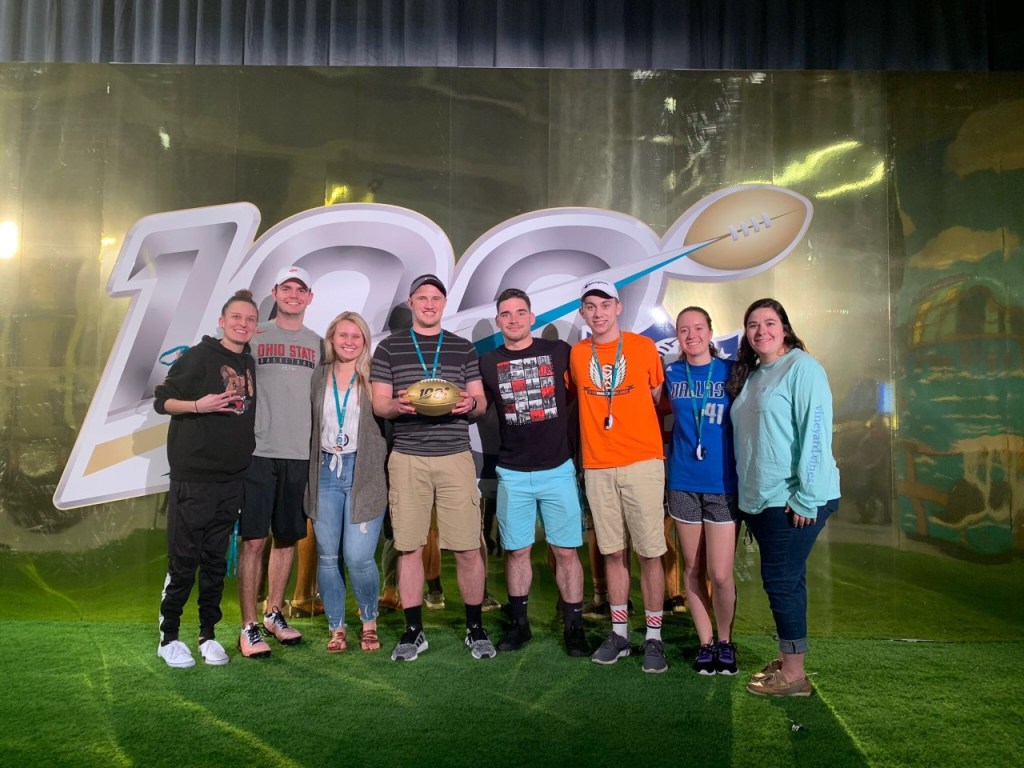
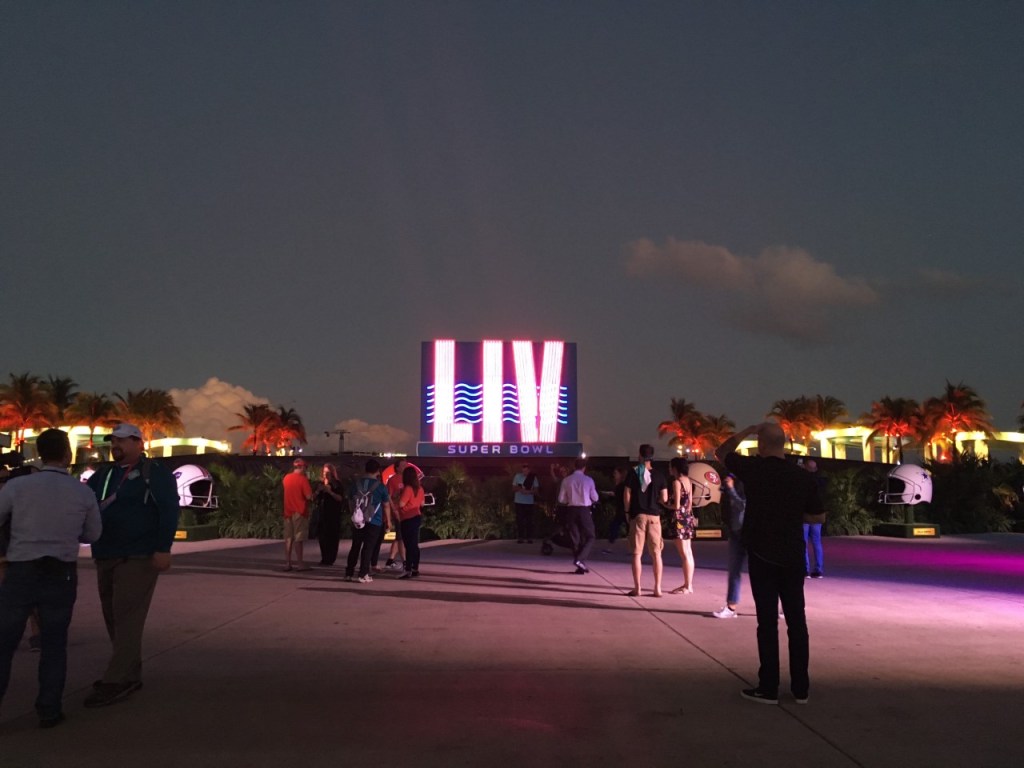
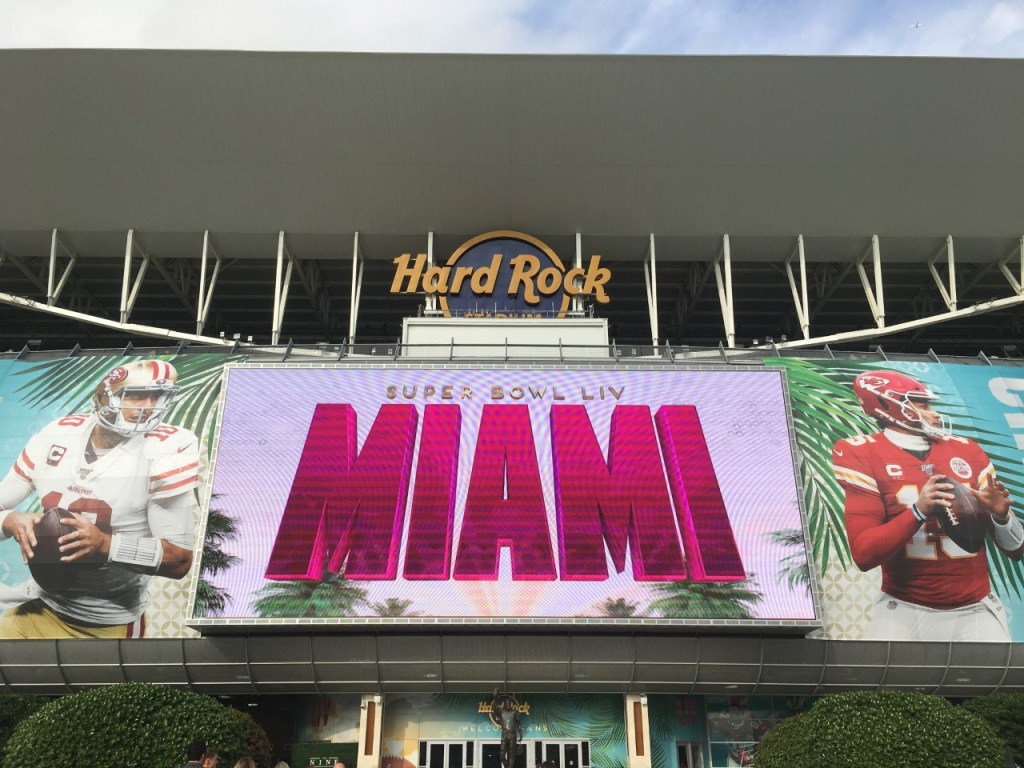
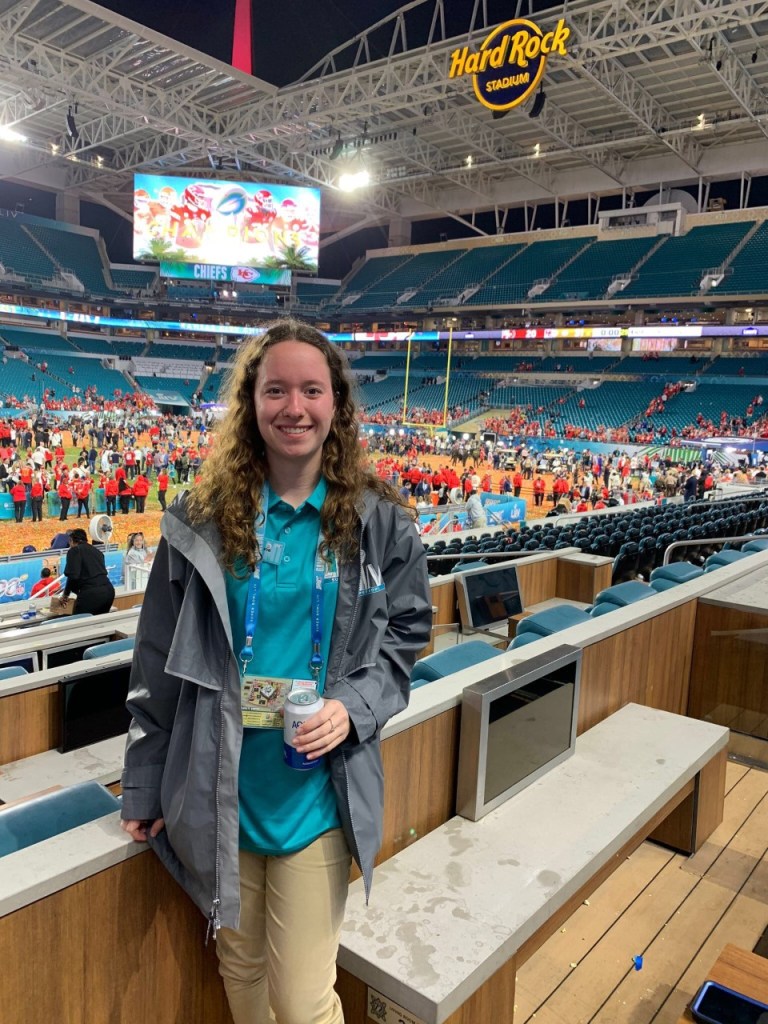
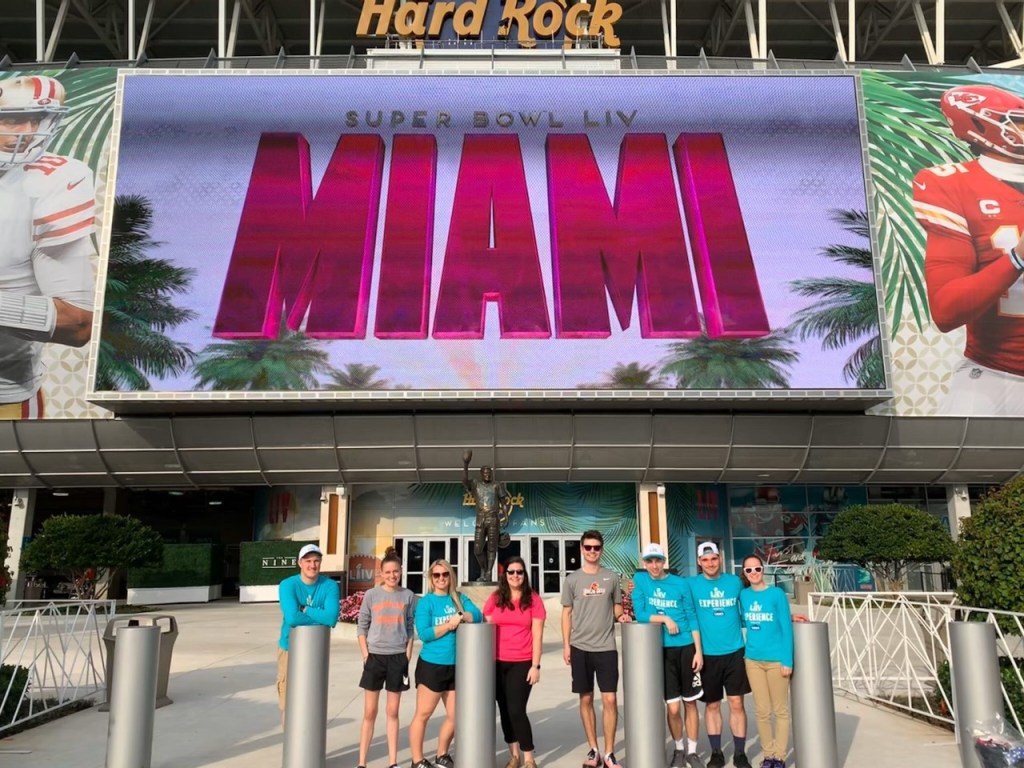
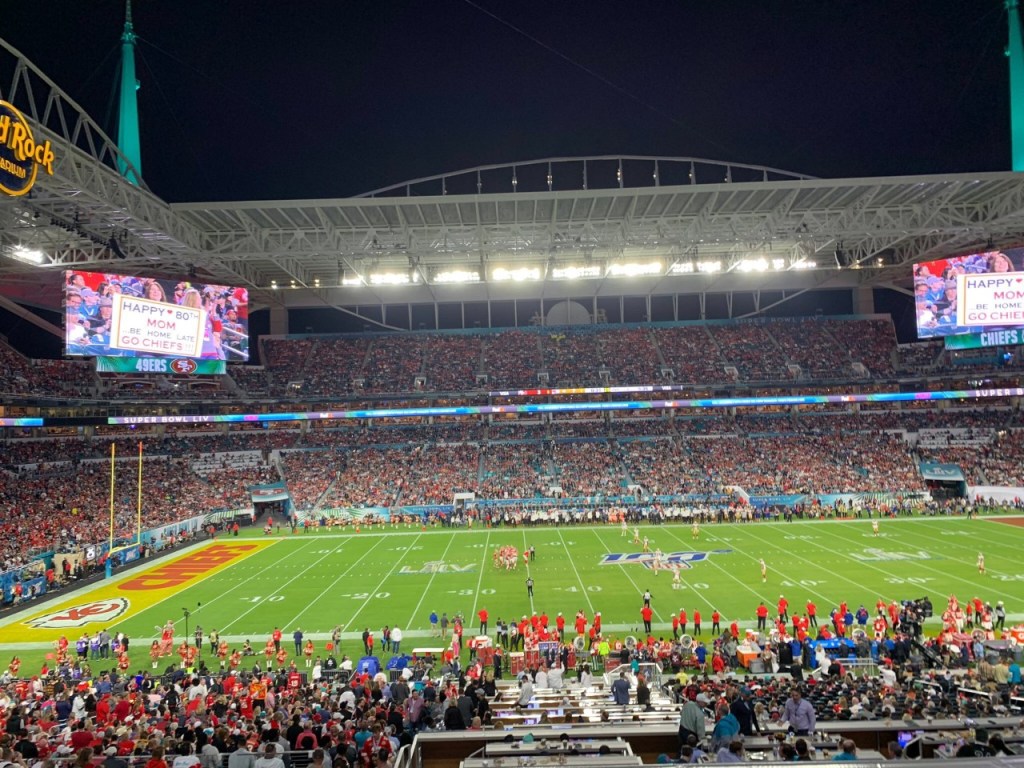
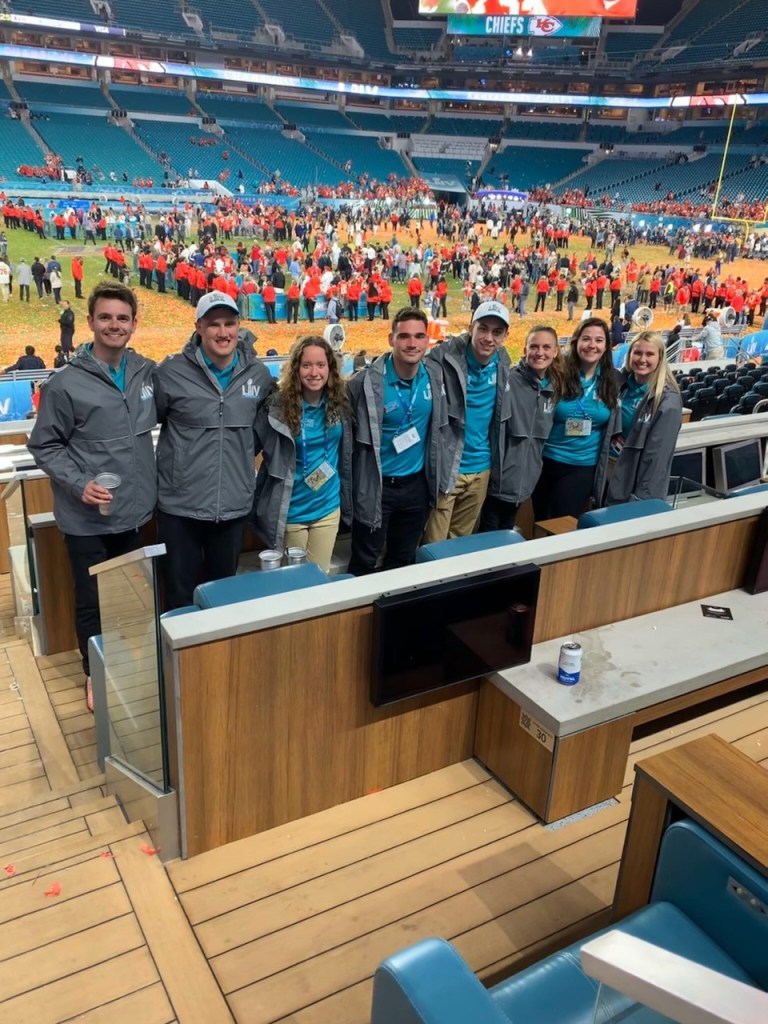
At this time three weeks ago, I was in a car coming home from a once-in-a-lifetime experience. For eight days I had been in Miami, Florida with seven other Bowling Green State University students volunteering at the Super Bowl. This is an opportunity that I applied for through the university’s Sport Management Alliance. I spent much of the semester following the NFL and waiting to see which teams would make the trip to Miami to play in the big game in February. After an exciting playoff race, the battle for the Lombardi Trophy came down to the Kansas City Chiefs and San Francisco 49ers. While in Miami, I interacted with both fan bases in the week leading up to the game as well as NFL fans from all over the world.
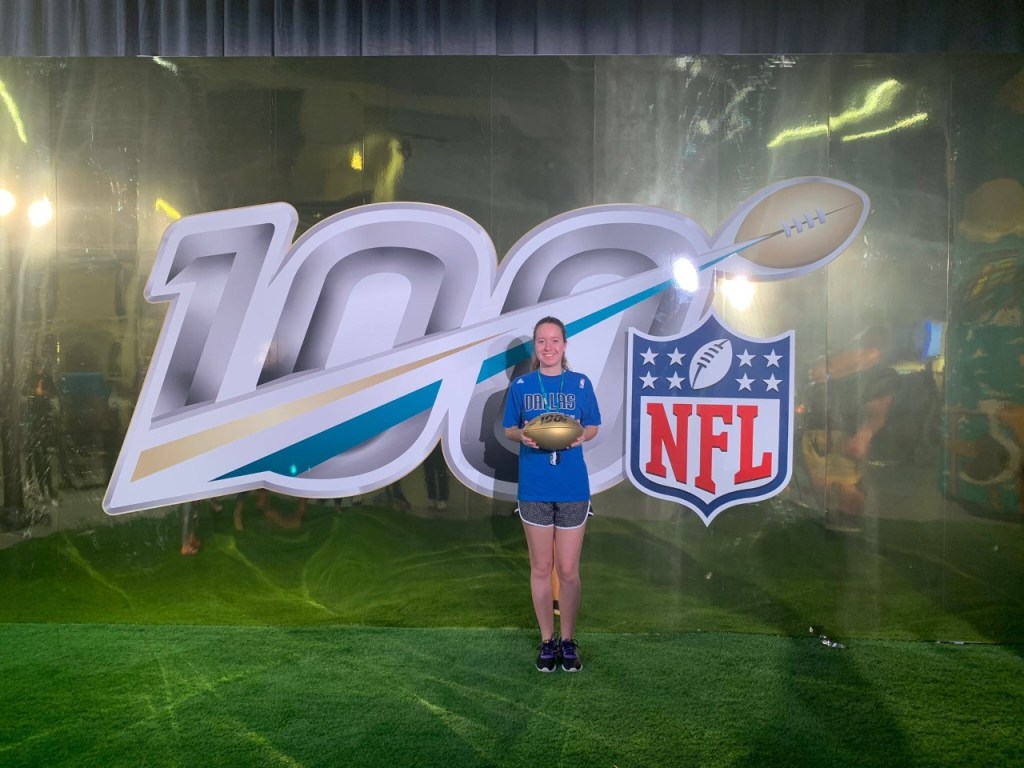
Just hours after our arrival in Florida the Monday before the Super Bowl, we attended Super Bowl Opening Night at Marlins Park, home of the Miami Marlins. The event was covered heavily by the media, as it was televised on NFL Network. Both teams were introduced on the floor, and interviews with stars like Patrick Mahomes, Travis Kelce, Jimmy Garoppolo, and Richard Sherman followed. We were each given a radio earpiece upon our arrival that allowed us to listen to different players while we walked around the concourse participating in different activities. We took individual and group pictures and met Miami Dolphins players Christian Wilkins and Charles Harris. Harris liked the Dirk Nowitzki shirt I was wearing, saying, “He’s my guy.”
Throughout the week I didn’t go a day without seeing a Kobe Bryant jersey somewhere. Bryant was involved in a helicopter accident the day before our arrival, and moments of silence were held on the plane as we landed in Miami and at Super Bowl Opening Night at Marlins Park. Many players in the interviews were asked what Bryant meant to them or about his legacy. The media was able to unite the sports world by crossing football with basketball and covering two major events at the same time, and it was fascinating to watch up close. American Airlines Arena and a couple other buildings in Miami were lit up in purple and yellow that night as sports fans mourned the loss of an NBA legend.
On Tuesday, we went to Bayfront Park to work at Super Bowl LIVE, an outdoor fan experience in the heart of Miami. This event was covered on the Super Bowl Host Committee’s Instagram account in the weeks leading up to the Super Bowl, and it featured various places for photo opportunities, food tents, live music, a large football field, and carnival games for kids. While this event was the main thing covered by the host committee on social media, I did not see as many individuals from the media making their way around the park. The majority of coverage I saw was at the Super Bowl Experience in the Miami Beach Convention Center.
We were at the convention center Wednesday through Saturday, working multiple volunteer shifts on three of those days. The Super Bowl Experience was an indoor fan fest that featured football activities like field goal kicking, Hail Mary, and NFL combine events. It also included photo opportunities with the Lombardi Trophy, a Super Bowl ring display, autograph signings from NFL players, and other displays showcasing the NFL’s history that spans one hundred years.
The Super Bowl Experience is where I truly saw the media at work. One of my classmates ran the obstacle course with a Los Angeles television reporter, who recommended a Cuban restaurant that ended up being a highlight of our week. Media covering the Chiefs took footage of their cheerleaders and mascot trying out the course. I spent most of my time working at the Hail Mary station where fans threw footballs into nets at various distances, and we had several reporters participate for television coverage. The media ensured that the event received exposure nationwide, creating the potential for more fans to attend in future years. Fans were enthusiastic and enjoyed participating in the games and meeting current and former players like Lamar Jackson, Dan Marino, and Rob Gronkowski. While not everyone was able to attend the Super Bowl, the Super Bowl Experience permitted anyone in the Miami area to get involved in the celebrations leading up to the big game.
Super Bowl Sunday was a hectic, exciting experience. We worked On the Fifty VIP party for some of the highest paying guests in the stadium. Six BGSU students worked inside the party and two of us participated in wayfinding and ushering in fans. From my post outside of the party, I saw Bruce Matthews and several other members of the NFL 100 All-Time team, Venus Williams, and Urban Meyer. Joe Theismann and Dan Marino were a couple of familiar names inside the party. As game time approached, we switched into our new role of finding fans in the suites who purchased post-game field access. We directed them where to go and what credential they would need. After having a break for halftime and part of the third quarter, we made our way back to the concourse outside the suites to try to catch any straggling fans with post-game field credentials. While I was there, I saw Larry Fitzgerald, without any security personnel in sight, meeting with fans, and a World War II veteran celebrating his one hundredth birthday. Photographers were taking his picture and thanking him for his service, celebrating his milestone. Other media personnel followed celebrities that I couldn’t pick out as they made their way in and out of the suites.
With five minutes left in the game, I made my way into the stairwell to take my post for directing fans to the field. While there, I listened to the Chiefs’ comeback on the radio. Knowing what was coming, I prepared myself for the hundreds of excited members of “Chiefs Kingdom” as they sprinted down the stairs toward the field, screaming and cheering as they went. After our job was over, we took in the postgame scene from the stands. The sight of confetti on the ground, some of which I took home with me, and the Kansas City Chiefs colors lighting up the stadium was incredible to see, especially since I have watched the Super Bowl from my living room every year since I can remember.
Participating in the Super Bowl LIV experience is something I will never forget, and the interactions with enthusiastic toddlers to 100-year-old war veterans, fans, and celebrities helped me truly understand the influence that sports have on people from all walks of life. I would like to thank Bowling Green State University and SMA for granting me the opportunity to participate in the Super Bowl festivities. I am thankful for the chance I was given to represent BGSU, and I look forward to doing so as I continue to further my career in sports.
Kelsey Kohlman graduated from BGSU’s Sport Management program in December 2013 and has been working at ESPN in the Stats and Information Group (SIG).
It was December of 2013 in my final week of being an intern for the Charlotte Bobcats (Hornets). The Lakers had just beaten Charlotte in a close game, and I was doing my normal postgame intern duties of going back and forth from the court, to the locker room tunnels, to the printer, to the media room, etc. However, soon that night was going to be unforgettable.
There was a young boy decked out in Kobe gear from head to toe in the tunnel leading to the locker rooms. Literally, I didn’t know that many Laker accessories existed lol. He was a quadriplegic in a motorized wheelchair with a trachea coming out of his throat. I couldn’t help but notice he was beaming with excitement everytime I walked past him.
A few minutes later, I just so happened to walk by the boy again (with a cart full of monitors) just as Kobe was coming out of the locker room. This was the boy’s “Make a Wish.” Since the hallway was too narrow to squeeze past, I got the pleasure of witnessing such a heart-warming interaction that I will never forget.
This wasn’t a 1 minute hello and good bye. Kobe squatted and put his arm around the boy’s shoulder and they started talking like they had known each other for ages. No awkward silence, no forced interaction, no sad puppy eyes, and no negative annoyance body language that some celebs may show when doing a “checkbox” quota meet and greet. It felt more genuine than I would have ever imagined.
The parents were standing near me, behind their son, probably because they didn’t want their son to see them bawling uncontrollably. Their happiness and being overcome by emotion was so evident, it made me tear up.
Kobe, the boy, and both parents then began walking toward my office, to an empty room where they could all chat in a more private setting. As I followed not far behind to continue on with my work, I just couldn’t get over how genuine Kobe looked/felt/sounded, how overly-happy this child was, and how something so simple can mean so much to a struggling situation..if done right. And Kobe did it all right that night.
Kobe was never a favorite for me, but seeing that interaction has always “hit” and stuck with me. I’ve told this story many times before because those few minutes were so shockingly heartfelt.
Millions of these “moments” happen each year. Am I saying Kobe was the best person to walk the planet? No. But I am saying people have so many sides to them. A superstar athlete can have a tender touch and a warm heart. A person that has had rough acts in the past can rebound and evolve into something greater.
Thank you Kobe for that memory. It will never fade, and in my eyes, it was better than anything you had ever done with a basketball.
Ben is a first-year undergraduate BGSU student from Uniontown, Ohio. He is a sport management major and a journalism minor. His primary interests include professional and collegiate football.
Patrick Mahomes and the Kansas City Chiefs played up to the New England Patriots this week, with Mahomes leading his team to a 23-16 victory. However, the game almost resembled a Home Alone movie script rather than an NFL play-calling sheet.
Upon the Chiefs’ arrival in Boston last weekend, a container holding the equipment of thirty-five players went missing. The container was later found in Newark, New Jersey, and delivered to Gillette Stadium in Massachusetts before the game’s 4:30 start time. If the container had not been delivered, over half of the Chiefs’ roster would have been missing their helmets and shoulder pads (Schefter, 2019). Without the proper equipment, the players could not have played. If the players could not play, then the game would have ended in the first forfeit in NFL history (Farrar, 2019).
According to the 2019 NFL Rulebook, “If a team forfeits a game, the opponent will be declared the winner by a score of 2-0, but the points will not be added to the winning team’s record for purposes of offensive production or tie-breakers” (“2019 official playing,” 2019, p. 41). Doug Farrar makes note of this in his article “Chiefs avoid first forfeit in NFL history after equipment is diverted to New Jersey,” but other implications of the would-have-been forfeiture are not discussed by sports media (Farrar, 2019).
Both the win-loss records for the Patriots and Chiefs would have been affected by a forfeiture. The Chiefs victory would not have occurred, and the team’s record would have been 8-5. The Patriots would have gained a victory, and their record would move to 11-2. Playoff spots would not have changed, however, as each teams’ status as division leaders would remain the same. A record of 8-5 would still be good for first place in the AFC West, while the Patriots would have stayed as the AFC East winners with a record of 11-2. (“2019 NFL standings,” 2019).
A forfeiture would have also prevented one of the roughest outings for a refereeing crew this season. Multiple significant calls went against the Patriots, with two would-be touchdowns not being called. On one occasion, safety Devin McCourty punched the football out of Travis Kelce’s hands, and Stephon Gilmore picked up the football and began racing to the end zone. However, the whistles blew before Gilmore reached the end zone, signaling the end of the play.
The Patriots responded on the ensuing drive by scoring a touchdown to make up for Gilmore’s non-touchdown. Patriots’ receiver N’Keal Harry caught a pass, avoided stepping out of bounds, and dove into the end zone for six points. However, a referee blew the whistle when he thought Harry went out, and the play was not ruled a touchdown. Since Patriots’ coach Bill Belichick already had to challenge the referee’s decisions twice in the game, he was out of challenges to use. As such, the play was non-challengeable and since it was not ruled as a scoring play, the referees were not forced to review the play.
Not being called a score doesn’t take away from the heart N’Keal Harry shows here or the execution from Edelman not blocking too soon and getting this called back.
However, the referees showed little bias in the grand-scheme of penalty-calling. Kansas City ended the game with ten penalties for a total of 136 yards against themselves. New England was only called for five penalties, with twenty-five yards against the team (“NFL Matchup,” 2019).
Ironically, the Chiefs shot a video of themselves as the actors from Home Alone two months ago. At least referees and Patriots’ fans alike can get some laughter out of the game.
Breven is a second-year undergraduate student at Bowling Green State University. Originally from Jackson Township, Ohio, Breven is a Sport Management major with a minor in Journalism. His interests lie in all sport, but he has a particular passion for football and soccer.
Soccer is undoubtedly the most popular sport in the world. I don’t think you would find someone to refute that point if you tried, it’s pretty much common knowledge. Why is it though, that the rest of the world cares more about soccer than we do in the United States? Certainly there are a few reasons: our men’s national team has never been high quality (though the women’s team is consistently one of the best), our domestic league pales in comparison to one like the Premier League in England, and we arrived at the soccer party pretty late. These would all be pretty reasonable arguments as to why soccer isn’t as important in America. However, I want to bring a new idea to that table: that American media outlets (ESPN, I’m looking at you) don’t give soccer the attention that it warrants.
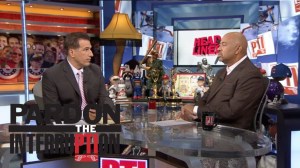
A great example of some questionable analysis from a specific ESPN employee about soccer came on Pardon the Interruption just before the Premier League started this past August. Of course, Pardon the Interruption features Tony Kornheiser and Michael Wilbon (most of the time) and airs every possible weekday on ESPN. Just before the Premier League began the current season, the two did a “preview” of the season (for clarity, Kornheiser was not on this particular showing, instead it was Frank Isola). To start, this was not a major headline in the show, signifying that the beginning of quite possibly the most popular soccer league in the world was merely an afterthought. I’ll focus on Wilbon in particular since Isola did some research and found some decent analysis to be had.
Wilbon began by picking Manchester United to win the Premier League this season. He cited the fact that they still have Paul Pogba and that manager Ole Gunnar Solskjaer had been there “a while.” Paul Pogba has only ever played to his full potential at Manchester United for small stretches, while I’m not too sure who would consider a half of a season to be “a while” if they understand how soccer clubs tend to handle managers. Beyond this, when Isola mentioned the Champions League and how Premier League favorites Manchester City might want to focus on winning said Champions League instead of focusing on the Premier League, Wilbon said, “Isn’t (the Premier League) the most prestigious league championship in the world in this sport?” Not only is that debatable initself, but not everyone can win the Premier League! The Premier League is just the English top division of soccer, therefore a team like FC Barcelona can’t win the Premier League (since they play in Spain). It’s pretty obvious here that one of the more influential analysts at ESPN has absolutely no idea how soccer functions internationally, which is one of the things holding soccer back in America.
I’ll give credit where credit is due: ESPN shows a decent amount of soccer. MLS games make it to the mainstream ESPN networks, along with some games from the Italian Serie A, and occasionally even the NWSL (National Women’s Soccer League) makes an appearance. Soccer even makes a fair number of appearances in SportsCenter’s Top 10 Plays. Where ESPN lacks heavily is in analysis, and what’s odd is that they used to give the analysis more airtime! ESPN FC used to be a show that ran fairly often on the ESPN networks. This was their soccer analysis show, and it does still run. However, it only runs on ESPN+, which is a subscription-based streaming service on top of what one might already be paying for ESPN. Adding to this is the fact that apart from the people working in the soccer department at ESPN, not many seem to have a lot of knowledge about the game or the players. If you watch SportsCenter, the only time you’ll ever hear about soccer is in the Top 10 Plays, and I would be willing to bet the analysis is slightly misinformed. A mispronounced name or two never goes amiss.
According to a 2018 poll, interest in soccer in America has gone up 27% since 2012. Six years is a really short time for that number to be so high, meaning that growth in interest is pretty steep. With that stat in hand, wouldn’t it only make sense for ESPN to start covering soccer more comprehensively? Would it not behoove the most well-known sports news network in America to at least become educated on the most popular sport in the world when it’s only gaining traction in their country? The way I see it, they might fall behind if soccer isn’t adopted soon. Oh and by the way: see what ESPN FC or any other soccer experts say about Manchester United’s chances at winning the Premier League, even before the season started.
They never had a chance and they still don’t. Thanks, Michael Wilbon.
Griffin is a second-year undergraduate BGSU student from North Ridgeville, Ohio. He is a Sport Management major and a Spanish minor. His primary sports interests are baseball and football, both collegiate and professional, but he is also interested in basketball, MMA, boxing and hockey
Since baseball’s inception, teams have looked for a leg up over their opposition. Whether that is the development of signs from coaches, the shift or stealing signs, it is expected and even encouraged that teams innovate new ways to win. The Astros, however, have taken it to a new level. Earlier this month, former Astros pitcher Mike Fiers dropped a bomb on the unsuspecting baseball world: the World Series winning team in 2017 cheated.
In 2017, reports came out that the Boston Red Sox were using an unapproved Apple Watch in the dugout. Naturally, that revelation turned to thoughts of cheating, and the opponent did nothing to dismiss those. The New York Yankees, arch rivals of the Red Sox tossed in accusations that the Sox were stealing signs from their catcher. The MLB launched an investigation into the team, and found them guilty of cheating. On September 15, 2017, Commissioner Rob Manfred fined the Red Sox for their scandal and created a new discipline protocol to deter future teams (Davidoff, 2019).
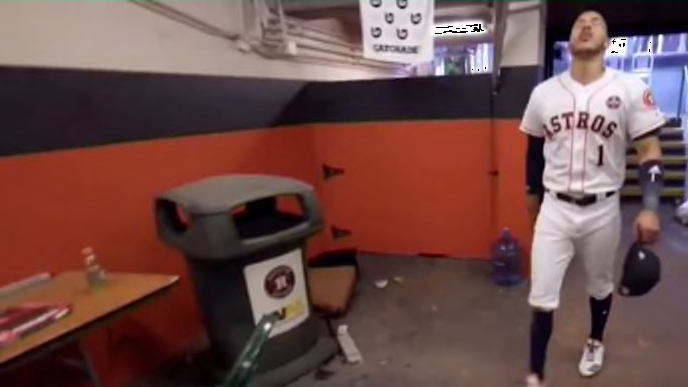
At the same time, however, a far larger scheme was underway, which can now implicate 3 different MLB managers. In Houston, the Astros had a few veteran additions off to a slow start. It was then that a slumping addition who is yet to be named and a team official concocted the plan: they were going to electronically steal signs. Throughout the season, the Astros perfected the system: using a camera placed in center field to pick up the signs from the catcher, sending it to a laptop in the tunnel, where a staff member banged on a trash can to signal the coming pitch to batters (Passan, 2019).
Fast forward to today, where the Astros are almost a certifiable dynasty. They’ve been to the past 3 World Series, hoisting the Commissioner’s Trophy only in 2017. Mike Fiers, a pitcher on that World Series team had just given an interview to The Athletic where he detailed how the Astros stole signs during all home games at Minute Maid Park in 2017. The baseball world exploded, shrapnel strewn all across the baseball landscape. Did the Astros cheat their way to a championship? Who ran this whole operation? Was Alex Cora, former bench coach and current Red Sox manager, involved? What about former Astros DH turned Mets manager Carlos Beltran? Information was at a premium, and nobody could pay the price.
The media, of course, jumped at the bomb Fiers threw into the world. Every major sports news outlet was looking into the Astros allegations, and the MLB opened another investigation almost immediately. Some sources tried to prove or disprove the allegations. Most, however, either ignored, or misused statistical evidence. One ESPN article cited the Astros success on the road, both in win-loss records and batting lines (Schoenfield, 2019). While these are good surface-level stats, they don’t tell the full story. Home and away splits can illustrate the differences between the Astros’ play in Minute Maid Park and away from it, but sign stealing won’t show up as a large impact on traditional stats. If one was to look at isolated power (ISO) and strikeout rate (K%), the numbers would tell a different story. Stealing signs is going to give the hitter an upper hand, that part is undebatable, but that advantage may not be evident in hits. ISO is simplified to slugging percentage minus batting average, which shows the player’s raw power (Slowinski, 2010). The MLB average ISO is .140, with higher values showing that players are hitting the ball harder for more extra bases and home runs (Slowinski, 2010). The Astros in 2017 paced baseball with a .196 ISO as a team, .56 higher than average (“Major League Team,” 2019). The Astros also bested the league in K%, which shows the percent of at-bats where batters struck out, with 17.3%, which was only 1.2% lower than the second place Indians (“Major League Team,” 2019).
Most articles, however, strayed away from making judgements. They simply relayed the information and waited to learn more before going after the Astros’ rings. Some, however, made sure to point to the Astros’ checkered past. During the 2018, reports from Cleveland and Boston of a uniformed Astros employee recording the dugouts made the MLB first investigate the Houston franchise (Passan, 2019). This came along with allegations from that same year of Astros players clapping signals to tell the batter what the coming pitch was ( Passan, 2019). While the past of the Astros is important, constant reminders and retelling can sway opinions. If the narrative that the Astros are cheaters is pushed by the media, an investigation into the allegations can become difficult. Fans make up their notions of what happened, and those fan ideals can destroy a franchise.
While gathering information is vital in the process, making sure it is properly relayed is important. Statistics are among the few ways, along with video, to show the Astros have stolen signs. If their numbers are drastically higher, which some advanced stats like ISO show, then maybe there is creedence to Fiers’s claims. Those numbers, however, have to be given and shared with the public, as opposed to selective stats like batting average that can paint an incomplete and biased picture of the problem. The media has done a good job overall so far in their coverage of the Astros, but as always, some things could be better. It just so happens that with advanced sign stealing techniques, advanced and traditional stats could be the problem






/cdn.vox-cdn.com/uploads/chorus_image/image/25148967/20131214_jla_ss1_140.0.jpg)

 Maxwell Media Watch