
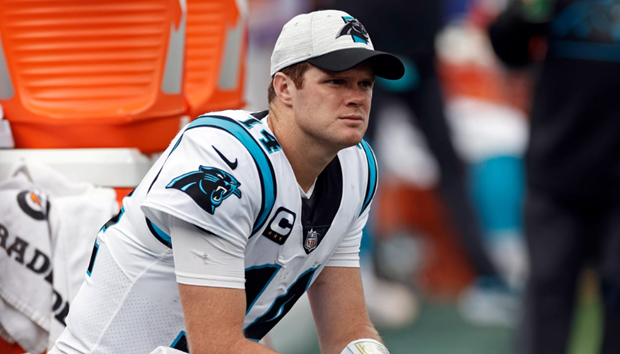
Sam Darnold sitting on the bench as a former backup quarterback for the Carolina Panthers
By: Sam Morris
Sam Morris is from Madison Heights, Michigan, and is an undergraduate student at BGSU majoring in Sports Management. He has a passion for sports writing and journalism. In his free time, he also performs, writes, and produces his own raps for the music industry club at BGSU.
October 11, 2024
The “Franchise Quarterback” Dilemma
The NFL quarterback is one of the most important and high-pressure positions in all of sports. Football games revolve around quarterbacks and their ability to make plays. From something as simple as a running back handoff to something as difficult as an 80-yard ‘Hail Mary,’ quarterbacks are involved in every single play.
Because of this level of importance, NFL GMs are hard-pressed by ownership to constantly be on the lookout for their next “franchise QB” who will lead them to the Super Bowl. This quarterback carousel can sometimes lead to teams getting QB’s that will last for decades and lead their team to success. Some of these would include Tom Brady with the Patriots, Ben Roethlisberger with the Steelers, Eli Manning with the Giants, and Pat Mahomes with the Chiefs. However, more often than not, a dilemma arises when the “franchise QB” that they thought they had is nowhere to be found. When this realization sets in after a few seasons, the team often moves on from their original candidate in one of two ways.
One proven way that teams move on is by adding other promising QB’s via trade or free agency, but a more recent trend that has been occurring is drafting QB’s out of college in the NFL Draft. This is mostly a hit-or-miss strategy that can lead to success stories like Jayden Daniels and C.J Stroud, but it can also result in complete busts like Trey Lance and Josh Rosen.
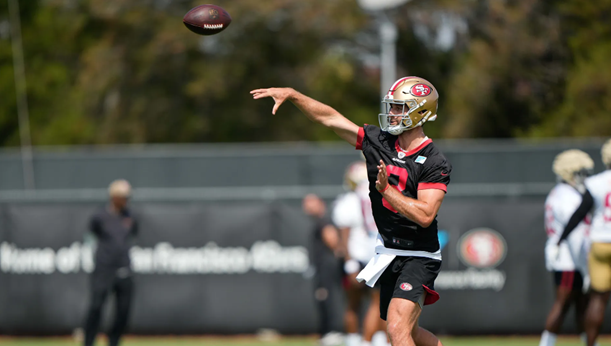
Former Arizona Cardinals first-round pick, QB, Josh Rosen, throwing on the 49’ers practice squad.
While it is important for NFL GMs to be constantly improving their rosters, I argue that teams give up on these young quarterbacks too early. Some of them are given just two or three years to develop and then are discarded when they are just hitting their stride in their low to mid-20’s.
I believe this theory is becoming more and more evident as three recent QB’s who their original franchises gave up on have taken the NFL by storm over the past few years. As you will soon read, the lesson GMs should be taking away from these three success stories is DON’T quit on your young drafted quarterbacks too soon.
Geno Smith
After a great 26-13 4-year career at West Virginia, Smith declared for the 2013 NFL Draft where he was the second QB off the board, picked in the second round by the New York Jets. Despite falling out of the first round, Smith was one of the most highly anticipated rookies coming out of the class.
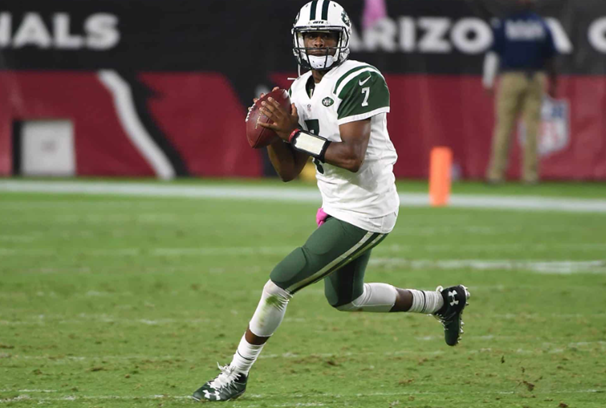
Geno Smith playing with his former team, the New York Jets
He played 4 years with the Jets and had some success with the team. His rookie season he had a poor TD/INT ratio but led the Jets to an 8-8 record, which was an improvement from the Jets’ previous season. Despite this beginning success, Smith was benched on-and-off during the following year after some turnover struggles and replaced by Michael Vick.
Smith’s next two seasons in New York were riddled with multiple injuries and he barely played because of them. However, when he did play, he had success in New York during these two seasons and was only 26 by the end of the season when the Jets eventually let him go.
Smith spent a year with the Giants and a year with the Chargers, both as a backup, learning from Eli Manning and Phillip Rivers. This experience of gaining veteran knowledge allowed him to fully hit his prime when he entered the Seahawks organization in 2019.
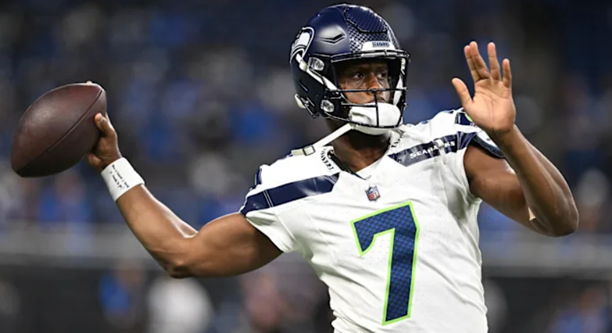
Geno Smith with his current team, the Seattle Seahawks
Originally picked up as a backup for Seattle, he earned the starting job in 2021 when Russell Wilson got injured and he completely shocked the NFL with a yearly performance better than that of his rookie season 8 years prior with New York. The following year, after Wilson was traded to Denver, Smith improved so much that he became a pro bowler, won the 2022 Comeback Player of the Year award, and even took Seattle to a playoff game.
In 2023, Smith showed no signs of slowing down. He was selected to his second Pro Bowl in a row with Seattle and was in the MVP race for much of the season. So far in 2024, Smith has continued his success by leading Seattle to a current first-place tie with San Francisco in the NFC West.
Although the Jets didn’t give up on Smith as early as some of the other QB’s on this list, he was, in my opinion, not given a fair chance with New York. New York hasn’t had a consistent quarterback since Mark Sanchez and getting rid of Smith didn’t help them at all. I believe that had they kept him for a few more years, he would have been able to give them production and success similar to the years he has spent as a starter with Seattle.
Baker Mayfield
Mayfield, the Cleveland Browns overall draft pick out of Oklahoma in 2018, is another QB who has proven his original team gave up on him too early. Unlike Smith, Mayfield was the clear #1 QB in his draft class coming out of college, leading Oklahoma to an outstanding 33-6 record during his time with the Sooners. He was also the 2017 Heisman winner.
Mayfield won the starting quarterback job during week 2 of his 2018 rookie campaign. While he only led the Browns to a 7-8-1 start, it was at least better than their previous season when they went 0-16! Many Browns fans felt like they had finally found their quarterback of the future and that Mayfield would eventually lead Cleveland to a resurgence in the AFC North. Mayfield also came in second place in the Offensive Rookie of the Year voting in 2018 to former Giants RB Saquon Barkley.
Despite a regression in Cleveland’s 6-10 2019 season, Mayfield finally led the Dawg Pound back to the postseason with an 11-5 regular season record in 2020. In the postseason, he led the Browns to a Wild Card victory over the Pittsburgh Steelers, their biggest rival, and barely lost to the eventual AFC champions, the Mahomes-led Kansas City Chiefs.
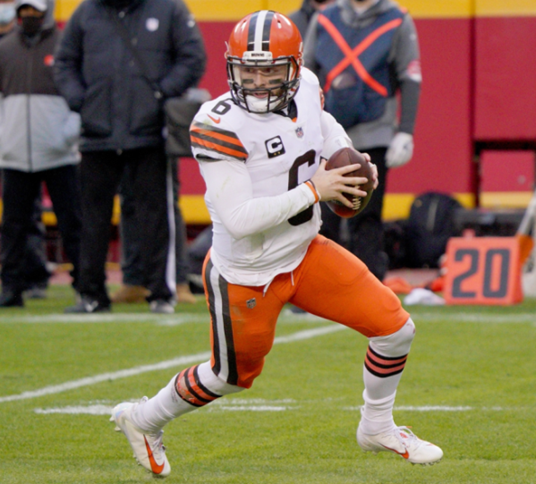
Baker Mayfield scrambles with the ball with his original team, the Cleveland Browns
The playoff excitement unfortunately didn’t last long for Cleveland, as they once again fell short of the postseason with an 8-9 record the following 2021 season. Because of injuries and the 3-win regression in 2021, Mayfield was let go to make room for their eventual trade pick-up from Houston, Deshaun Watson, after the conclusion of the 2021 season.
This decision seemed legitimate at the time, but looking back on it, it was an enormous mistake by the Browns. Mayfield gave the Browns a playoff berth and win in just his third year with the team, something that the Browns hadn’t done as a franchise since 2002! I believe they could have given him at least another year to develop. Also, when you look at the fact that Mayfield went through 4 different coaches and 4 different offensive coordinators in his age 23-26 seasons, it’s no wonder he struggled a little each year.
Once Mayfield got to Tampa Bay in 2023, he proved to Cleveland and to the NFL that the Browns quit on him too early. He made a Pro Bowl in his first year with the team, won the NFC South, won a playoff game against the Eagles, and almost won a second playoff game against Detroit which would have sent them to the NFC Championship.
Mayfield was supposed to be a transitional quarterback for Tampa Bay but he has now become part of their future plans as he signed a three-year contract extension in the 2024 offseason, and he currently has Tampa Bay in a tie with Atlanta for first place in the NFC South.
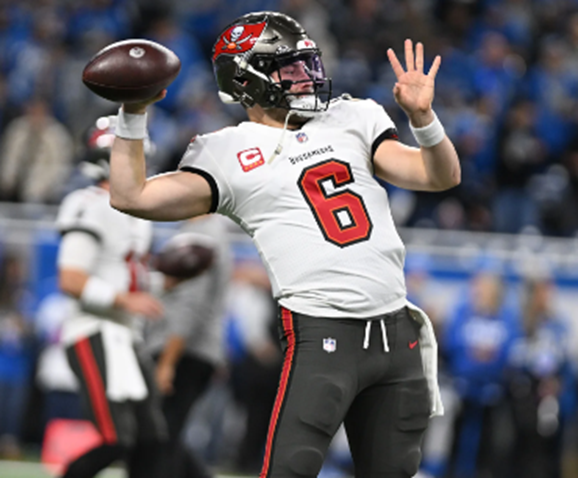
Baker Mayfield throwing the ball with his current team, the Tampa Bay Buccaneers
On the other hand, Cleveland is a mediocre 19-20 since Mayfield’s departure.
Sam Darnold
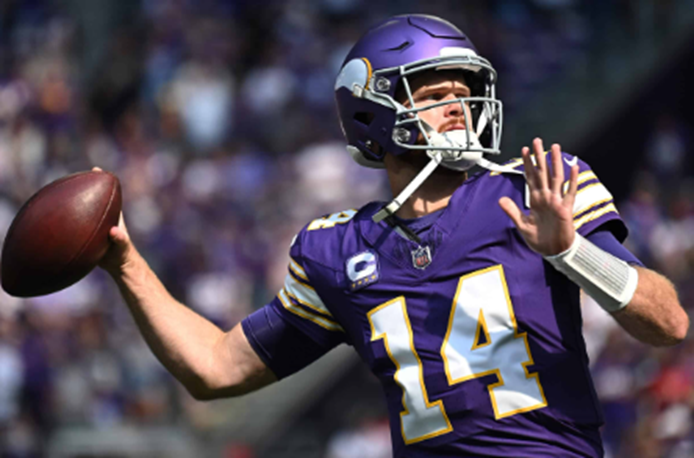
Sam Darnold throwing the ball for his current team, the Minnesota Vikings
Sam Darnold is perhaps the most successful quarterback whose team gave up on him way too early. Darnold is a surprise lead MVP candidate so far this year. He is 13th in the NFL in yards (1,111), 2nd in the NFL in TD’s (11), and has just 4 interceptions. He is also leading the Vikings to an NFL-best 5-0 record (tied with Kansas City).
Like Mayfield, Darnold was supposed to be a guy for Minnesota that they could play as a bridge-type quarterback while they wait for rookie J.J McCarthy to come back from injury next season. However, Darnold has risen to the occasion and has completely taken the NFL by storm.
Despite being in his 7th season and in the same draft class as Mayfield, Darnold is actually only in his age-27 season, making him 6 months younger than Joe Burrow. Darnold, from USC, was the third overall pick by the Jets in the 2018 draft. His college statistics for the most part were some of the best in the country, but his interceptions were a cause for concern with some scouts.
Darnold’s turnover problems continued into the NFL and essentially plagued him throughout his 3 seasons as a Jet. Darnold then bounced around the league, playing with Carolina and San Francisco before eventually landing with the Vikings this past offseason.
Darnold’s rise as one of the league’s best gunslingers has been nothing short of extraordinary and he is yet another reason why teams that draft young QB’s should let them develop instead of quitting on their talent too early.
Bryce Young and the Future of QB’s
Now that I’ve examined the three quarterbacks above whose teams have given up on them prematurely, I want to talk about someone whose team, I believe, is giving up on him too early, and that player is Bryce Young.

Bryce Young holding up his draft day jersey at the 2023 NFL Draft
Carolina was a pit stop for both Darnold and Mayfield above, and even though it wasn’t the place that originally gave up on both of the quarterbacks, the Panthers didn’t even consider bringing them on as future pieces and simply shipped them off as soon as the next year’s draft came along.
The Panthers could have had two of the NFL’s best players at the moment, but instead are stuck with an aging Andy Dalton as the QB and a rightfully upset Bryce Young as the backup. I think they would be making a colossal mistake by trading Young at the end of the season if they don’t let him play out the rest of the year to prove himself. Carolina is likely to miss the playoffs, so they have nothing to lose by playing Young the rest of the year to see if he improves. If they do trade him in his young age-23 season, they could just be the next victim of this “quitting on quarterbacks” trend a few years down the road with Young starring for another team like Mayfield and Darnold are doing right now.
As for the future of the quarterback position, I think we will continue to see teams draft franchise QB prospects in the NFL Draft and then move on from them in a few years if they don’t produce Mahomes-level results by age 25, 26, or 27. This is an easy trap to fall into in a league that is always in a win-now type of mindset. And while some of these players will truly become busts (Josh Rosen, Trey Lance, Mac Jones etc.), others (Darnold, Mayfield, Smith) may hit their primes just a few years later and prove to their former teams that they quit on them prematurely.
 Maxwell Media Watch