Author Archives: Brady Shick

The Invisible Deadline Holding Major League Baseball’s Top Prospects Back

By: Brady Shick

Brady Shick is from Sagamore Hills, Ohio and recently graduated from Bowling Green State University. He is currently seeking opportunities to pursue a career in Baseball Operations.

July 7, 2025

Every team in Major League Baseball (MLB) looks for a way to get a foot up on their competitors. In past drafts, teams have taken high school prospects higher than they are projected and try to sign them away, with more money than projected, from the college for which they committed to play. One of the most common ways and most controversial is through service time manipulation. Service time is a value system that equates the number of days a player spends on the active 26-man roster for each Major League team. Service time is then used to determine when a player reaches arbitration with his respective club. Small market teams are normally the main culprits of manipulating their players’ service time, but almost always headlined each season by the Pirates. The most common way to manipulate is through the Super-2 deadline and the debuts of top prospects.

The Super-2 deadline normally takes place in the end of May or beginning of June every year and is the cutoff date for players to gain an extra year in which they are arbitration eligible, which normally takes place after three years of service time. If a player is in the top 22% of service time compared to those in their rookie class, they gain an extra year where they can go to arbitration to make more money during that season. If teams wait to call up a prospect later they can save money to use in free agency.

Teams like the Pirates constantly use this strategy with examples being Gerrit Cole, Austin Meadows, Tyler Glasnow, and most recently Paul Skenes. Notable stars called up after the deadline include Bobby Witt Jr (Kansas City Royals), Byron Buxton (Minnesota Twins), Elly De La Cruz (Cincinnati Reds) among others. Most of these players eventually went on to free agency, signing with other teams or being traded prior to reaching free agency.

2025 and Super-2 

Within the last week, Major League Baseball has seen two of their top minor league prospects come up to the big leagues in Jac Caglianone (Royals) and Roman Anthony (Red Sox). Caglianone, a former two-way player, hitting and pitching at the University of Florida, has dominated across both AA and AAA levels in the minors. This was all while learning a new position (right field). Caglianone made his Major League Debut without playing a full season in the minors and after dominating in the lower levels. 

On the other hand, Roman Anthony has been as dominant as anyone in the minors this season batting .288 with 10 homers in 58 games. He was also the top prospect in all of Minor League Baseball’s second visit to Triple-A. Many scouts across the industry were perplexed as to why he hadn’t gotten the call to the big leagues yet. Major League executives were less confused on his arrival time to Boston. By holding Anthony until this time of the season the Red Sox let the Super-2 deadline pass and gained an extra year of pre-arbitration control on Anthony. All of this was done for the Red Sox to save a few extra bucks while continuing to fall out of the division and wild card standings. 

The Red Sox aren’t the only team following this practice. The second ranked prospect in the minors, Bubba Chandler (Pirates), is currently pitching in Indianapolis. The Pirates have called up three other pitching prospects from Triple-A all of whom were on staff with Chandler and none of whom have pitched as well as he has. This is just another instance of the utilization of the Super-2 deadline for baseball.

Dying Practice

Many fans will remember that the 2022 MLB season was delayed due to a players’ strike. One of the largest gripes by the Players Union was the service time manipulation by front offices across the league. Finally, after three plus months of a strike both the owners and players agreed on a new collective bargaining agreement with this issue somewhat resolved.

The solution was for owners and front offices to be incentivized to call up their top prospects at the beginning of the season. If a top prospect makes the Opening Day roster and then wins his league’s respective Rookie of the Year award, that team receives a pick after the first round in the next draft. A team will also receive an extra pick if that prospect finishes in the top three of the Cy Young or MVP awards before he reaches arbitration. However, a team is only eligible for one pick each draft and each player’s success can only be responsible for one extra pick. Since the inauguration of this rule, the Orioles and Mariners have benefitted with Adley Rutschman finishing second in the Rookie of the Year race in 2022 and Julio Rodriguez winning Rookie of the Year that same season.

This new system also can have negative consequences for front offices. Last year’s National League Rookie of the Year did not make the Opening Day Roster for the Pittsburgh Pirates. Had Skenes been up since day one, the Pirates would have received an extra pick in this month’s draft, but due to the new rules this wasn’t the case. Additionally, because Skenes won Rookie of the Year he was awarded a full-year of service time and the Pirates lost the extra year of pre-arbitration they were fighting to maintain.

Future of the Super-2

Service time manipulation has been a big issue for years within the MLBPA and it looks like a better solution is coming. Potentially, long gone are the days of prospects not making their debuts until early to mid-June thanks to the potential for an extra draft pick. However, baseball might be the hardest to predict a prospect’s future. There are plenty of guys that take a year or even a couple to figure out the big leagues. With so much uncertainty teams and front offices will continue to find ways to lengthen their competitive window and service time manipulation is the most accessible. But for the fans hopefully they can see a Travis Bazzana (Guardians) or a JJ Weatherholt (Cardinals) on an Opening Day roster.
Three Number One Prospects Ready to Shine: The Race for the 2025 AL Rookie of the Year

By: Brady Shick

Brady Shick is from Sagamore Hills, Ohio and recently graduated from Bowling Green State University. He is currently seeking opportunities to pursue a career in Baseball Operations.

March 26, 2025

One of the most prestigious awards in Major League Baseball is the Rookie of the Year Award. Hall of Famers like Rod Carew, Willie Mays, and Johnny Bench have won it. The Rookie of the Year was originally named the J. Louis Comiskey Award, after the infamous owner of the Chicago White Sox. The award was then changed to the Jackie Robinson Award in 1987 to commemorate the 40th anniversary of Robinson breaking the color barrier and winning the award en route to his Hall of Fame career.

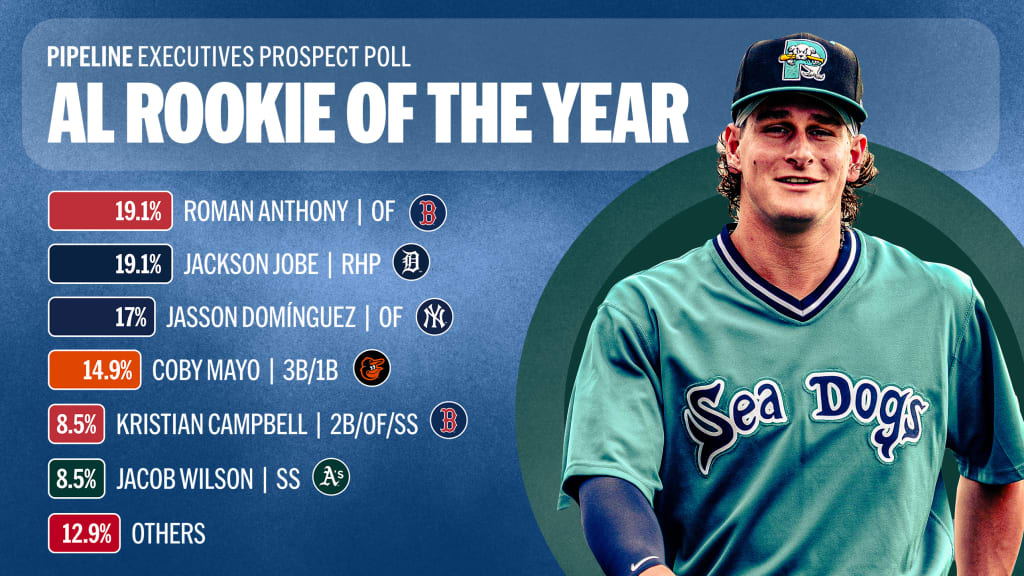
While the 2024 National League Rookie of the Year race was the more entertaining between the two leagues, 2025 brings a fresh breath of talent to the American League. Each of the players below are the top prospects for their respective clubs with two of the prospects likely to make the opening day rosters. 

Favorites

Jackson Jobe

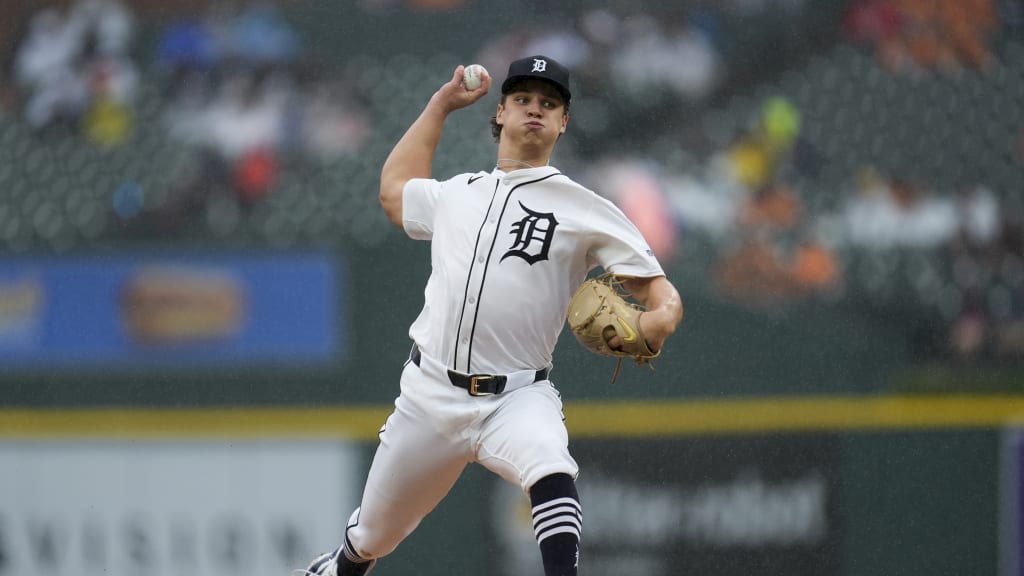
The Tigers made an exciting playoff run at the end of last season. After trading Jack Flaherty and continuing to sell at the trade deadline the Tigers appeared to be giving up on the season. However, after the deadline the Tigers caught lightning in a bottle and made it into the postseason. As a wild card team, the Tigers took the Guardians to five games in the Divisional Series. During that stretch the Tigers were short on pitchers and called up their top pitching prospect Jackson Jobe. Jobe threw four innings during the regular season in two games and finished with a 0.00 E.R.A. 

From a scouting standpoint Jobe recently struck out perennial All-Star Vladimir Guerrero Jr. in a spring training start, displaying his dominant pitching arsenal. Jobe’s best pitch is his fastball that sits in the upper 90s with excellent rise. Jobe then pairs his fastball with another plus pitch in his slider. His slider is an analytics darling thanks to its high RPM and movement. Jobe additionally, throws a changeup and cutter to complete his pitching arsenal. The biggest gripe against Jobe is his workload and injury history. He set a professional career high last season throwing 91 ⅔ innings across multiple levels. Additionally, he missed time due to a strained hamstring and back inflammation over his early career.

Jacob Wilson

Jacob Wilson is one of the best pure hitting prospects in recent history. He has the swing and hands to adapt to any pitch in any zone. Not to mention he strikes out in fewer than 10% of his plate appearances. That is unheard of in today’s game. His approach is comparable to hitters from the 60s and 70s. He is in the box to put the ball in play and will do so on a line. He will swing at anything and make contact. In my opinion Jacob Wilson will win a batting title at some point during his career. 

Wilson is also the son of a former gold glove shortstop, Jack Wilson (Pirates, Mariners, and Braves), and it’s apparent in his game. Jacob Wilson profiles to be a potential gold glove shortstop thanks to his soft hands and excellent footwork. If it is within his range he will cleanly field the ball and deliver a strike to first. 

If he has a weakness, Wilson lacks the ability to hit for power. He will likely never hit more than 15 home runs in a season and he doesn’t have elite exit velocity numbers. This can be concerning in today’s MLB where every hitter chases launch angle and exit velocity. Additionally, Wilson is of average speed. For someone who is a contact hitter with little power, speed is normally a must. Wilson is by no means slow but he’s not going to impress on the base paths. 

Dark Horse

Travis Bazanna 

Travis Bazanna was the number one overall pick and the only one of these prospects I’ve had the opportunity to see in person. Bazanna was the obvious choice at number one for the Guardians last year. He has the potential to have an elite hit tool and also be an above average power hitter for his position, second base. This is all in large part due to his quick hands and compact swing from the left side. While he struggled at first, Bazanna helped lead the Lake County Captains to their first Midwest League Title in 14 years; he homered for his first professional hit. His numbers, while not impressive, were brought down by how long it took him to get adjusted. There is no doubt in my mind however that Bazanna will hit at the next level. 

Now the red flag for the Guardians taking Bazanna at number one overall was the fact that he is and only will be a second baseman. Bazanna is athletic but not a great fielder. His athletic ability lets him cover more area than most but he lacks the fundamentals at the position and is regularly caught in between hops. Additionally, Bazanna’s arm keeps him regulated to second base long term with a below average grade.

The Guardians made a move this off season to free up second base for Bazanna at the position. In December the Guardians traded their gold glove second baseman, Andrés Gimenez, for a starting pitcher, two pitching prospects, and an outfield prospect. This trade was only two seasons removed from a 7 year extension with the Guardians for Gimenez. Making a move like this hints at the faith that the Guardians have in Travis Bazanna and his future. However, Bazanna has only played in High-A for the Guardians last season. While he will likely start the season in Double-A the Guardians are not likely to be rushing him to make his MLB debut.

Conclusion

Jackson Jobe looks like he could be this season’s Paul Skenes. Jobe has a great pitching arsenal led by an elite fastball similar to Skenes. Additionally, Jobe already has had the experience in high leverage situations at the Major League level pitching for the Tigers in relief during last year’s postseason. His AL Central counterpart, Travis Bazanna is a former number one overall pick with a ton of potential in front of him. The Guardians have freed up second base for the long-term for Bazanna to take over and it’s just a matter of time for him to do so. Out west Jacob Wilson is coming to the league as one of the most disciplined hitting prospects in recent history. The only thing holding him back will be his power, but he benefits from playing a critical position at shortstop. This race is likely to be as good as the fans have seen in recent memory.

From Japan to Clemson, South Carolina: National League Rookie of the Year Candidates

By: Brady Shick

Brady Shick is a recent graduate of Bowling Green State University from Sagamore Hills, Ohio. He is currently pursuing a career in Baseball Operations and looking for opportunities.

February 28, 2025

One of the most prestigious awards in Major League Baseball is the Rookie of the Year Award. Hall of Famers like Rod Carew, Willie Mays, and Johnny Bench have won it. Originally named the J. Louis Comiskey Award, after the infamous owner of the Chicago White Sox, the award was changed to the Jackie Robinson Award in 1987 to commemorate the 40th anniversary of Robinson breaking the color barrier and winning the award en route to his Hall of Fame career.

Twenty twenty-four brought one of the best National League (NL) “Rookie of the Year” Races in recent years. Headlined by two first round picks in Paul Skenes and Jackson Merrill, it was one of the tightest races we have seen. Even the third finalist, Jackson Chourio, would have been likely to win Rookie of the Year most other seasons. Chourio finished the season batting .275 with 21 home runs and 22 steals. Meanwhile, Merrill’s efforts in batting .292 with 24 homers resulted in him earning his first ‘Silver Slugger’ award. FInally, Skenes finished the season as a NL Cy Young Candidate with a resume of 133 innings pitched, a sub 2.00 ERA, and 11 wins. Skenes ended up taking home the award in a tight race with Merrill and this season could bring the same.

2025 Favorites 

Roki Sasaki

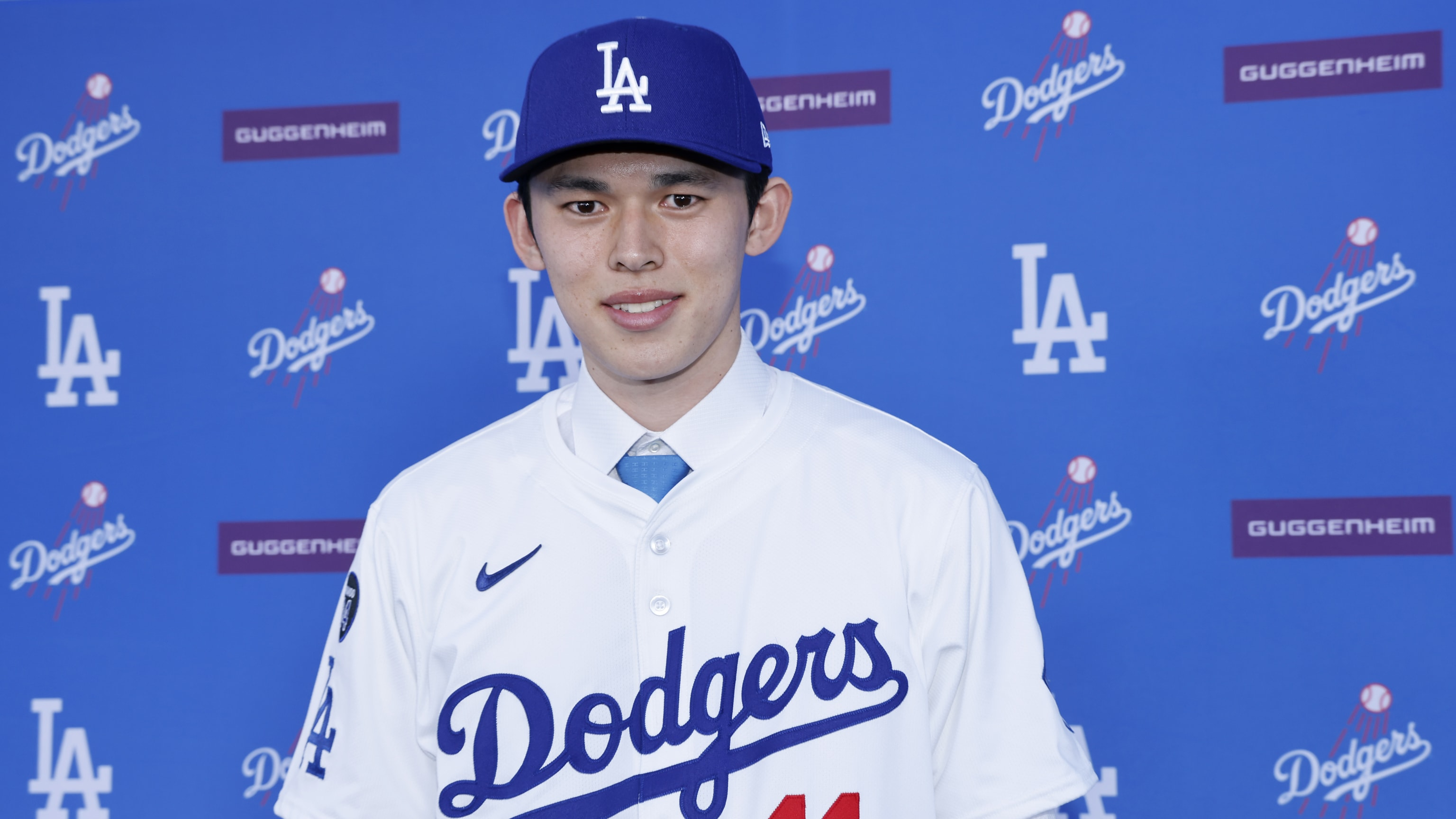
Right now far and away the favorite for NL Rookie of the Year is Roki Sasaki. Sasaki comes over from Nippon Baseball in Japan to join the reigning World Series winning Los Angeles Dodgers. Sasaki was one of the biggest free agents this season aside from Juan Soto. In Japan’s professional league, Sasaki had a 2.10 E.R.A over 4 seasons, and more than 500 strikeouts in fewer than 400 innings. While in Japan, Sasaki also outdueled Yoshinobu Yamamoto in a head-to-head matchup before Yamamoto signed his 12-year $325 million contract with the Dodgers last offseason. Sasaki also dominated during the World Baseball Classic (WBC) with two spectacular starts in 2023.

The only thing stronger than Sasaki’s reputation is his pitching arsenal. Sasaki debuted his stuff for the world at the WBC with a fastball consistently topping out at 100+ and an elite splitter. These pitches led to 11 strikeouts on two starts for Sasaki including some against current MLB veterans. 

Sasaki goes into one of the best situations possible in LA. Joining an organization known for developing talent, especially on the pitcher’s mound, with names like Clayton Kershaw, Walker Buehler, and Ross Stripling, they are poised to help Sasaki fulfill his potential. This along with being one of the best pitchers in Japan is why Roki Sasaki is the current favorite to win National League Rookie of the Year.

Dylan Crews

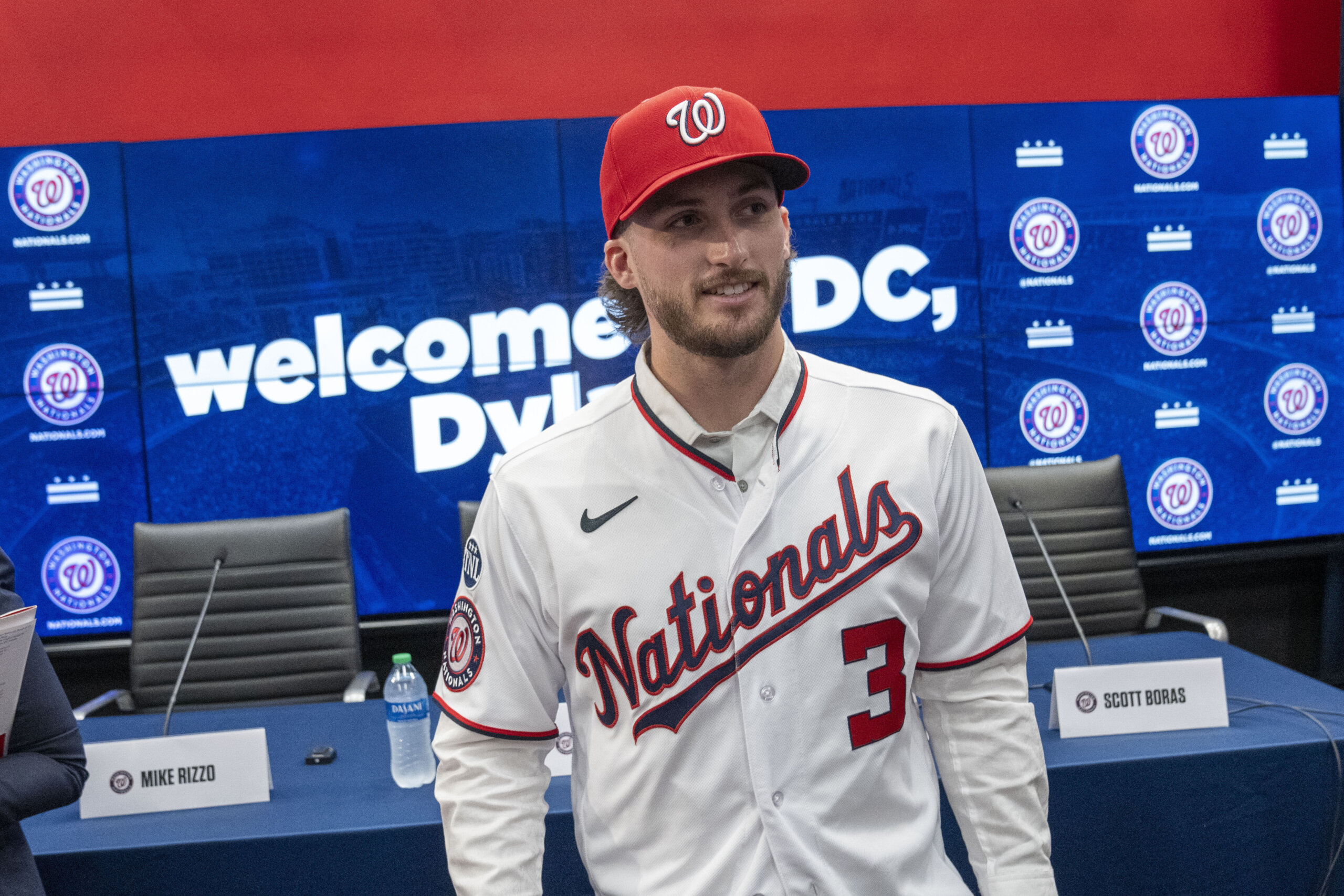
Even though Paul Skenes finished his first season in the majors as a Cy Young finalist and National League Rookie of the Year, the media wasn’t sure if he was going to the Pirates with the first pick. There was buzz around his Louisiana State University teammate outfielder Dylan Crews that he might be going to Pittsburgh. Crews was a five-tool prospect coming out of college and had a dominant junior year batting over .400 with 18 home runs. However, Crews ultimately ended up being drafted by the Nationals who held the next pick. 

Crews made his Major League Debut in 2024, but still maintained his prospect status thanks to a small sample size of at-bats and he is ranked as the 6th best prospect by Baseball America. While Crews did not have a great start to his career he showed flashes of his five tool potential. Crews stole 12 bases in 31 games, played well defensively, and added 8 extra-base hits. Crews will make the Nationals’ roster out of Spring Training to be an everyday outfielder for the Nats. He will be a strong contender for Rookie of the Year.

Bubba Chandler

In high school Bubba Chandler was a multi-sport athlete. Prior to being drafted he was a 4-star quarterback recruit committed to play at Clemson. However, when he was drafted by the Pirates in 2021 he decided to sign with the franchise and start his professional baseball career. Originally, Chandler was a two-way player for the Pirates’ affiliates, where he would play in the designated hitter spot on days he wasn’t pitching.

Last season saw Chandler’s first year in the minors where he devoted himself strictly to pitching. This decision saw a vast improvement in his season statistics from a year prior and he really excelled in Triple-A for Indianapolis. Chandler saw his best minor league success late in the season last year just one step away from Major League Baseball. In Triple-A Chandler finished the season with an E.R.A of 1.83 in nearly 40 innings with 54 strikeouts in 7 starts

The main thing holding Chandler back amongst this group is the timetable for his MLB debut. The Pirates are notorious for manipulating service time to get the most years of control for their top prospect using the Super-2 deadline. This deadline is an arbitrary date during each season in which a player doesn’t receive a full year of service time. This gives the team an extra year of control before the player goes to free agency. The Pirates have done this for almost all of their top prospects including Paul Skenes, Gerrit Cole, Andrew McCutchen and other top prospects. Additionally, the Pirates are not contenders so there is no reason to push Chandler to Pittsburgh.

Conclusion

The favorite to win National League Rookie of the Year is undoubtedly Roki Sasaki. From his stellar performances at  the World Baseball Classic and dominating in Japan, Sasaki has debuted his talent across the world and it’s time for him to showcase it for Major League audiences. Dylan Crews and his five tools will be an immense talent for a young Nationals team with no one to take away opportunities. It will be time for him to show more than just flashes of his five-tool potential. As for Chandler the only thing holding him back is the Pirates’ timetable for his debut. Regardless, this year’s race could be just as exciting as the 2024 Rookie of the Year race.

NCAA’s Suspension Issues and Their Coaches

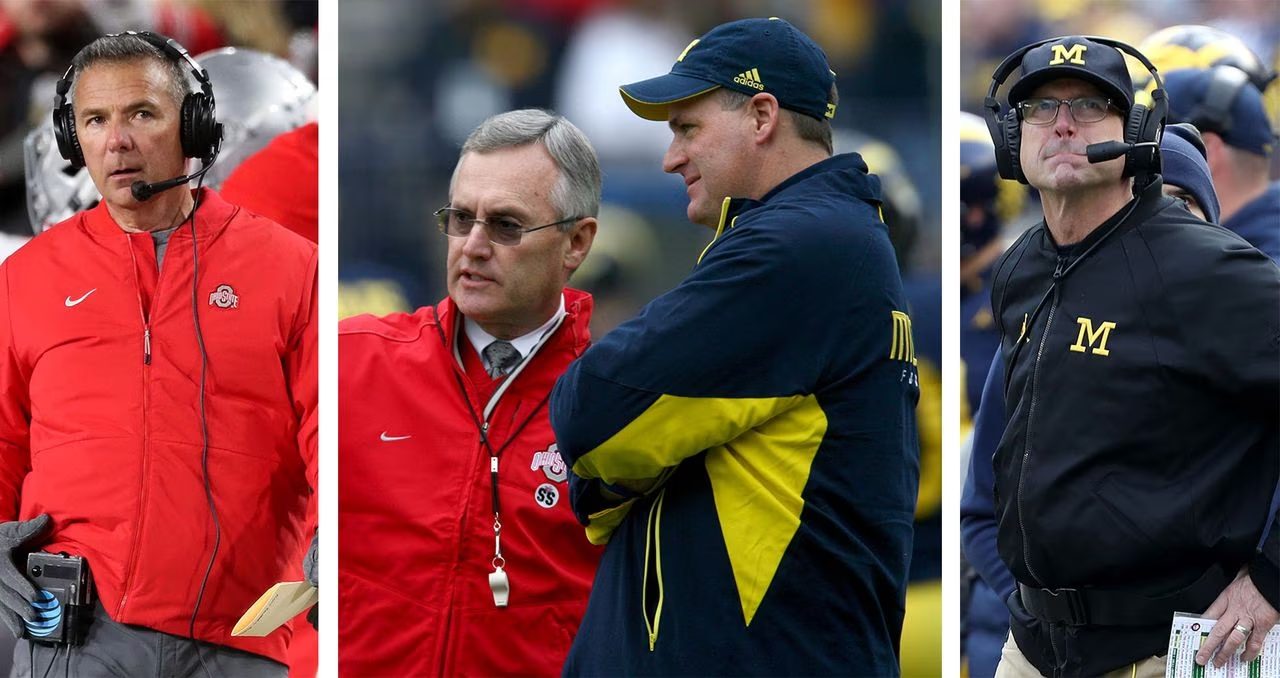
Caption: (L-R) OSU Coaches Urban Meyer (2012-2018), Jim Tressel (2001-2010), UM Coaches Rich Rodriguez (2008-2010), and Jim Harbaugh (2015-present)

By: Brady Shick

Brady Shick is a fourth-year undergraduate student at BGSU from Sagamore Hills, Ohio. He is majoring in Sport Management and minoring in Marketing. Baseball, golf, and football are his main sport interests.

October 6, 2023

Jim Harbaugh, Urban Meyer, and Jim Tressel. All highly acclaimed coaches from the Big Ten. All of whom served suspensions from their respective programs due to different NCAA violations. Tressel was initially suspended two games for not notifying university or NCAA officials of Ohio State players taking improper benefits. Tressel requested that his suspension be five games to match the 5-game suspensions of 6 players. Urban Meyer was suspended three games for insufficient action against an assistant coach who allegedly assaulted his wife. Jim Harbaugh was suspended for three games for recruiting violations during the height of the Covid-19 pandemic.

Across these eleven games of suspensions their programs collectively went 9-2 with a scoring differential of +233. The only losses came from Tressel’s 2011 Ohio State team that was missing key players due to their acceptance of improper benefits. That means that each of these teams on average was winning by more than three touchdowns during games their head coach was suspended. That was with the head coach supposedly being the catalyst of any program. Urban Meyer built up three struggling programs into top 25 teams before leaving for another school. Harbaugh turned around a Michigan team that was clawing its way to a .500 record and hadn’t beaten The Ohio State in 10 years. Yet with both of these coaching greats missing from the sidelines their teams were winning by almost 30 points.

I don’t believe that these teams should lose because a head coach is missing, but to be dominant has something to say about the severity of the suspensions. Only one of the teams they played during these stretches was ranked and over half of the teams were not from a Power-5 Conference. These suspensions were all against lackluster competition. Because of this, we often see coaches at large schools committing various NCAA violations with little to no consequences. During their suspension, coaches are still allowed to see their players during the week leading up to games. Either way these suspensions don’t actually end up being punishments.

There are a few ways to fix this problem. One, you could start suspending coaches for fewer games and apply suspensions when they play conference games. Two, a coach’s suspension could include daily practices. This would prevent the head coach from having contact with his team and would serve as an actual suspension from the team.

I don’t want to see utter chaos and a team losing their national championship hopes because a coach is suspended. I do want to see actual consequences for breaking the rules.